GN Launches Fitting Software with NAL-NL3 Prescription Formula
The new GN software makes the National Acoustic Laboratories’ next-generation formula available to hearing care professionals.


The new GN software makes the National Acoustic Laboratories’ next-generation formula available to hearing care professionals.

A mid-year review of hearing aid verification and real-ear measurement systems, audiometry, live speech mapping, otoscopes, and modular fitting systems. Also featured are tympanometers, OAE and ABR test equipment, cognitive assessment, and pediatric VRA equipment.



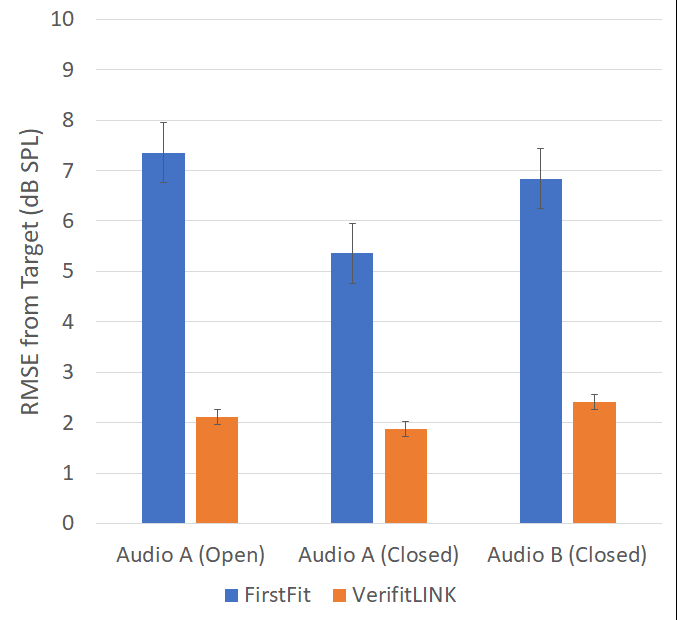
This clinical study by John Pumford, AuD, and Gus Mueller, PhD, examines the new autoREMfit application of Audioscan VerifitLINK as integrated into Signia Connexx hearing aid fitting software. The results reveal good fit-to-target accuracy (RMSE ~2 dB; 65 dB SPL input) for two different audiograms and coupling systems. Test-retest reliability was excellent with values no greater than 1 dB at any frequency. Clinical benefits of this autoREMfit collaboration are discussed.


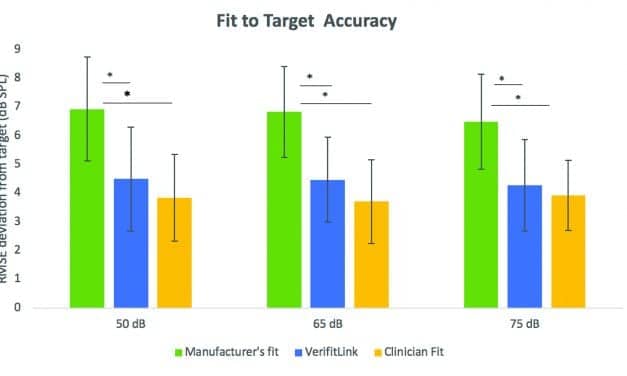
Several “autoREMfit” systems have been developed to assist in hearing aid fittings. This article evaluates a new fit-to-target platform, Audioscan’s VerifitLINK, that could be integrated into any manufacturer’s software, and documents its performance in target matching during hearing aid fitting.
Read More
Before jumping to the conclusion that any PSAP and/or future OTC hearing device would be suitable for the many different types of hearing losses, we need to look at their coupler and real-ear performance data. This study by Adam Voss, Kristi Oeding, AU Bankaitis, John Pumford, and Michael Valente suggests current PSAPs are suitable for mild losses only.
Read More
Now that we’ve defined (at minimum) what an OTC hearing device should look like, maybe it’s time to start defining a minimal standard for what a professional hearing aid fitting should look like.
Read More
Valente et al found that 79% of the study participants preferred the programmed fittings using REM versus the first-fit. They conclude that “Using a first-fit alone without reprogramming using REM is fitting hearing aids blindly and not determining whether the patient is being provided appropriate audibility for soft and average speech…The audiologist or hearing aid dispenser can never be certain if he/she is appropriately fitting the patient without using REM.”
Read More
It’s time to clearly distinguish professional service from self-service by showing why licensed hearing care professionals can make a huge difference in hearing aid outcomes. Let’s commit to getting consumers a list of essentials by creating a voluntary standard protocol for every licensed professional who dispenses hearing aids. Let’s spell out what consumers should expect. And then let’s promote the hell out of it.
Read More
Brent Edwards, PhD, who has recently been appointed director of the National Acoustic Laboratories (NAL) research center in Sydney, Australia, is interviewed by Douglas Beck, AuD, in this edition of “HR’s“ Inside the Research. Topics include research at NAL, the NAL’s cortical auditory evoked potential (CAEP) system known as HEARLab, over-the-counter hearing aids, and more.
Read More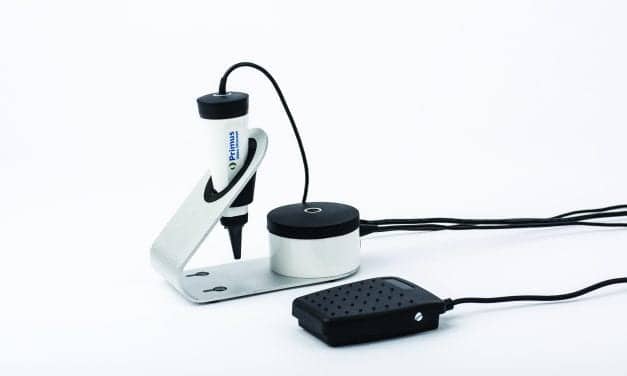
In this new era of disruptive technology, hearing care practices need valuable information to help increase the knowledge of decision makers. Primus Business Analytics is designed to help owners and managers effectively identify growth and development opportunities, understand best-practice protocols, the duration and scope of testing, and assist in fine-tuning in ways that would otherwise be virtually impossible.
Read More
The ASIu Class of 2018 will take place on March 29-30 at the Otometrics/Audiology Systems corporate office in Schaumburg, Ill.
Read More
Verification of a hearing aid (or hearing protection) fitting is an obvious usage, but it can be quite instructive about some general acoustic principles.
Read More
This article looks at how differences in the level of audibility provided by each fitting approach—REM vs Quick Fit—impacts speech understanding and, indirectly, patient loyalty towards the provider.
Read More
Douglas Beck, AuD, interviews long-time educator and clinician Ted Venema, PhD, about the issues surrounding hearing aid compression, inner and outer hair cell loss, digital noise reduction, speech in noise, and verification.
Read More
The areas of speech mapping, probe-microphone measurements, and the verification of prescriptive targets continue to be important topics in hearing aid dispensing and hearing healthcare.
Read More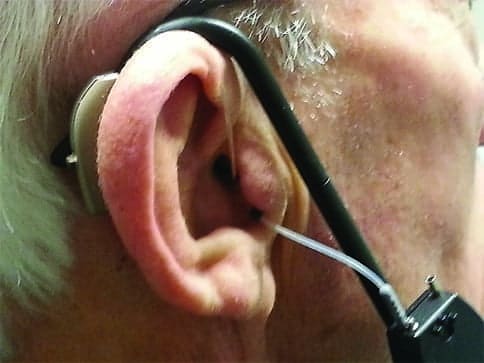
Real-ear verification is considered a “best practice” when fitting hearing aids. In this study, a clinical verification approach was applied to verify the implementation of the NAL-NL2 rationale in the Widex Unique hearing aids.
Read More
Integrated into Audioscan’s Speechmap®, the MAOF highlighter provides guidance during FL verification to help clinicians provide an optimal fit.
Read More
This study shows that 97.7% of subjects showed deviations from the NAL-NL2 in excess of 5 dB in both ears—well in excess of the nearly two-thirds of hearing aid fitting errors reported by the now-famous Consumer Reports article of 2009. Research continues to show that hearing aids that provide more real-ear verified aided speech audibility result in better outcomes than hearing aids that do not provide as much aided speech audibility.
Read More