Researchers Use Organoid-on-a-Chip to Model Inner Ear Development
The system aims to provide insight into sensory hair cell development and potential pathways for regeneration.
University of Oklahoma research indicates that the brain relies on real-time hearing to guide complex speech motor skills, with implications for speech therapy.
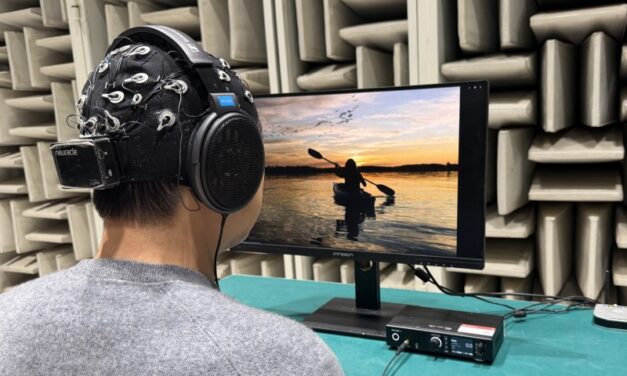
New research published in JASA suggests that in noisy settings, visual engagement improves auditory sensitivity.
The 2026 award recognizes Ingeborg and Erwin Hochmair for their contributions to cochlear implant technology.
Read MoreA meta-analysis finds over 40% of musicians report tinnitus, with auditory risks extending across all musical genres.
Read MoreThe VASCilia platform uses deep learning to accelerate imaging analysis by 50-fold, aiding research into hearing loss and gene therapy.
Read MoreThe research analyzed data from 72 adult cochlear implant recipients, including users of bilateral, bimodal, and unilateral devices.
Read MoreFindings from two studies show improved speech understanding in noise for the Nuance Audio Glasses open-ear hearing solution.
Read MoreNew research finds an association with a lower risk of dementia for prescription hearing aid users, though no changes were observed in cognitive test scores.
Read MoreA new study suggests noninvasive prenatal screening can detect cytomegalovirus, a common cause of permanent hearing loss in newborns.
Read MoreA deep transfer learning AI model predicted spoken language outcomes in children one to three years after cochlear implantation with 92% accuracy.
Read MoreAustralian researchers have identified key genetic and molecular drivers of long COVID using large-scale global datasets and AI, offering a path toward more precise diagnosis, risk prediction, and targeted treatments.
Read MoreA new peer-reviewed study shows that Phonak Infinio Sphere hearing aids with AI-based noise reduction reduce cognitive load and listening effort while improving speech understanding in noisy environments.
Read MoreThe system’s developers think the technology could one day help users of hearing aids to filter their soundscapes without the need to manually direct the AI’s “attention.”
Read MoreA major longitudinal study of more than 3,300 teens finds that by age 18, one in eight adolescents shows signs of probable noise-induced hearing damage and over 6% have sensorineural hearing loss.
Read MoreResearchers at Macquarie University have discovered that the human brain rapidly adapts to the acoustic characteristics of spaces, with speech understanding optimized in environments with a moderate amount of reverberation.
Read MoreA new digital reconstruction study shows that middle-ear hearing loss becomes severe when fluid occupies about half of the ear cavity, offering a non-invasive marker for diagnosing and staging otitis media with effusion.
Read MoreA new study finds that humans’ ability to focus on a single voice in noisy environments—known as selective attention—appears not to originate in subcortical structures like the brainstem or auditory nerve.
Read More