New research published in JASA suggests that in noisy settings, visual engagement improves auditory sensitivity, challenging the conventional wisdom that eye closure enhances listening.
Contrary to popular belief, closing one’s eyes to concentrate on a sound in a noisy environment may impair auditory detection, according to a study from Shanghai Jiao Tong University published in The Journal of the Acoustical Society of America. The research indicates that in noisy soundscapes, visual engagement can significantly improve hearing sensitivity.
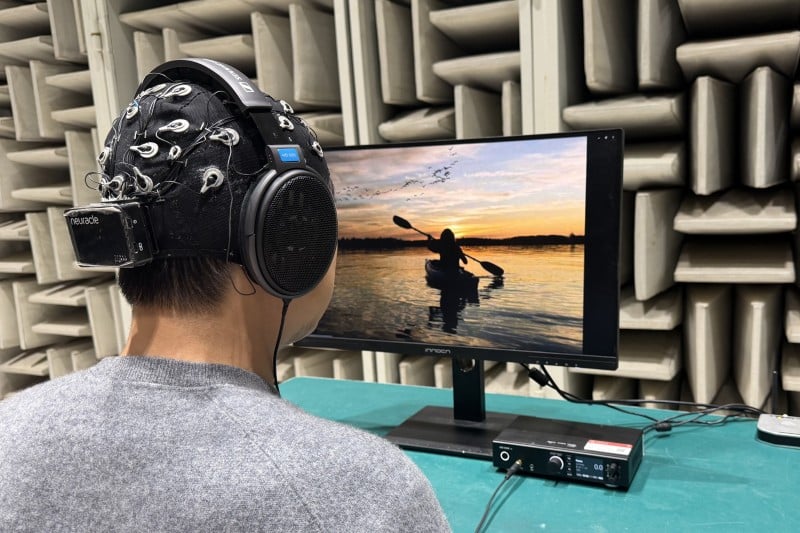
In the study, researchers tested volunteers’ ability to detect sounds through headphones amid background noise. Participants adjusted the volume of target sounds until they were barely audible under four conditions: with eyes closed, with eyes open viewing a blank screen, viewing a still picture corresponding to the sound, and viewing a dynamic video matching the sound.
The results showed that auditory detection was worse with eyes closed compared to when they were open. The highest hearing sensitivity was observed when participants watched a video that corresponded with the sound they were trying to hear.
“We found that, contrary to popular belief, closing one’s eyes actually impairs the ability to detect these sounds,” says author Yu Huang. “Conversely, seeing a dynamic video corresponding to the sound significantly improves hearing sensitivity.”
Read more about Hearing in Noise
To understand the neural mechanism behind this finding, researchers used electroencephalography (EEG) to monitor participants’ brain activity. They found that closing the eyes induces a state of neural criticality, which causes the brain to more aggressively filter both background noise and the quiet target sounds.
“In a noisy soundscape, the brain needs to actively separate the signal from the background,” says Huang. “We found that the internal focus promoted by eye closure actually works against you in this context, leading to overfiltering, whereas visual engagement helps anchor the auditory system to the external world.”
The authors note that this effect is specific to noisy environments. In quiet conditions, closing the eyes is still likely a helpful strategy for detecting faint sounds.
The research team plans to continue investigating the relationship between vision and hearing, including how the brain processes mismatched audio and visual information. This future work aims to distinguish the general effects of attention from the benefits of multisensory integration.
Featured image: Yu Huang