A 3D-printed earplug design aims to improve protection and user comfort by canceling specific sound waves within the ear canal.
Researchers have developed a “meta-earplug” that uses Helmholtz resonators to address two persistent challenges in hearing protection: the occlusion effect and the attenuation of low-frequency sounds. The design, detailed in the Journal of the Acoustical Society of America, aims to improve both the comfort and effectiveness of passive earplugs, particularly in industrial settings.
Traditional earplugs often create the occlusion effect, where the user’s voice sounds hollow or booming due to bone-conducted vibrations building up pressure on the eardrum. They also struggle to block low-frequency sounds, such as rumbling traffic or machinery vibrations, which can leak into the ear canal.
The new design incorporates Helmholtz resonators—small, bulb-shaped structures with narrow necks—to manage sound waves within the ear canal.
“When an ear is sealed with an earplug, the space inside becomes a small, enclosed cavity where sound reflects back and forth between the eardrum and the earplug,” says Kévin Carillo, an author of the study, in a release. “These reflections interact with each other; depending on their timing, they can either add up, which increases pressure and reduces ear protection, or cancel each other out, which is the effect we want.”
By using these resonators, the researchers found they could simultaneously improve comfort and protection. To target a range of low-frequency industrial sounds, the team designed an earplug with multiple resonators arranged in a series, each tuned to a different frequency to relieve acoustic pressure without electronics.
The complex, small-scale architecture of the resonators required 3D printing to achieve the necessary geometric precision. “The challenge at this tiny scale is precision: In the resonators, the cavities are a few cubic centimeters, and [their] necks are submillimeter,” Carillo says.
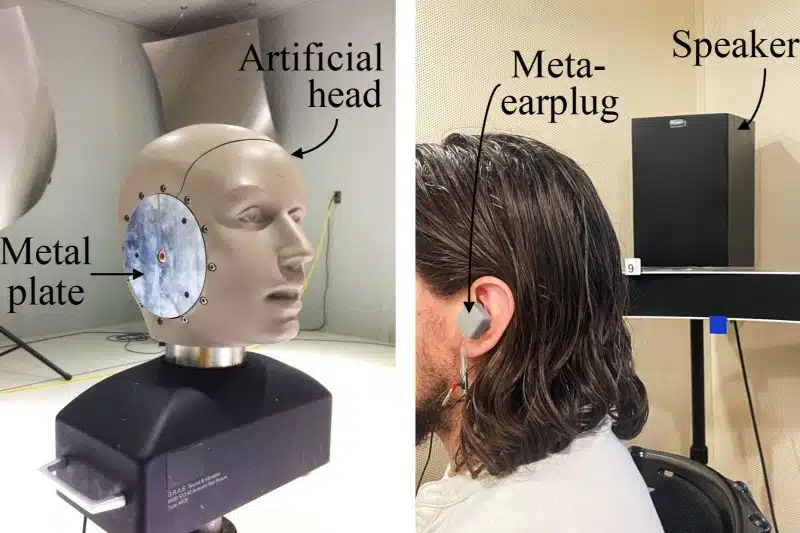
The authors tested the 3D-printed meta-earplug on an artificial head and a group of human participants, demonstrating an effective reduction in low-frequency sound. The research team plans to continue its work to adapt the technology for high-intensity impulse noises, such as those from nail guns or explosions, which are too sudden for the ear’s natural protective reflexes.
Featured image: The authors tested the 3D-printed meta-earplug on an artificial head and a group of human participants, demonstrating an effective reduction in low-frequency sound. Photo: Carillo et al