
Advanced device features, including those found in new AI-powered hearing aids, can influence overall well-being, not just audibility.
By Maren Stropahl, PhD; Kevin Seitz-Paquette, AuD
Maintaining good hearing is essential for healthy aging. While many people think of hearing health mainly in terms of audibility and understanding speech, its influence runs much deeper, affecting overall well-being and quality of life (Vercammen et al., 2020; WHO, 2021). Hearing loss is a risk factor for social isolation, depression, cardiovascular issues, and cognitive decline (Besser et al., 2018; Livingston et al., 2024), which has led experts to advocate for a holistic approach to hearing care.
The global population is experiencing significant demographic shifts driven by both overall population growth and a rapid increase in the proportion of older adults making up the population. Today, approximately eight billion people live in this world, and the number is projected to reach 10 billion by 2050. Especially the population of older adults is increasing significantly; during this period, the number of adults aged over 65 years will likely double, while those aged over 80 years will triple. With the outlook of more people living above the age of 65 years, the prevalence of age-related hearing loss will likely also increase (Gerland et al., 2022; WHO, 2021). These inevitable changes will bring both challenges and opportunities to our society, and to hearing health care in particular (UnitedNations, 2017; WHO, 2024).
Hearing Health and a Holistic Perspective on Hearing Care
Hearing health is a broader concept that goes beyond the “physiological hearing loss” typically measured by the pure tone audiogram (PTA). The PTA is a valid measure to assess hearing thresholds, but it does not capture the personal impact of hearing difficulties. A more holistic approach to hearing health encompasses much more, such as the ability to understand speech in conversation, to localize sounds for safety and orientation, and to appreciate complex non-speech sounds like music or nature. These capabilities together support richer communication, deeper social engagement, and in the long term, a better quality of life (Humes et al., 2024).
To better understand the impact of untreated hearing loss as well as the beneficial effects of hearing care on the broader aspects of health and well-being, we would like to introduce a framework which represents the holistic perspective on hearing care.
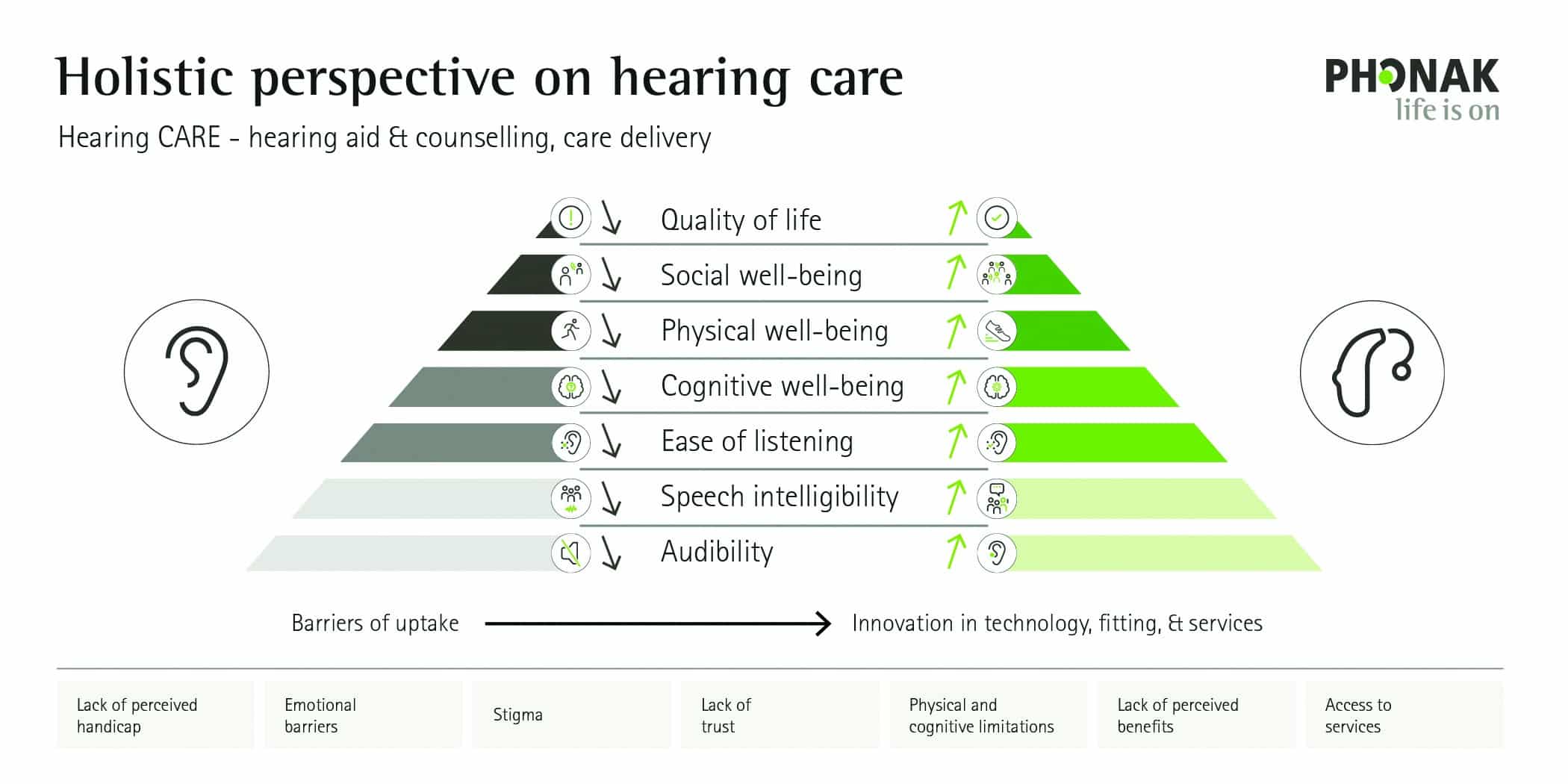
When taking a holistic view of hearing care, one could think of it in terms of several directly or rather indirectly connected dimensions, represented here as a pyramid in Figure 1. The dimensions are by no means complete but represent a scheme to look at the evidence available.
The left side of the pyramid represents the growing body of evidence about the negative consequences of untreated hearing loss. Hearing loss is still often regarded as a “normal” part of the aging process, often resulting in a lack of treatment. However, there is strong evidence that untreated hearing loss can have a drastic impact on quality of life and other aspects of health. Even though hearing aid adoption has grown over the past several years and satisfaction has improved, the number of people seeking help still remains lower than anticipated compared to the actual number of cases (Powers, 2025).
Today, it takes an average of four to seven years from the point when a person notices a change in their hearing to when they are actually fitted with hearing solutions (Powers & Carr, 2022). One potential reason for this delayed uptake is that hearing loss (in most cases) does not have a sudden onset, its progression often happens over a long time, and it is not always immediately noticeable. Because of this gradual progression, in their early stages, hearing difficulties can be compensated for through increased attention and listening effort (Timmer et al., 2018). Many who are affected are unaware, and it is often people in their social circles who are the first to recognize it.
Untreated hearing loss not only reduces speech intelligibility and audibility and increases listening effort, but it has now been established that there is a connection between untreated hearing loss and an increased risk for cognitive decline (Livingston et al., 2024; Sanders et al., 2021; Taljaard et al., 2016), although the causal mechanism has not been clearly identified. Additionally, hearing loss makes maintaining social connections more difficult, which can affect overall well-being (Motala et al., 2024).
The bottom of the pyramid represents some of the many barriers to hearing solution adoption. These include stigma, emotional resistance, a lack of perceived handicap, and a lack of awareness about the potential benefits of hearing care. Stigma remains a huge barrier to hearing care, which very likely prevents individuals from dealing with their hearing loss.
To overcome the barriers and the negative impact of untreated hearing loss, innovation in technology and in fitting approaches and, probably most importantly, the right counseling approaches are essential. Taken together, this will help individuals with hearing loss to experience the benefits of hearing care, which are presented on the right side of the pyramid.
Much evidence has been published over the past several years shedding light on the holistic or whole person benefits of hearing care on these multiple dimensions. Hearing aids can restore audibility and improve speech intelligibility, while also reducing listening effort (Ferguson et al., 2017; WHO, 2021). There is emerging evidence that hearing care supports cognitive health (Lin et al., 2023; Sarant et al., 2024), helps people remain socially active (Reed et al., 2025; Timmer et al., 2024), and improves overall quality of life (Chisolm et al., 2007; Wells et al., 2019). The influence of hearing care on social interaction and participation for people with hearing loss has been a subject of recent focus (Timmer et al., 2024), especially because of the growing evidence emphasizing the importance of an active social lifestyle as a key factor for healthy aging (Haslam et al., 2018). Within the limits of a larger study, it was shown that people with hearing aids appear to have a larger number of and more diverse social contacts in comparison to people with untreated hearing loss (Reed et al., 2025). Moreover, another study evaluated that hearing care can have an influence on reduced fatigue and increased social participation in daily life (Holman et al., 2021).
This holistic perspective in hearing care shows that untreated hearing loss can have far-reaching negative effects, but timely and effective hearing care can positively impact multiple dimensions of health and well-being. What is essential is to quantify the benefit of hearing care on these multiple dimensions so as to foster elderly individuals’ acceptance and adoption of hearing care.
Understanding Hearing Technology Through a Holistic Lens
New approaches using artificial intelligence (AI) are increasingly shaping hearing research and hearing care (Diehl et al., 2023). In addition to automatically classifying listening situations and adjusting settings, AI may also be used to improve speech understanding. Recent methods can separate important sounds such as a voice from background noise. Trained on large amounts of speech data, these algorithms can handle even complex listening environments (e.g. multiple speakers). This speech-enhancement approach can greatly improve the signal-to-noise ratio compared to traditional directional microphone techniques. Research has shown that it is especially effective when large deep neural networks (DNNs) are used that directly extract the target speech signal from background noise (Diehl et al., 2023; Zheng et al., 2023).
The specific DNN that has been integrated into Phonak’s new Audeo Infinio Ultra Sphere (henceforth, Sphere) technology is a powerful, rather large DNN with several Mio parameters and more than 10 hidden network layers. It directly extracts the speech signal through the DNN—not only indirectly by steering or post-processing noise reduction solutions. The so-called U-net structure has been shown to be specifically effective for speech enhancement tasks. It comprises convolutive layers mainly representing the spectral content of speech as well as recurrent layers mainly representing temporal information of speech sounds. The size and architecture of the DNN are crucial factors determining the performance of the solution.
Hearing technology is often evaluated using technical metrics of sound quality (e.g., HASQI, Kates and Arehart (2022)) or predicted speech understanding (e.g., HASPI, Kates and Arehart (2022)), as well as basic clinical tests of speech in noise performance (e.g., HINT, Nilsson et al. (1994)). These measures can provide valuable insights into product performance under idealized conditions. The effects measured indicate the promise of new technology for real-world situations. But because the conditions are often designed to show the maximum benefit of a new technology, the effect size is likely to be overstated compared to what would be achieved in real-life listening. Additionally, these approaches may not capture the full benefit of modern, DNN-based approaches to noise reduction when applied to dynamic environments.
Clinical research with the latest technology aims to include measures of speech intelligibility and listening effort in multi-talker, dynamic conversations, listening-related fatigue, cognitive performance, and social quality of life. Including these outcomes alongside more fundamental measures of speech understanding and sound quality allows us to understand the effectiveness, not just the efficacy, of novel approaches to noise management. In this article, evidence for the benefits of Sphere, and in particular, its DNN-based direct speech extraction system, Spheric Speech Clarity, will be presented and interpreted through a holistic lens.
Improvement in Multi-Talker and Dynamic Conversations
Many social events include conversations with multiple participants in noisy places. For example, consider a typical gathering of family or friends in a busy restaurant; in such conversations, the person talking may switch frequently and unpredictably. Sometimes, turn-taking breaks down and several people speak simultaneously.
Sphere’s ability to support patients in this type of environment has been evaluated in numerous clinical studies around the world. In fact, Sphere is supported by 21 completed studies, with others still running (cf. phonak.com/evidence for a complete overview). Two experiments from a study conducted in 2025 at the University of Oldenburg illustrate how Spheric Speech Clarity performs as compared to state-of-the-art binaural beamforming (StereoZoom).
In the first experiment, participants were seated in the center of a 16-speaker circular array. Background noise was presented from all 16 speakers simultaneously for a combined presentation level of 75 dB SPL. Sentences from the OLSA corpus were presented at an adaptive level, and the results were expressed as the SNR at which the participant scored 50% correct (SRT). Each OLSA sentence contains exactly 5 words; during this test, each word of the sentence was presented randomly from the speakers located at 0, 45, 90, 270, and 315 degrees azimuth relative to the participant. This simulates a conversation environment where the target may change location unpredictably and rapidly.
When completing the task described above while listening to hearing aids using Spheric Speech Clarity, participants’ average SRT was significantly better than when listening to hearing aids using StereoZoom. The average SRT was reduced by 3.2 dB SNR, which indicates that participants could maintain equal performance when the SNR of the environment was 3.2 dB lower (i.e., more challenging) when listening with Spheric Speech Clarity (p < 0.001, d = 1.8). By allowing increased performance at more negative SNRs, Sphere helps users navigate noisy environments that otherwise might have been too challenging.
In the second experiment, participants were seated in the same 16-speaker array, and background noise was again presented from all speakers simultaneously for a combined level of 75 dB SPL. However, in this experiment, sentences were presented from one of three speakers at 5 dB SPL above the participant’s SRT. The participant was tasked with listening for the name ‘Kerstin’ and repeating the final word of all sentences from that speaker until the name ‘Kerstin’ was repeated. At that point, participants were told to switch their attention to the new speaker and continue this process of directing attention to the most recent location of ‘Kerstin’ (Latzel, et al., 2025). This task is similar to listening for one’s name in a loud conversation environment, like a reception or party.
Participants were 19.9 percentage points more accurate when completing this task using Spheric Speech Clarity as compared to StereoZoom, a statistically (p < 0.001, d = 1.6) and clinically significant improvement. The results of both experiments highlight Spheric Speech Clarity’s exceptional performance in fast-paced, complex communication situations like those that occur for patients with active social lives. By providing greater access to speech from all directions, participants’ abilities to understand and correctly respond to speech were improved in complex environments. Moreover, this improvement did not require participants to adapt their own behavior, such as by locating and turning to face the target, as is often the case with traditional directional systems.
Reducing Listening-Related Fatigue
Participating in complex social situations is not just about understanding the speech of those around you. Equally important is the ability to sustain one’s energy during these social interactions. Previous research has shown that treatment of hearing loss can reduce the perception of fatigue over the span of several years; however, it is also of interest how—or if— hearing aids can impact fatigue experienced during difficult short-term listening situations (Bessen et al., 2024).
In another experiment completed at the University of Oldenburg, participants were seated in the same 16-speaker array as described above and completed a task almost identical to the second experiment. However, during this evaluation of fatigue, the speech materials overlapped in time by a varying amount. As participants performed better, the amount of overlapping time between sentences increased; if participants performed worse, the overlapping time decreased. Overlapping time was adapted with the goal of maintaining 50% correct performance for the participants (Latzel et al., 2025).
In any listening task, fatigue is expected to reduce performance over successive test sessions. Participants completed the fatigue experiment twice for each listening condition: Spheric Speech Clarity and StereoZoom. When completing the task with Spheric Speech Clarity, performance significantly increased from the test to retest session. When completing the task with StereoZoom, performance decreased. The participants’ ability to train on the task and improve over successive test sessions with Spheric Speech Clarity points to a reduction in fatigue, as they had spare cognitive energy to devote to training and improving on the test.
Improved Quality of Life
Facilitating conversations in dynamic social situations and reducing listening-related fatigue may contribute to an overall improvement in social satisfaction and quality of life. To understand how Sphere impacts the patient’s quality of life, a survey of Sphere users was conducted through a clinic in Vancouver, Canada.
A total of 22 patients who had used Sphere hearing aids for at least one month participated in the survey. A majority of respondents were long-term (5 or more years) hearing aid users with moderately severe or severe self-reported unaided hearing difficulty.
When asked about Sphere’s performance in situations where the participants most wanted to hear better, a majority agreed that Sphere was helpful, was worth the trouble of using, and changed their enjoyment of life. Further, almost three-quarters of participants reported that they experienced either no or only slight residual hearing difficulty when using Sphere.
Participants were also given the opportunity to share their experiences in free-field responses. Many participants noted that their willingness to participate socially has increased as a result of using their new device. Although the comments are largely positive, several participants also noted situations that remain challenging, such as maintaining attention when more than one person is speaking, large group conversations (e.g., 6-8 people), and situations with loud music.
Summarizing, the evidence of new technology on holistic health dimensions relevant for a person with hearing loss is growing and the future of hearing care will foster the real-world benefit even more. It could be shown that AI-driven technology is already considered an essential part of hearing care and will continue to shape its future. Ongoing advances are expected to further streamline the patient journey while improving hearing performance. The next section highlights several key areas of future development.
The Future of AI in Hearing Care
Hearing technology has progressed significantly over the past decade. The next phase of innovation featuring larger DNNs integrated into hearing devices has the potential to make an even greater impact. Recent evidence, including that presented in this article, shows that large DNNs can improve speech understanding beyond what traditional beamforming approaches achieve. With more situation-specific and stimulus-specific DNNs, speech enhancement can be taken to the next level, further improving one of the greatest challenges for people with hearing loss: understanding speech in noisy environments.
DNNs may also improve audibility by working alongside gain models to enable more precise, individualized device settings. Applying DNNs to targeted features such as wind noise reduction or feedback management can further enhance the naturalness of processed sound. AI models are already used in design optimization, and future developments in this area are likely to improve fitting accuracy and wearing comfort.
Another important area where AI can enhance the patient experience is its integration into the hearing care process. AI agents could support hearing care professionals by reducing administrative workload and assisting with predictive fitting in the fitting software (e.g., for acoustic coupling or automated acclimatization). They may also support the development of soft skills, such as counseling.
For patients, AI agents can simplify the hearing care journey and support decision-making by fostering motivation, providing information, counseling, fine-tuning, problem-solving, and general ongoing engagement throughout the journey. The potential here is substantial, offering new ways to involve more people in their hearing care and reducing drop-out rates along the journey.
Summary and Conclusion
Maintaining good hearing is essential across the lifespan and is an important component for healthy aging. It is essential to integrate device performance with outcomes that matter to people with hearing loss, like communication in daily life, cognitive performance, psychosocial well-being, and user experience across diverse settings. By aligning evidence with patient-centered care, it can be demonstrated how advanced device features can influence overall well-being, not just audibility. With future approaches to hearing care supported by AI technology, there are promising opportunities to enhance the patient journey as well as the performance of hearing technology. Yet despite so many technological advancements, it remains essential to make patient and family needs the central focus for a holistic approach to hearing care.
About the Authors:
Maren Stropahl, PhD, is senior director of holistic hearing care at Sonova AG. Kevin Seitz-Paquette, AuD, is senior director of audiologic insights at Sonova.
Original citation for this article: Stropahl M, Seitz-Paquette K. Holistic Hearing Care: New Technologies and Their Whole Person Benefits. Hearing Review. 2026;33(3):22,24-25.
References
Bessen, S. Y., Zhang, W., Huang, A. R., Arnold, M., Burgard, S., Chisolm, T. H., Couper, D., Deal, J. A., Faucette, S. P., & Goman, A. M. (2024). Effect of hearing intervention versus health education control on fatigue: A secondary analysis of the ACHIEVE study. The Journals of Gerontology, Series A: Biological Sciences and Medical Sciences, 79(11). https://doi.org/https://doi.org/10.1093/gerona/glae193
Besser, J., Stropahl, M., Urry, E., & Launer, S. (2018). Comorbidities of hearing loss and the implications of multimorbidity for audiological care. Hearing Research, 369, 3-14. https://doi.org/https://doi.org/10.1016/j.heares.2018.06.008
Chisolm, T. H., Johnson, C. E., Danhauer, J. L., Al., E., Portz, L. J. P., Abrams, H. B., Lesner, S., McCarthy, P. A., & Newman, C. W. (2007). A systematic review of health-related quality of life and hearing aids: Final report of the American Academy of Audiology Task Force on the Health-Related Quality of Life Benefits of Amplification in Adults. Journal of the American Academy of Audiology, 18, 151-183. https://doi.org/10.3766/jaaa.18.2.7
Dawes, P., & Völter, C. (2023). Do hearing loss interventions prevent dementia? Zeitschrift Fur Gerontologie Und Geriatrie, 56(4), 261-268. https://doi.org/10.1007/s00391-023-02178-z (Können Interventionen gegen Hörverlust einer Demenz vorbeugen?)
Diehl, P. U., Singer, Y., Zilly, H., Schönfeld, U., Meyer-Rachner, P., Berry, M., Sprekeler, H., Sprengel, E., Pudszuhn, A., & Hofmann, V. M. (2023). Restoring speech intelligibility for hearing aid users with deep learning. Scientific Reports, 13(1), 2719. https://doi.org/10.1038/s41598-023-29871-8
Ferguson, M. A., Kitterick, P. T., Chong, L. Y., Edmondson‐Jones, M., Barker, F., & Hoare, D. J. (2017). Hearing aids for mild to moderate hearing loss in adults. Cochrane Database of Systematic Reviews(9). https://doi.org/10.1002/14651858.CD012023.pub2
Haslam, C., Jetten, J., Cruwys, T., Dingle, G., & Haslam, S. A. (2018). The new psychology of health: Unlocking the social cure. Routledge.
Holman, J. A., Drummond, A., & Naylor, G. (2021). Hearing Aids Reduce Daily-Life Fatigue and Increase Social Activity: A Longitudinal Study. Trends in Hearing, 25, 23312165211052786. https://doi.org/10.1177/23312165211052786
Kates, J. M., & Arehart, K. H. (2022). An overview of the HASPI and HASQI metrics for predicting speech intelligibility and speech quality for normal hearing, hearing loss, and hearing aids. Hearing Research,426, 108608. https://doi.org/https://doi.org/10.1016/j.heares.2022.108608
Lin, F. R., Pike, J. R., Albert, M. S., Arnold, M., Burgard, S., Chisolm, T., Couper, D., Deal, J. A., Goman, A. M., & Glynn, N. W. (2023). Hearing intervention versus health education control to reduce cognitive decline in older adults with hearing loss in the USA (ACHIEVE): a multicentre, randomised controlled trial. The Lancet, 402(10404), 786-797. https://doi.org/https://doi.org/10.1016/S0140-6736(23)01406-X
Livingston, G., Huntley, J., Liu, K. Y., Costafreda, S. G., Selbæk, G., Alladi, S., Ames, D., Banerjee, S., Burns, A., Brayne, C., Fox, N. C., Ferri, C. P., Gitlin, L. N., Howard, R., Kales, H. C., Kivimäki, M., Larson, E. B., Nakasujja, N., Rockwood, K.,…Mukadam, N. (2024). Dementia prevention, intervention, and care: 2024 report of the Lancet standing Commission. Lancet (London, England),404(10452), 572-628. https://doi.org/10.1016/s0140-6736(24)01296-0
Motala, A., Johnsrude, I. S., & Herrmann, B. (2024). A longitudinal framework to describe the relation between age-related hearing loss and social isolation. Trends in Hearing, 28, 23312165241236041.
Nilsson, M., Soli, S. D., & Sullivan, J. (1994). Development of the Hearing In Noise Test for the measurement of speech reception thresholds in quiet and in noise. Journal Acoustical Society of America, 95, 1085-1099.
Powers, T. A. (2025). Tracking Change: What MarkeTrak and EuroTrak Reveal About Global Hearing Aid Trends. Seminars in Hearing,
Powers, T. A., & Carr, K. (2022). MarkeTrak 2022: Navigating the changing landscape of hearing healthcare. . Hearing Review, 29(5), 12-17.
Reed, N. S., Chen, J., Huang, A. R., Pike, J. R., Arnold, M., Burgard, S., Chen, Z., Chisolm, T., Couper, D., Cudjoe, T. K. M., Deal, J. A., Goman, A. M., Glynn, N. W., Gmelin, T., Gravens-Mueller, L., Hayden, K. M., Mitchell, C. M., Mosley, T., Oh, E. S.,…Group, A. C. R. (2025). Hearing Intervention, Social Isolation, and Loneliness: A Secondary Analysis of the ACHIEVE Randomized Clinical Trial. JAMA Internal Medicine. https://doi.org/10.1001/jamainternmed.2025.1140
Sanders, M. E., Kant, E., Smit, A. L., & Stegeman, I. (2021). The effect of hearing aids on cognitive function: A systematic review. PloS One, 16(12), e0261207. https://doi.org/10.1371/journal.pone.0261207
Sarant, J., Busby, P. A., Schembri, A. J., Fowler, C., & Harris, D. C. (2024). ENHANCE: a comparative prospective longitudinal study of cognitive outcomes after 3 years of hearing aid use in older adults. Frontiers in Aging Neuroscience, 15, 1302185. https://doi.org/ 10.3389/fnagi.2023.1302185
Taljaard, D. S., Olaithe, M., Brennan-Jones, C. G., Eikelboom, R. H., & Bucks, R. S. (2016). The relationship between hearing impairment and cognitive function: a meta-analysis in adults. Clinical otolaryngology: official journal of ENT-UK ; official journal of Netherlands Society for Oto-Rhino-Laryngology & Cervico-Facial Surgery, 41(6), 718-729. https://doi.org/10.1111/coa.12607
Timmer, B. H., Bennett, R. J., Montano, J., Hickson, L., Weinstein, B., Wild, J., Ferguson, M., Holman, J. A., LeBeau, V., & Dyre, L. (2024). Social-emotional well-being and adult hearing loss: clinical recommendations. International Journal of Audiology, 63(6), 381-392. https://doi.org/10.1080/14992027.2023.2190864
Timmer, B. H., Hickson, L., David, M., & Launer, S. (2018). Do hearing aids address real-world hearing difficulties for adults with mild hearing impairment? Results from a pilot study using ecological momentary assessment. Trends in Hearing, 22, 2331216518783608.
UnitedNations. (2017). World Population Ageing 2017 – Highlights. United Nations, Department of Economic and Social Affairs, Population Division.
Vercammen, C., M., F., S.E., K., Meis, M., Singh, G., Timmer, B., Gagné, J., Goy, H., Hickson, L., Holube, I., Launer, S., Lemke, U., Naylor, G., Picou, E. M., Scherpiet, S., Weinstein, B., & Pelosi, A. (2020). Well-Hearing is Well-Being. Hearing Review, 27(3), 18-22.
Wells, T. S., Nickels, L. D., Rush, S. R., Musich, S. A., Wu, L., Bhattarai, G. R., & Yeh, C. S. (2019). Characteristics and Health Outcomes Associated With Hearing Loss and Hearing Aid Use Among Older Adults. Journal of Aging and Health, 0898264319848866. https://doi.org/10.1177/0898264319848866
WHO. (2021). World report on hearing (9789240020481). https://www.who.int/publications/i/item/world-report-on-hearing
WHO. (2024). Ageing and health WHO. Retrieved November 22, 2024 from
Zheng, C., Zhang, H., Liu, W., Luo, X., Li, A., Li, X., & Moore, B. C. (2023). Sixty years of frequency-domain monaural speech enhancement: From traditional to deep learning methods. Trends in Hearing, 27, 23312165231209913.



Did the obsolete BTE give a better listening experience for music? Needs can be so individual. I knew a person who held onto an obsolete BTE for so long it was literally held together with tape and her audiologist had a continuing mission of finding spare parts for it. Why? For 20+ years she tried hearing aid after hearing aid that gave tremendous improvement in everyday life, but were absolutely useless on the phone. She said, “I’m sorry. I’m not giving up the phone and we’re not having a conversation about it.” The memories are vague as it was many years ago, but apparently her audiologist made a nuisance of himself to various manufacturers with one simple question: Why is it that with all this technical advancement you are unable to produce a BTE with a T-coil that functions as well as an analog BTE that was designed in the ’80’s?!?!
Holistic? Quality of life? Active users? But yet again not a mention of MUSIC, even in the scholarly references.
When will the industry catch up? My need is to enjoy a concert, a CD, choir practice… A speech focused device can wreck those. Been there. Rescued by a great audiologist who retrieved an obsolete BTE from her drawer and invited me to play a little keyboarf while she removed high-end clogging and compressor pumping.