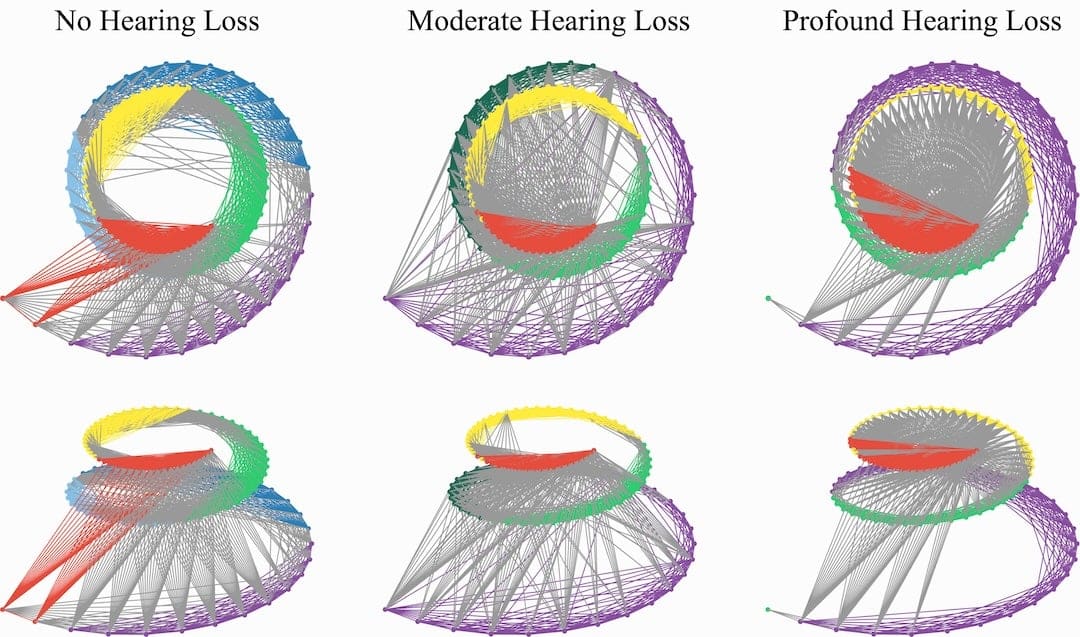
A Rice University research team has developed a network-based framework for modeling cochlear sound processing that may inform more personalized hearing aid and cochlear implant settings.
Researchers at Rice University have proposed a new way to model how the cochlea processes sound—one that treats the inner ear not as a series of isolated frequency channels but as an interconnected network—with potential implications for how hearing devices are fitted and programmed.
The study, published in Proceedings of the National Academy of Sciences Nexus, introduces a framework called GSP Cochlea, which applies graph signal processing (GSP) to model the functional relationships between thousands of cochlear hair cells mapped onto a three-dimensional reconstruction of the human cochlea. The research was led by bioengineering associate professor Robert Raphael, electrical and computer engineering associate professor Santiago Segarra, and Melia Bonomo, now a lecturer in the Department of Physics and Astronomy at Rice.
Traditional cochlear modeling relies on classical signal processing—mapping the cochlea’s response onto a uniform grid where each point tracks the activity of an individual sensory cell in isolation. The GSP approach instead organizes those cells according to the cochlea’s natural spiral geometry, identifying broader functional groupings called modules that form a mesh-like network across the structure.
“Classical signal processing is typically built for regular domains like lines and grids,” says Segarra, in a release. “Graph signal processing lets us move beyond that assumption and study data supported on irregular networks, which is often a better match for biological systems.”
When tested, GSP Cochlea outperformed alternative models on measures of information processing—including the detection of signals in noise, a core challenge for hearing aid designers and users alike.
“One of the extraordinary things the cochlea needs to do is separate signals from noise,” says Raphael, in a release. “When the model showed GSP is a superior method of signal detection, that led me to believe that GSP is more than a powerful tool: It could very well be that this is what the cochlea evolved to do.”
Rethinking What Hearing Loss Represents
Perhaps the most clinically relevant finding involves what the framework reveals about the nature of hearing loss itself. The team generated cochlear graphs using hearing-loss data from more than 200 patients and found that worsening hearing loss correlated with a breakdown in network organization—not simply a reduction in sensitivity at specific sound frequencies.
That distinction carries direct implications for how hearing devices are currently programmed.
“Hearing aids are tuned based on a patient’s audiogram, the standard clinical measure for hearing loss,” says Raphael, in a release. “Currently, what a hearing aid does is it amplifies the frequencies that the audiogram flags as deficient. However, that does not take into account that the modularity of the system has changed.”
The researchers suggest that GSP Cochlea could eventually inform personalized device settings for both hearing aids and cochlear implants—settings that account for how the network structure of an individual patient’s cochlea may have changed, rather than relying solely on audiometric thresholds.
A Holistic View of Auditory Processing
The GSP framework also offers a new visualization tool: by distilling responses to multiple auditory stimuli into a single graph, clinicians and researchers can assess a patient’s sound perception more holistically than current methods allow.
“Our framework provides a tool to study the overarching functional relationships between sensory cells, which is not possible using classical signal processing,” says Bonomo, in a release.
Raphael has indicated he plans to extend the approach up the auditory pathway, including to the auditory cortex, and sees longer-term potential in the development of auditory brain-computer interfaces.
“This work marks a paradigm shift in how we think about auditory processing,” says Raphael, in a release. “It opens up new avenues for research on the neural underpinnings of perception and it could eventually impact how we build auditory brain-computer interfaces.”
The research was funded by the US National Library of Medicine (T15LM007093) and Rice University. The full study, “GSP Cochlea: A graph signal processing approach for studying sound encoding,” is available in PNAS Nexus at doi.org/10.1093/pnasnexus/pgag134.
Featured image: Examples of the cochlea graphs created using GSP Cochlea and audiogram data from patients with varying hearing loss diagnoses. The nodes are color-coded according to their module membership. A module is a group of nodes that share more functional connections amongst themselves than they do with the rest of the nodes in the network. Within-module connections are displayed in the same color as the module, whereas between-module connections are in gray. Image: Melia Bonomo/Rice University