There are two distinctly different signal processing design philosophies used in modern-day premium hearing aids. A new study looks at how both natural processing and AI approaches perform under the same noisy conditions.
By Petri Korhonen, MSc; Francis Kuk, PhD; Christopher Slugocki, PhD
Improving communication in noisy environments is one of the central goals of hearing aid design. Despite this shared goal, manufacturers vary in how they attempt to solve the speech‑in‑noise (SiN) problem. Widex’s sound design philosophy centers on preserving the natural auditory cues in the original sound with minimal distortions. If these cues are distorted, listeners may experience increased listening effort, fatigue, and reduced satisfaction, even if speech remains audible. To highlight the importance of natural sound, in a survey of 3,877 Widex hearing aid users, 94% rated sound quality as very or extremely important (Ziegler et al., 2023). Preserving natural sound is important not only for sound quality but also for speech understanding. The auditory system relies on prediction by anticipating upcoming words, sound levels, and spatial cues (Best et al., 2008; Sohoglu et al., 2012). When hearing aids maintain these cues, they provide stable, predictable information, and reduce the need for the brain to reconstruct missing details. In contrast, listening to distorted acoustic cues may require engagement of additional cognitive resources to interpret speech leaving the listener feeling fatigued after social interactions, even if the speech is audible (Peelle, 2018).
Achieving Natural Sound
Preserving the natural details of the original sounds does not imply that no hearing aid processing is applied. In fact, the opposite is true. Achieving natural and high-quality sound requires coordinated action of several signal processing features, each designed with the shared goal of preserving the details of the original sound. The following features are key in achieving natural sound in the Widex Allure hearing aids.
Achieving The Cleanest Possible Input: True Input Technology
The quality of hearing aid sound processing is limited by its weakest link. If the input sound level exceeds the hearing aid’s input limit, the sound is clipped and compressed, which is perceived as crackling, popping, or as muffled speech. Widex’s True Input technology was the first to achieve extended 108 dB input dynamic range with 113 dB SPL upper limit and extremely low 5 dB SPL noise floor. This technology improves speech understanding in loud noisy situations in which users might be inclined not to use their hearing aids (Kuk et al., 2015).
Reducing Comb‑Filter Artifacts Through Low Processing Delay
Open‑fit and vented fittings introduce a mixture of direct unaided and aided, processed sound at the eardrum. When these two sounds arrive at the eardrum at different times due to hearing aid processing delay, listeners perceive an undesired “hollow” or “metallic” coloration known as comb-filtering. Thus, to avoid this, the hearing aid processing delay should be kept to a minimum. Widex hearing aids achieve ~2–5 ms processing delay, shorter than the typical 5–8 ms found in premium hearing aids (Balling et al., 2020). Widex’s ZeroDelay technology in the PureSound program further reduces processing delay to just 0.5 ms, which effectively eliminates comb-filtering and provides noticeably more natural sound in open or vented fittings. Its effect has been demonstrated to improve listening preference (Balling et al., 2021) and spatial perception (Korhonen et al., 2022). According to research, it preserves natural voicing cues in stop consonants (Korhonen et al., 2024), promotes better fidelity of neural speech signal (Zhou et al., 2024; Slugocki et al., 2020), and reduces coloration-pitch distortions for vowel sounds (Slugocki et al., 2023).
Compression That Preserves the Signal Envelope (Variable Speed Compression)
Compression in hearing aids adjusts the gain so soft inputs become audible and loud ones remain comfortable. Slow‑acting compression adjusts the gain gradually, helping to maintain the temporal envelope of speech. In contrast, fast‑acting compression attempts to ensure audibility by responding to rapid changes in sound level. The drawback of fast-acting compression is that it may smear temporal cues. A substantial body of evidence supports the use of slow-acting compression (Kuk 1998; Windle et al., 2023), which has been Widex’s strategy since Senso, the first digital in‑the‑ear hearing aid (Ludvigsen & Tøpholm, 1997). Widex’s Variable Speed Compression blends both slow- and fast-acting strategies. At and above conversational levels, the slow compressor dominates to preserve temporal structure. For soft sounds, highly modulated sounds, or when there are large level changes, fast-acting compression ensures audibility for softer elements of speech. This dual approach preserves the temporal envelope of speech while still ensuring audibility in situations where speech level changes rapidly (Kuk et al., 2019).
… While Achieving Noise Management
Preserving natural sound supports communication only when speech cues remain audible. Widex Allure’s Speech Enhancer Pro builds on established noise‑reduction philosophy with updated processing. First, a fast time‑domain analyzer operates across 52 bands for accurate noise estimation. Second, slowly operating Speech Enhancer noise reduction system frequency shapes the sound to optimize Speech Intelligibility Index (SII) for the individual wearer, resulting in both objective and subjective benefits (Peeters et al., 2009). The slower processing helps maintain stable and calm sound experience.
Because compression, noise reduction, and adaptive directionality all operate simultaneously, it can be difficult to control where the final hearing aid output is placed relative to the wearer’s residual dynamic range. Widex Speech Enhancer Pro’s third element, the Hearing Threshold Level Optimizer, is designed to place the final output appropriately in each frequency band, keeping speech above threshold at frequencies where noise level is low and keeping the noise floor below threshold where noise is present. This results in more similar speech loudness across noisy conditions, improving the perceived naturalness of the target speech (Korhonen et al., 2025).
The Widex HD Locator automatic adaptive directional system is designed to further reduce background noise by continually monitoring the environment and selecting the polar pattern that provides the best SNR. It shifts through directional patterns for full environmental awareness in quiet and the least amount of noise around the listener in challenging environments (Kuk et al., 2005; Kuk et al. 2017).
What About Machine Learning in Hearing Aids?
Machine learning-based noise reduction has emerged as a novel strategy for speech-in-noise management in commercial hearing aids. These systems rely on deep neural networks (DNNs), which are trained using large datasets of real‑world recordings to distinguish between speech and noise. The hearing aid uses this learned knowledge to reduce noise in everyday listening. Generally, the size, diversity, and realism of the datasets influence how well the system generalizes to everyday listening. Networks trained on limited or artificial datasets may perform acceptably in controlled conditions, but struggle in real‑world noisy communication situations. The DNN-based noise reduction systems vary across manufacturers in how they are designed, trained, and optimized. Developers need to balance between development cost, processing complexity, memory requirement, and battery consumption, which can lead to differences in their real-world performance across manufacturers.
Widex Approach Compared to DNN-Based Hearing Aid Approach
The Widex Allure RIC R D hearing aid does not use machine learning for noise processing; but based on the Widex design philosophy, its processing that prioritizes the naturalness of the original sound should have already ensured the best hearing aid experience including speech-in-noise listening. Given the growing interest in DNN‑based noise reduction, an important question for clinicians is whether the machine learning-based systems necessarily translate into improved speech‑in‑noise performance. To address this, we compared speech‑in‑noise performance with Widex Allure RIC R D against four competitors’ devices that marketed DNN as their noise management strategy.
METHODS
Participants
Twenty-nine adults with symmetrical sensorineural hearing loss participated. Based on four-frequency pure-tone averages (4FPTAs), 14 had mild-to-moderate loss (≤ 40 dB HL; mean = 31.3 dB HL) and 15 had moderate to moderate-to-severe loss (> 40 dB HL; mean = 53.1 dB HL). Participants’ average ages were 74.0 yrs in both HL group. Eight participants in the Mild HL group had been using hearing aids for an average of 8.6 years, and 13 in the Mod HL group for an average of 22.2 years. Participants’ MoCA scores ranged from 20 to 30 (mean = 26.8 [Mild], 26.6 [Moderate]).
Study Hearing Aids
Five premium hearing aids were fit using manufacturers’ proprietary gain targets and default settings. The same ear-tips, selected individually according to the Widex fitting software’s recommendations, were used with all devices. All devices used “fixed” speech-in-noise programs, except Widex Allure, which in the absence of a noise program used Universal or the PureSound program (only for mild sloping hearing loss). Feedback tests were conducted for all fittings.
Setup
Hearing aid fitting and testing took place inside a sound-treated booth (3 x 3 x 2 m; W x L x H). Listeners were surrounded by eight loudspeakers as shown in Figure 1. The target speech was presented from -30°, 0°, or +30° azimuth in a pseudo-random order simulating a group conversation. Every second sentence came from 0°, while the side‑speaker location (±30°) was randomized with an equal number of presentations. The level of the speech was initially 83 dB SPL and thereafter adjusted based on listener performance. Three speech-like temporally decorrelated distractor signals (ISTS, Holube et al., 2010) were presented from 150°, 180°, and 210°. Additionally, cafeteria noise was presented from 90°, 150°, 180°, 210°, and 270° at -10 dB relative to the ISTS signal. The total combined background noise level was 68 dB SPL.
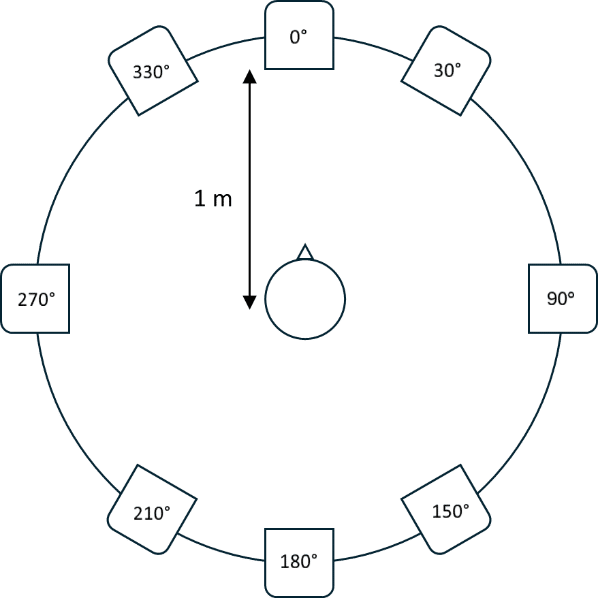
Figure 1: The loudspeaker configuration used during the study.
Procedure
In the first study phase, we estimated the listeners’ speech-in-noise performance intensity (P-I) function using a Bayesian-guided method known as the ezSRT test (Slugocki et al., 2026). Each trial included 24 “low context” sentences taken from the Repeat-Recall Test (Slugocki et al., 2018) presented against the background noise. The performance was scored based on 3 or 4 target words per sentence. At the end of the test, the ezSRT test provides an estimate of the performance-intensity (PI) function including the SNRs corresponding to 90% speech understanding (i.e., speech reception thresholds of SRT90). Because most daily successful communications demand near‑complete comprehension, SRT90 would likely represent the poorest/lowest SNRs needed for effective real‑world communication. Thus, evaluating devices at this SNR level offers clinicians clearer insight into which hearing aids are most likely to deliver realistic benefit for communication in everyday situations.
In the second study phase, we measured listener word recognition performance for 32 sentences with each study hearing aid at a fixed SNR corresponding to individual SRT90 of the best-performing device in the first study phase. The experiment followed a single-blind design. The order of HA conditions was counterbalanced across participants.
RESULTS
The Widex Allure RIC R D is labeled as ‘Allure.’ The other study hearing aids were labeled HA#2 through HA#5 to ensure anonymity.
Signal-to-Noise Ratios (SNR) For 90% Correct Identification
The mean P-I functions in Figure 2 showed that Allure and HA#2 provided the best performance, with their P-I curves positioned furthest left. HA#5 showed the poorest performance, while HA#3 and HA#4 fell in the middle. There was greater separation among the P-I curves for the Mod HL group than for the Mild HL group, suggesting greater performance differences among hearing aids in listeners with greater hearing losses.
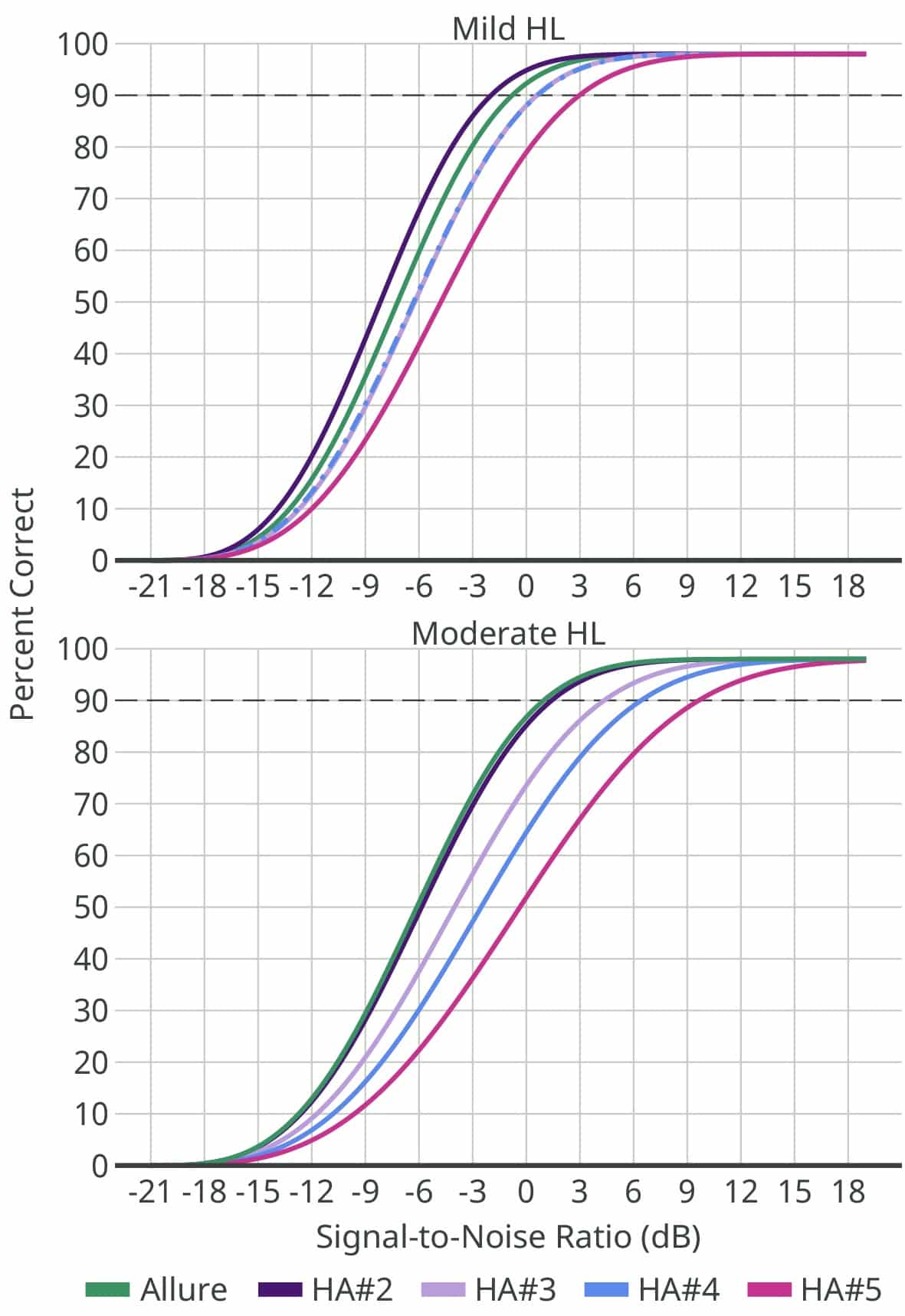
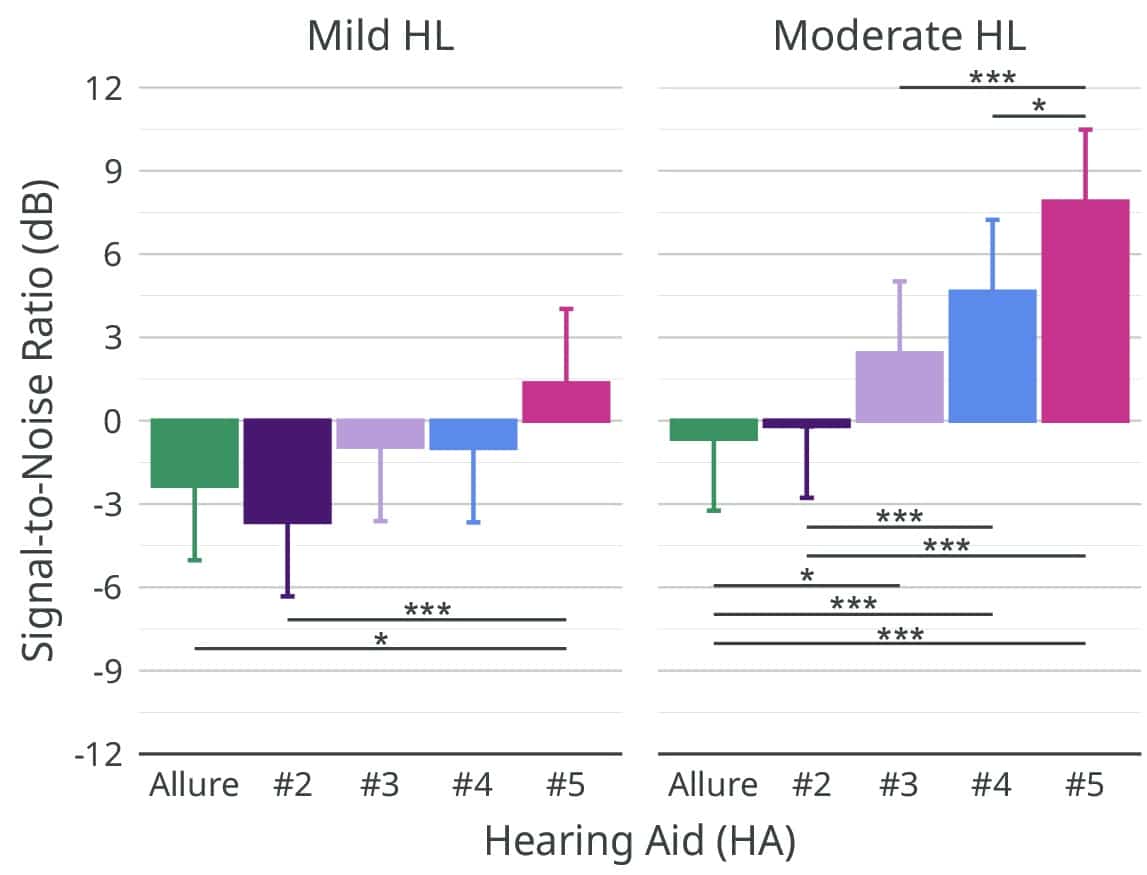
Differences across hearing aids at SRT90 were more evident in the Mod HL group compared to the Mild HL group (Figure 3). Notably, in the Mod HL Group, Allure and HA#2 did not differ significantly from one another. Allure outperformed all other hearing aids except HA#2 by an average of 5.2 to 8.5 dB in this study. In the Mild HL group, Allure and HA#2 did not differ from each other. Allure significantly outperformed HA#5 by 3.6 dB.
Individual Word Scores (In Noise) at the Fixed SNR for SRT90
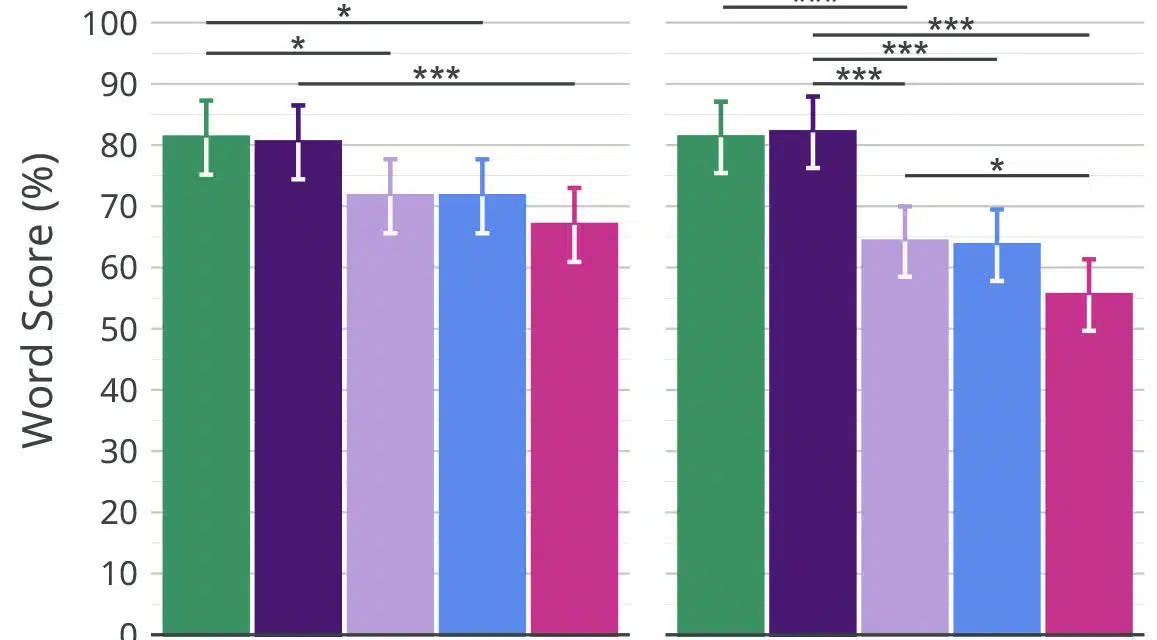
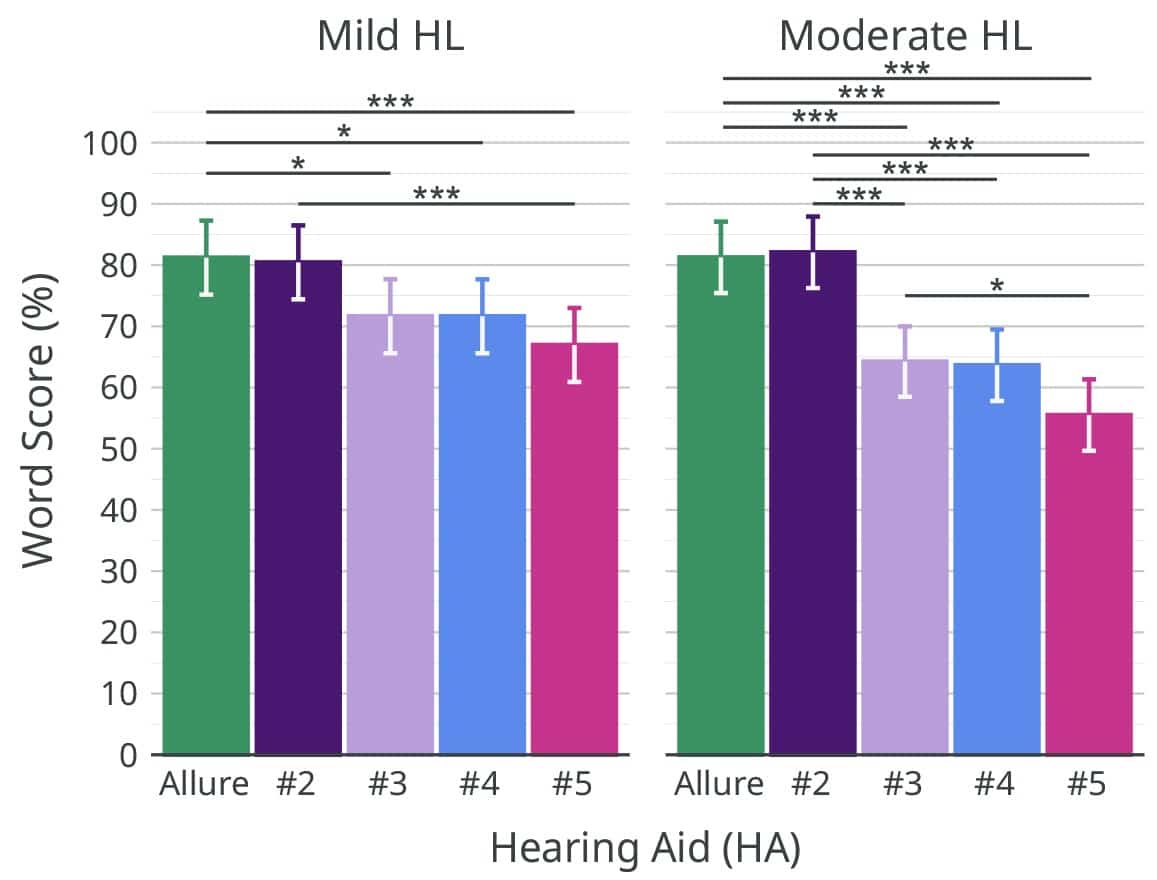
The individual listener’s word identification performance was measured at SRT90 for the best performing device. Allure and HA#2 did not differ significantly from one another in either HL group (Figure 4). Allure outperformed hearing aids HA#3, HA#4, and HA#5 by an average of ≈10–14% in the Mild HL group and ≈18–26% in the Mod HL group.
DISCUSSION
The Widex Allure RIC R D and HA#2 showed significantly better speech‑in‑noise performance than the other DNN‑based devices (HA#3–HA#5). Because all devices except Widex Allure RIC R D use DNN as a noise mitigation strategy, these findings support our belief that natural processing in the Allure can be as effective, if not more effective than, DNN-based noise processing. In a way, these findings challenge the notion that the current generation DNN‑based devices are inherently superior to non‑DNN options tested under the current test setup.
This highlights the need for clinicians to look beyond the inclusion of DNN technology when estimating a hearing aid’s efficacy in speech-in-noise management. Instead, they should understand the pros and cons of the technology as they relate to user benefits and examine the efficacy data that supports the feature.
The vast differences in measured speech-in-noise performance among the five study hearing aids (as much as 8.5 dB at SRT90) suggest that there is a real, meaningful difference in speech-in-noise ability amongst today’s premium hearing aids. This highlights the importance of conducting speech-in-noise testing during clinical hearing‑aid fittings to select the device that delivers the best performance for an individual.
The test setup in the current study was designed to simulate real‑world group conversations with multiple talkers in realistic and challenging noise background representing everyday listening demands. We selected SRT90 as the lowest SNR at which realistic and meaningful communication occurs. For Allure and HA#2, the average SRT90 values across all listeners was -1.7 dB. Because meaningful real‑world communication situations rarely involve SNRs that are < 0 dB (Smeds et al., 2015), these SNRs reflect some of the most demanding noise conditions a listener is likely to face and therefore approximate real‑life performance. The remaining hearing aids (HA#3–HA#5) showed higher SRT90 values (0.8–4.7 dB), suggesting noticeably poorer real‑world performance.
Listeners with a milder hearing loss typically have fewer auditory‑resolution challenges than those with more hearing losses. Thus, we would expect poorer aided performance in the moderate than in the mild hearing loss group. However, word‑recognition scores for Allure and HA#2 were similar across mild and moderate groups (about 80%). In contrast, HA#3–HA#5 showed poorer performance in the moderate than in the mild group (60% vs. 70%). This suggests that Allure and HA#2 likely offer even more benefit to those with a moderate loss than the other study devices.
DNN‑based speech‑in‑noise systems vary substantially in their designs, which affect how well they generalize across listening environments. Models trained on limited or less diverse datasets may perform poorly in acoustic conditions not included in the training data. Therefore, results from one DNN system cannot be assumed to generalize to other DNN solutions or test conditions. Notably, this study found that a non‑DNN strategy focused on preserving natural speech cues performed favorably with the major DNN‑based noise‑management systems.
CONCLUSION
The sound design philosophy used in the development of Widex Allure relies on maintaining the naturalness of the sound that aligns with auditory system’s natural expectations. It outperformed most other flagship DNN-based hearing aids in speech-in-noise performance measured in the current study.
Petri Korhonen, MSc (tech), is a principal research scientist; Francis Kuk, PhD, is the director; and Christopher Slugocki, PhD, is a senior research scientist at the WS Audiology Office of Research in Clinical Amplification (ORCA) in Lisle, Ill.
Original citation for this article: Korhonen P, Kuk F, Slugocki C. Comparing natural processing and AI approaches in speech-in-noise performance. Hearing Review. 2026;33(3):15-17.
Featured image: Widex
REFERENCES
Balling LW, Mosgaard LD, Helmink D. Signal processing and sound quality. Hearing Review. 2022;29(2):20-23.
Balling LW, Townend O, Helmink D. Sound quality for all: The benefits of ultra-fast signal processing in hearing aids. Hearing Review. 2021;28(9):32-35.
Balling LW, Townend O, Stiefenhofer G, Switalski W. Reducing hearing aid delay for optimal sound quality: a new paradigm in processing. Hearing Review. 2020;27(4):20-26.
Best V, Ozmeral EJ, Kopco N, Shinn-Cunningham BG. Object continuity enhances selective auditory attention. Proc Natl Acad Sci USA. 2008;105(35):13174-8.
Holube I, Fredelake S, Vlaming M, Kollmeier B. Development and analysis of an International Speech Test Signal (ISTS). Int J Aud. 2010;49(12):891-903.
Korhonen P, Kuk F, Slugocki C, Peeters H. Less is more – Optimizing the dynamic range of hearing aid output. Hearing Review. 2025;October.
Korhonen P, Slugocki C, Ellis G. Low processing delay preserves natural cues and improves spatial perception in hearing aids. Hearing Review. 2022;29(6):20-25.
Korhonen P, Slugocki C, Kuk F, Peeters H. Impact of hearing aid processing delay on stop consonant voicing perception in open fittings. Am J Aud. 2024;33(3):932-941.
Kuk F. Rationale and requirements for a slow acting compression hearing aid. Hearing Journal. 1998;51(6): 45–53.
Kuk F, Keenan D, Lau C-C, Ludvigsen C. Performance of a fully adaptive directional microphone to signals presented from various azimuths. J Am Acad Aud. 2005;16(6):333-47.
Kuk F, Lau C-C, Korhonen P, Crose B. Speech intelligibility benefits of hearing aids at various input levels. J Am Acad Aud. 2015;26(3):275-288.
Kuk F, Seper E, Lau C-C, Korhonen P. Tracking of noise tolerance to measure hearing aid benefit. J Am Acad Aud. 2017;28(8):698-707.
Kuk F, Slugocki C, Korhonen P, Seper E, Hau O. Evaluation of the efficacy of a dual variable speed compressor over a single fixed speed compressor. J Am Acad Aud. 2019;30(7):590-606.
Lelic D, Stiefenhofer G, Lundorff E, Neher T. Hearing aid delay in open-fit devices: Preferred sound quality in listeners with normal and impaired hearing. JASA Express Letters. 2022;2(10):104803.
Ludvigsen C, Tøpholm J. Fitting a wide range compression hearing instrument using real ear threshold data: A new strategy. Hearing Review. 1997;2:37-39.
Nasreddine ZS, et al.. The Montreal Cognitive Assessment, MoCA: A brief screening tool for mild cognitive impairment. J Am Geriatr Soc. 2005;53(4):695-699.
Peelle JE. Listening Effort: How the cognitive consequences of acoustic challenge are reflected in brain and behavior. Ear Hear. 2018;39(2):204-214.
Peeters H, Kuk F, Lau C, Keenan D. Subjective and objective measures of noise management algorithms. J Am Acad Aud. 2009;20(2):89–98.
Slugocki C, Kuk F, Korhonen P. Development and clinical applications of the ORCA Repeat and Recall Test (RRT). Hearing Review. 2018;25(12):22-26.
Slugocki C, Kuk F, Korhonen P. Hearing aid delay: Two /i/ or not two /i/? Hearing Review. 2023;30(9):14-16.
Slugocki C, Kuk F, Korhonen P, Peeters H. The Intelligibility-based Repeat-Recall Test (i-RRT): I. Bayesian-guided estimation of multiple speech reception thresholds (ezSRT). 2026;In review.
Slugocki C, Kuk F, Korhonen P, Ruperto N. Neural encoding of the stimulus envelope facilitated by Widex ZeroDelay technology. Hearing Review. 2020;27(8):28-31.
Smeds K, Wolters F, Rung M. Estimation of signal-to-noise ratios in realistic sound scenarios. J Am Acad Aud. 2015;26(2):183-196.
Sohoglu E, Peelle JE, Carlyon RP, Davis MH. Predictive top-down integration of prior knowledge during speech perception. J Neurosci. 2012;32(25):8443-8453.
Stiefenhofer, G. Hearing aid delay in open-fit devices–coloration-pitch discrimination in normal-hearing and hearing-impaired. Int J Aud. 2023;62(5):424-432.
Windle R, Dillon H, Heinrich A. A review of auditory processing and cognitive change during normal ageing, and the implications for setting hearing aids for older adults. Front Neurol. 2023;14:1122420.
Zhou M, Soleimanpour R, Mahajan A, Anderson S. Hearing aid delay effects on neural Phase locking. Ear Hear. 2024;45(1):142-150.
Ziegler J, Balling L, Helmink D. The importance of natural sound for hearing aid users and clinicians. Hearing Review. 2024;31(6):20-23.