Building Patient Connections
Building strong patient connections in hearing care through a holistic approach and personalized recommendations enhances trust and leads to better outcomes.
Now that the OTC has gone into effect, press releases spotlighting new hearing care partnerships and hearing devices have become ubiquitous.
We need to celebrate the victories when we can. The progress made in creating awareness about the links between diabetes and hearing loss has been impressive.
Unless you’ve been locked in your soundbooth for the past three years, you’re probably well aware that a new class of over-the-counter (OTC) hearing aids will get the green light from the US Food and Drug Administration (FDA) sometime around August 2020, with the notice of proposed rulemaking (NPRM) slated for this November.
Read MoreIn a series of videos, the “Hear Well. Stay Vital.” campaign shows the importance of hearing health to pursuing and staying engaged with activities that ignite your passion, such as dance, music, or enjoying grandchildren.
Read MoreIf the inquisitive individual starts asking about the why of his/her hearing loss—the actual physical reasons and possible proof—and what anatomical structures are involved (and/or by how much), I’m afraid most dispensing professionals necessarily resort to studious equivocation. Although important strides have been made, routine differential diagnosis remains something of a chimera when it comes to hearing loss.
Read MoreIt doesn’t seem possible, but “The Hearing Review” turned 25 years old in January. If someone had told me in November 1993 that I’d be writing about hearing healthcare 25+ years later, I would have been very skeptical.
Read MoreHearing aid net unit sales in the United States increased by 6.2% in the third quarter (Q3) compared to the same period last year, according to statistics generated by the Hearing Industries Association (HIA), Washington, DC.
Read MoreOn October 5, the FDA granted De Novo status to Bose Corporation for a self-fitting hearing aid for mild-to-moderate hearing loss.
Read MoreNow that we’ve defined (at minimum) what an OTC hearing device should look like, maybe it’s time to start defining a minimal standard for what a professional hearing aid fitting should look like.
Read MoreAdvocacy and involvement on behalf of your profession can be as important as updating your clinical skills, should one day you awaken to find that you do not have the appropriate professional representation for your profession.
Read MoreDepression and its connection to hearing loss seems pretty logical and self-evident, especially if you’re a dispensing professional who experiences daily the difference that amplification can make in a person’s life. However, new research indicates the story is far more complex.
Read MoreAudiology and neuroscience have the potential to radically change the future of healthcare.
Read MoreIt’s possible we will see more major M&As and “Industry Consolidation, Act 2” in the next several years.
Read MoreThose practices with larger gross revenues have the critical mass to leverage their advantages in an increasingly competitive market.
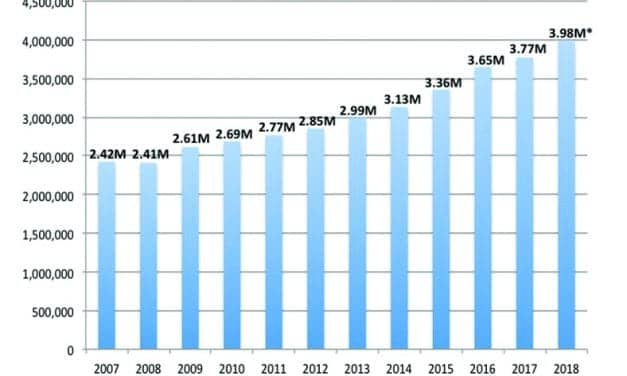
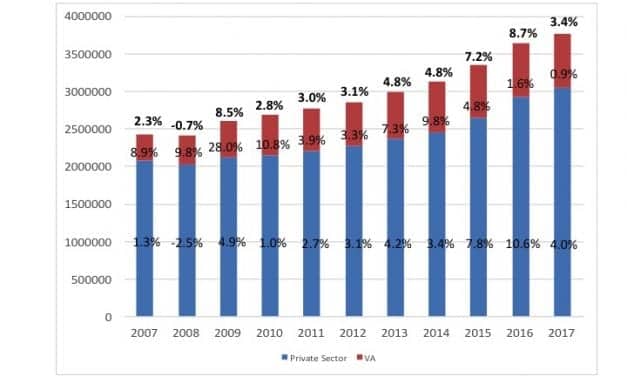
Read MoreHearing aid net unit sales in the United States grew by 3.4% in 2017, with a 4.0% growth rate for the commercial/private sector and 0.92% for the Department of Veterans Affairs (VA), according to statistics generated by the Hearing Industries Assn (HIA), Washington, DC.
Read MoreIt was a wild year, but that’s good in the publishing world because there was never a lack of great information.
Read MoreIn the third quarter of 2017, private sector unit sales of hearing aids increased by 2.8%, VA dispensing fell by 1.3%, and the total market gained 2.0% in unit volume compared to the same period last year.
Read More