Hearing Loss Test Checks Eyes Instead of Ears
A new hearing test measures how a patient’s pupils involuntarily change size in response to sound.

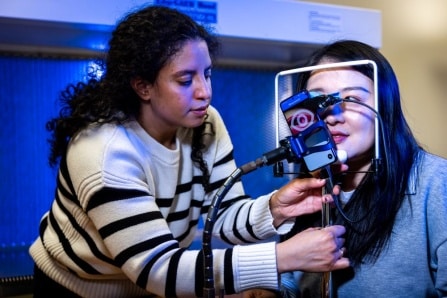
A new hearing test measures how a patient’s pupils involuntarily change size in response to sound.
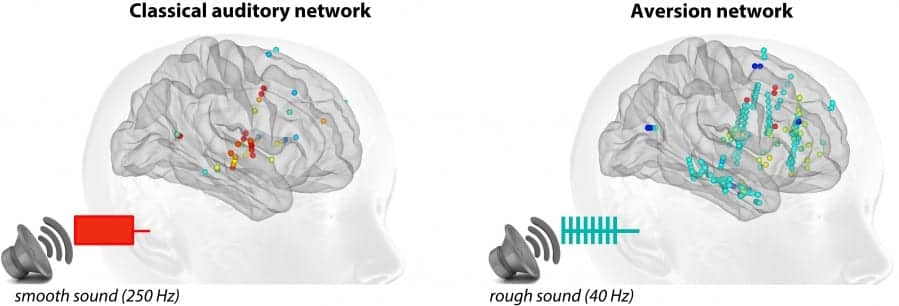
Neuroscientists from the University of Geneva (UNIGE) and Geneva University Hospitals (HUG), Switzerland, have been analyzing how people react when they listen to a range of different sounds, the aim being to establish the extent to which repetitive sound frequencies are considered unpleasant





Is the connection between sensory impairment and cognitive decline linear, with one health concern leading to the other, or is it cyclical, reflecting a more complex connection? AGS-NIA conference attendees think answers to these questions are critical, which is why their conference report maps the state of sensory and cognitive impairment research while also outlining important priorities for future scholarship and clinical practice.


The new condition is called recurrent spontaneous vertigo with head-shaking nystagmus.
Read More
Hearingbenefit.com is the company’s dedicated direct-to-consumer website store, which is designed to complete the purchase phase for the consumer.
Read More
A look at seven chronic conditions associated with hearing loss—ranging from depression to diabetes—along with a review of some of the key supporting scientific evidence and papers.
Read More
The Medicare Hearing Aid Coverage Act addresses one piece of the puzzle by improving access to hearing aids and related examinations.
Read More
These potentially modifiable risk factors—including hearing loss—have been identified at multiple phases across the lifespan, not just in old age. The ‘Lancet’ Commission’s report was simultaneously published in ‘The Lancet’ and presented at AAIC 2017.
Read More
The researchers found evidence to suggest a link between hearing loss and mild cognitive impairment, a condition that can precede the onset of dementia.
Read More
According to a report on NPR, Americans are getting Alzheimer’s and other dementia at a declining rate. Researchers say more aggressive treatments of co-morbidities and higher education in the population are factors.
Read More
September is World Alzheimer’s Month, and September 21 is World Alzheimer’s Day — a good opportunity to raise awareness of connections between memory, cognitive function, and hearing loss.
Read More
Can you imagine a drug that would sharpen memory, make it easier to learn a language, and help those with dementia and Alzheimer’s disease by rewiring the brain and keeping neurons alive? A new Rutgers study indicates that a cancer drug may have the potential to achieve these outcomes.
Read More