From building rapport to leveraging technology, HCPs share creative strategies to keep kids engaged for successful pediatric testing.
By Melanie Hamilton-Basich
Conducting pediatric hearing tests requires a unique blend of clinical skill and creative improvisation. The most accurate diagnostic equipment is only as effective as the clinician’s ability to gain a child’s cooperation, a task that can be complicated by short attention spans, anxiety, and developmental differences. For hearing care professionals (HCPs), success often depends on transforming a clinical procedure into an engaging game, a challenge that changes with every child who walks through the door.
This means that a pediatric hearing assessment is often less about rigid protocols and more about dynamic, responsive care. The ability to pivot, adapt, and connect with a young patient on their own terms is paramount. It involves reading subtle cues, drawing from a wide variety of games and distractions, and understanding that the first few minutes of an appointment can set the tone for the entire session.
“The more you’re their new best friend, the more they’re going to want to please you, the more cooperative they’ll be,” says Amanda Goodhew, MSc, BSc (Hons), an international clinical trainer at Interacoustics Academy who focuses on pediatric audiology. This emphasis on relationship-building before testing begins is a cornerstone of effective pediatric care. Ashley Ervin, AuD, a pediatric audiologist at Atrium Health Wake Forest Baptist Health in Winston-Salem, N.C., frames it as a simple, guiding philosophy: “The first thing that we really try to do is just meet our patients where they’re at.”
Building a Foundation of Trust
According to Goodhew, the most critical work can happen before a child even enters the sound booth. She advocates for taking five minutes at the start of an appointment to build rapport. “It’s not the time to be trying to force them to do otoscopy and look in their ears or worry too much about the history,” she says. “Actually get to know them, get them to feel safe, build that friendship.” This initial interaction allows the HCP to observe the child’s temperament and abilities, such as their dexterity with certain toys or their comfort level with having their ears touched.
This preparation can even begin before the appointment. A brief call with parents can uncover valuable information about a child’s interests, as well as any potential fears or negative triggers. “If they hate dogs, don’t show them dogs,” Goodhew notes. “Being able to identify positive and negative triggers is a really, really useful thing.”
Ervin puts this principle into practice daily. She recalls an appointment with an older child on the autism spectrum who was upset in the lobby and ready to leave with his grandmother. Ervin followed them to the parking lot and learned that the boy was interested in toilets. By starting a conversation about his interest, she was able to build a connection, make him feel comfortable, and successfully complete a full audiogram. “After I made that connection, he was very comfortable,” Ervin says. “We were just calm and had a conversation and I was very upfront…telling him all the things I was going to do before I did it.”
This approach is especially important for children who are sensitive to touch. Rather than starting with otoscopy or placing headphones on their heads, Ervin will first gather information from the family, identify what motivates the child, and begin with testing that doesn’t require physical contact, saving more invasive procedures for the end of the appointment. In one case, a child was uncomfortable being touched by a clinician. The team adapted by popping the headphones off the headband and having her father hold them to her ears. “That way she felt comfortable with him, and we were still able to get what we needed,” Ervin says.
Utilizing A Modern Toy Box
The engagement strategies required for behavioral testing vary significantly by age and developmental stage. Visual reinforcement audiometry (VRA) for younger children is about passive engagement, where the goal is to keep their attention centered with a simple toy so a sound stimulus can successfully draw their head to the side. In contrast, conditioned play audiometry (CPA) for older children requires active engagement, where the child must listen for a sound and perform a task. Playful props need to be available to accommodate this wide range.
Therefore, a well-curated and diverse set of toys is one of the most powerful assets in a pediatric audiology clinic. Relying on a single type of toy can be a significant limitation.
Different game structures appeal to different children. For example, a game of throwing blocks into a tub can feel endless, which works well for some children who enjoy the repetition. “But for other kids, they might get a little frustrated by that and be like, when are we going to change it up? What’s the end target?” Goodhew says. For these children, a task with a clear endpoint, like building a tower, provides a sense of satisfaction and a visible goal. The trade-off is that once the goal is reached, the game is over, and the clinician must be ready with a new activity.
Ervin’s clinic uses a range of creative CPA tasks. For older children, she turns the classic ball-in-a-bucket game into a more dynamic activity. “I usually will hold the bucket in different positions, like around myself and around the child and kind of encourage them to shoot it like a basketball,” she says. “They have a lot of fun.” Another popular activity that Ervin recently came up with involves making friendship bracelets. “Every time that they hear a sound, we’ll take a bead and put it on an elastic band,” she says. “They’re able to make a bracelet and then take something home with them as a reward.”
A particularly useful category of toys for children who are developmentally transitioning to CPA are cause-and-effect toys. These are toys that perform an action—like lighting up, spinning, or shooting across a table—when the child presses a button. “When they hear the sound, they press a button and the toy does something,” Goodhew says. “It’s like a kind of halfway house between conditioning and doing standard play audiometry.” This immediate, dynamic reward can be more motivating than simply putting a peg in a board.
For VRA, the challenge is finding a distractor that is more interesting than the world around them but less interesting than the sound and visual reward. Ervin’s clinic uses items like pop-it toys, books, and glitter-filled water wands to keep children’s attention focused forward. “We try to keep them as distracted as possible and as happy as possible without keeping them too distracted,” she says.
Leveraging Technology for Engagement
In addition to physical toys, technology offers a vast and customizable array of tools for engagement. The shift from traditional light-up puppet reinforcers in VRA to video screens has been a significant development over the past couple of decades.
Goodhew is a strong proponent of having both options available. While the classic puppets can still be magical for some children, screens offer nearly infinite variety. “You can constantly have something new appearing rather than just using two or three puppets and cycling through the same ones for the whole test,” she says. This ability to introduce novel reinforcers is supported by research showing that it can rekindle a child’s interest when they start to habituate.
Screens also allow for personalization. If a clinician learns that a child loves Peppa Pig, they can use clips from the show as a highly motivating reward. For very young infants or children with complex needs or visual impairments, high-contrast black-and-white images can be particularly effective. Another benefit is the physical setup can be adapted. Goodhew suggests having screens on movable arms or stands that can be brought closer to the child. “An 8-month-old can’t focus that far away,” she notes. “We need to work with that.”
For older children who are not quite ready for standard button-pushing audiometry, Ervin’s clinic has developed what they call “the video game.” It is a PowerPoint presentation with animations from popular movies and TV shows. The child hits a large button when they hear a sound, and the
tester advances the slide to show a rewarding animation on a monitor inside the booth.
For more objective tests like otoacoustic emissions (OAEs) or tympanometry, which require the child to be still and quiet, technology can be a lifesaver. Ervin often uses a tablet to play a child’s favorite movie. “Usually if we explain what we need to do… they say yes,” she says, regarding parental consent for screen time. “Because ultimately the goal is they don’t want to come back, especially if they have normal hearing.”
Adapting in the Moment
Even with the best preparation, HCPs must remain flexible. A child who is engaged one moment can become distracted or uncooperative the next. Recognizing the signs of over-distraction—such as fixating on a toy and no longer performing the task—is crucial. When this happens, Ervin’s strategy is to gently remove the distracting toy and redirect the child with something less absorbing, like a book.
For fidgety children, sensory tools can be effective. Ervin’s clinic has found success with Silly Putty. “It used to be really popular in the early 2000s and now no one knows what Silly Putty is,” she says. “We use that for our kiddos that just cannot keep their little bodies and hands still.” Goodhew agrees, noting that modern sensory toys like fidget spinners and slime can also work wonders to keep children captivated and grounded. “Keeping up with what these kids know in the real world is really important,” she says.
Incorporating breaks is another simple but powerful technique. When a child rips their headphones off, Ervin will take them and sing a song about taking a short break. “We’re going to have a five-second break. Are you ready?” she’ll sing. Giving children a moment to stand up, dance, or “get their wiggles out” before resuming the test can reset their focus and cooperation.
Technology can also assist, particularly during objective tests that require a child to be still and quiet. For otoacoustic emissions (OAEs) or tympanometry, some devices feature on-screen animations, like a rainbow appearing as a test progresses. Ervin’s clinic uses an Amazon tablet to play a child’s favorite movie. She always asks for parental permission first, explaining why the test is important and how a brief period of screen time can help obtain the necessary information. “I have yet to have a parent say no,” she says.
Ultimately, the goal of pediatric audiology is to gather as much reliable information as possible, but experienced clinicians know that some days will be more productive than others. The key is to remain patient, creative, and accepting of the situation. “I feel like the longer that you do this, the more you learn what works and what doesn’t,” Ervin says. “And I also think it’s OK to accept that sometimes you’re just not going to get what you want to get that day. And that’s OK.”
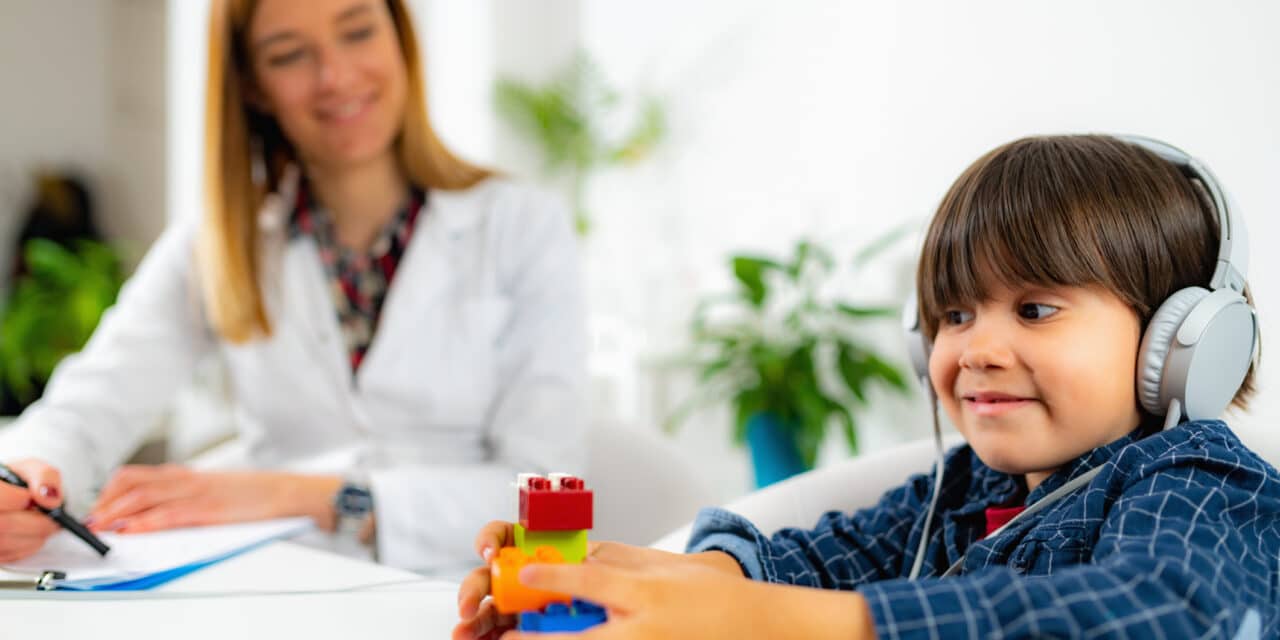
Featured image: A well-curated and diverse set of toys is one of the most powerful assets in pediatric audiology. Different tests require different types of engagement, and some children prefer certain toys and games over others. Photo: ID 206154509 © Microgen | Dreamstime.com