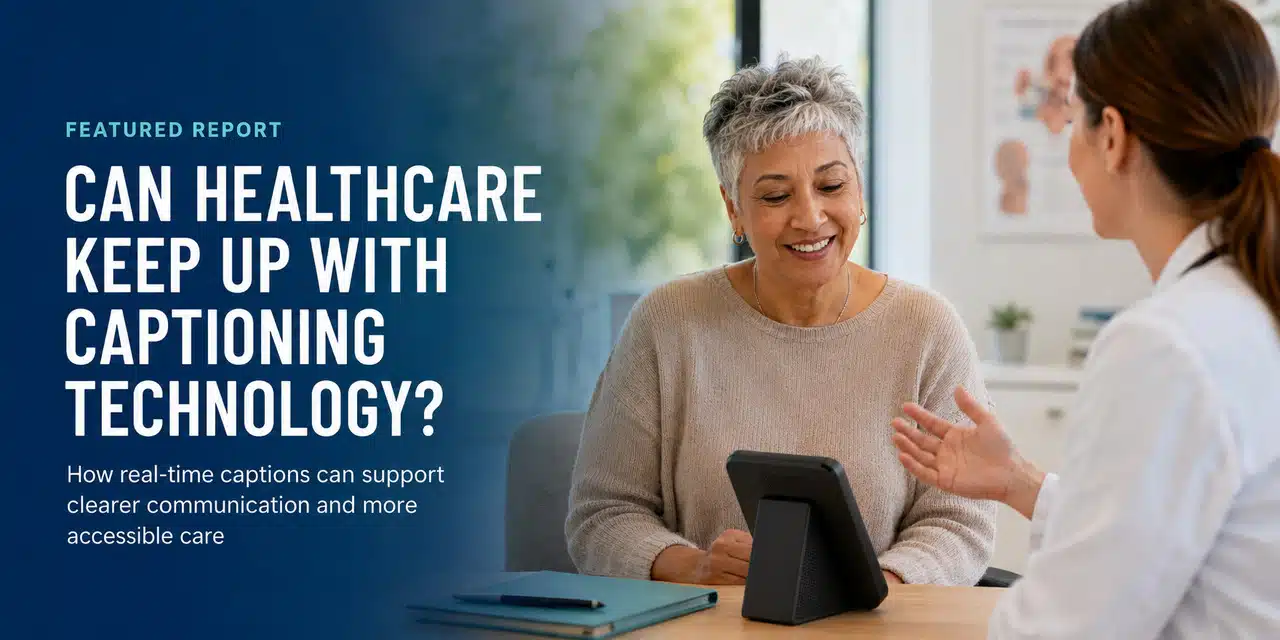
Communication Barriers Can Affect Every Stage of Care
Clear communication is fundamental to safe, effective healthcare. Yet many patients with hearing loss still encounter barriers when scheduling appointments, discussing treatment options, participating in telehealth visits, and navigating fast-paced clinical environments.
Real-Time Captions Can Improve Understanding and Confidence
Advances in real-time captioning, speech recognition, mobile applications, and wearable technology are creating new ways to close these communication gaps. When patients can both hear and read what is being said, they may experience less anxiety, retain more important medical information, and participate more fully in decisions about their care.
Hearing Aids May Not Be Enough in Complex Healthcare Settings
Even well-fitted hearing aids may not provide sufficient support in noisy waiting rooms, emergency departments, telephone conversations, or virtual appointments. Captioning can complement amplification by giving patients another way to follow conversations and verify critical details.
Explore Captioning Across the Healthcare Journey
This featured report examines the evolving role of captioning throughout the healthcare experience—from the physician’s office and emergency department to telephone calls and virtual appointments. It also explores how hearing care professionals can help patients identify communication tools that fit their individual needs.
What You’ll Learn
In this featured report, you’ll discover:
- How real-time captioning can improve comprehension, recall, and informed consent
- Why communication accessibility remains inconsistent across healthcare settings
- How captioning can complement hearing aids in noisy or complex listening environments
- The role of captioned telephone services in telehealth and routine patient communication
- How word-recognition and speech-in-noise testing can help identify patients who may benefit
- Practical ways clinicians can improve captioning accuracy and communication accessibility
- Why hearing care professionals should discuss captioning options more frequently with patients
Help Patients Become More Active Participants in Their Care
Download the featured report to learn how today’s captioning technologies can help people with hearing loss communicate more confidently, understand critical health information, and remain active participants in their care.
Sponsored by

Medqor is committed to protecting and respecting your privacy. We may contact you about our products and services or share information with sponsorship partners, as well as other content that may be of interest to you. By submitting your information, you consent to us contacting you for this purpose in accordance with our privacy policy.
For further information, please check out our privacy policy here