Running hearing care practices today requires a balancing act to provide optimum patient care with only so many hours in the day, especially as many audiology organizations grow larger and more complex, requiring new levels of standardization, visibility, and governance.
With this in mind, The Hearing Review’s chief editor, Melanie Hamilton-Basich, sat down with Kurt Bager, CEO of Auditdata, to talk about how the company’s modular, end-to-end software ecosystem provides solutions to help hearing care organizations operate more efficiently while improving clinical quality and patient outcomes.
To start off, is there an inspiration or guiding principle that you bring to Auditdata, and how does it inform the direction of the company?
I have spent most of my career at the intersection of healthcare, technology, and business operations. Before joining Auditdata, I worked extensively with companies driving digital transformation and data-driven innovation. Audiology appealed to me because it combines profound human impact with a field that still has enormous potential for smarter technology.
My guiding belief—in work and life—is that technology should empower people, not replace them. At Auditdata, that means building solutions that strengthen clinicians, improving patient outcomes, and reducing unnecessary administrative burdens. That philosophy shapes our strategy and our products every day.
From your perspective as the CEO, what defines Auditdata as a company?
Auditdata has been dedicated to audiology for more than 30 years. Our mission is to help hearing care organizations deliver better patient outcomes at scale through intelligent, user-centered technology—especially as clinics grow across multiple locations and face increasing operational and clinical complexity.
We combine deep clinical insight with operational expertise. What sets us apart is our ability to connect the entire patient journey—from initial interest to diagnostics to aftercare—through our integrated suite: Manage, Measure, and Engage.
We see ourselves not simply as a software vendor but as a long-term partner that helps clinics grow, standardize workflows, and deliver consistent, high-quality hearing care.We work closely with multi-location and growing clinic groups, where leadership teams must balance standardization, clinical quality, and operational visibility across every location.

After working with so many audiology businesses, what have you learned about improving clinic operations with technology?
Three lessons stand out:
1. Data must guide decisions. Clinics that use data systematically—to optimize scheduling, follow-ups, marketing, and performance—consistently outperform those who rely on intuition alone.
2. Standardization drives reliability and outcomes. Technology-supported workflows ensure consistent testing, more accurate fittings, less admin time, and better patient experiences.
3. Technology only works when it supports people. Tools must reduce complexity and administrative work—not add to it. Adoption succeeds when technology feels natural and helps clinicians do what they do best.
One clear example of this is guided clinical workflows. As organizations grow, even small variations in how tests are conducted or documented can lead to inconsistent outcomes. By embedding best-practice workflows directly into the software, clinicians are supported step by step without feeling constrained.
This improves reliability, shortens onboarding for new staff, and gives leadership confidence that high clinical standards are being met consistently across every location reducing return rates and increasing efficiency.
From your perspective, are there gaps in current audiology software offerings that Auditdata is designed to fill?
Yes. Many clinics still struggle with issues such as fragmented systems for scheduling, CRM, diagnostics, and documentation as well as limited clinical decision support, where data is captured but not meaningfully utilized.
They may have insufficient business intelligence for multi-clinic oversight and poor integration between clinical and commercial workflows. For many clinics, reimbursement and invoicing processes are still manual and time-intensive, resulting in extended payment cycles and increased cash outlays.
Auditdata’s ecosystem is built to close all of these gaps—unifying workflows, standardizing processes, and turning data into actionable insight.
But the real challenge isn’t a lack of software—it’s a lack of connection between systems.
Why is Auditdata especially strong for multi-clinic operations?
Multi-clinic businesses require consistency, scalability, and visibility—all areas where Auditdata excels. It provides centralized performance insights across all locations, standardized clinical workflows supported digitally, benchmarking and best-practice sharing across teams, end-to-end integration from lead acquisition (Engage) to diagnostics (Measure) to follow-up (Manage), and fast onboarding of new clinics.
Let’s now shift the focus to artificial intelligence. What is Auditdata’s approach to AI today? What can you do right now?
Today, AI is already built into our applications and actively improves daily clinical and operational workflows. Our focus is on practical, reliable AI that reduces administrative effort and enhances the clinician’s effectiveness.
There are many things that AI can do TODAY in Auditdata solutions.
AI Notes is our newest and most transformative feature. It automatically transcribes counseling sessions with patients, extracts key clinical elements, and generates structured documentation, including consultation summaries, journal entries, and patient letters. It also ensures completeness and consistency and saves clinicians significant time and administrative effort.
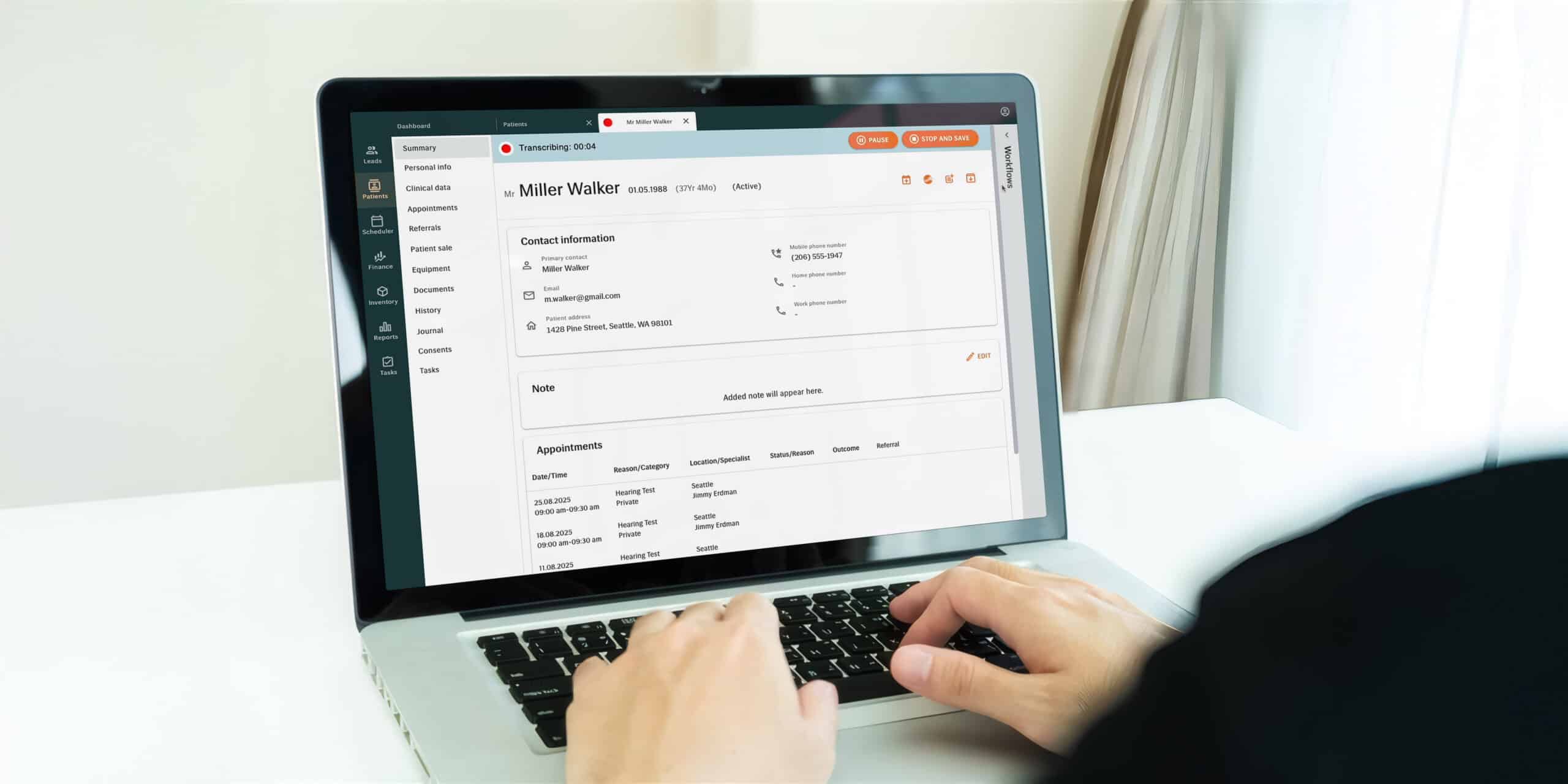
AI-enhanced search technology is another important feature. AI improves search functions throughout our platform, enabling clinicians and staff to find the right data faster and more accurately.
Our AI architecture also supports language-independent data handling, which is critical for global customers and multi-market providers.
When it comes to workflow and decision support (Roadmap), AI provides guidance that reinforces best practices in both our Measure and Manage software offerings.
AI and automation help clinics work more efficiently, but their real value for multi-location organizations is reducing variation, improving oversight, and supporting—not replacing—clinical judgment.
To enhance operational efficiency (Roadmap), AI assists with smarter follow-up suggestions, improved patient retention processes, and more effective operational decision-making.
Technology becomes essential once clinics operate across multiple locations, where manual processes and inconsistent workflows create risk for both leadership and clinicians.
What is Auditdata’s long-term vision for AI?
Our vision looks ahead to fully automated documentation across all parts of the clinic journey and predictive insights for both clinical outcomes and business operations, as well as proactive patient management, enhanced personalization, hybrid care models, and deeper language independence. And importantly, our long-term vision centers around AI-driven decision support that strengthens—not replaces—clinician judgment.
What do you expect the future of audiology operations to look like—and where do you see Auditdata fitting in?
The next decade will bring connected workflows, predictive analytics, automation, and hybrid care. Auditdata aims to be the operating system for modern hearing care, bringing together data, workflow, clinical expertise, and AI-enhanced support into a unified ecosystem.
Data becomes most powerful for enterprise and multi-location clinics, where leadership needs reliable insights across locations to make informed operational and clinical decisions.
Our role is to empower professionals, strengthen clinical outcomes, and ensure clinics thrive in a more data-driven, competitive landscape.
We’re excited about what’s ahead for hearing care organizations that are growing responsibly—especially those navigating the complexity of multi-location operations while staying true to patient-centered care.
SPONSORED BY

Medqor is committed to protecting and respecting your privacy. We may contact you about our products and services or share information with sponsorship partners, as well as other content that may be of interest to you. For further information, please check out our privacy policy here