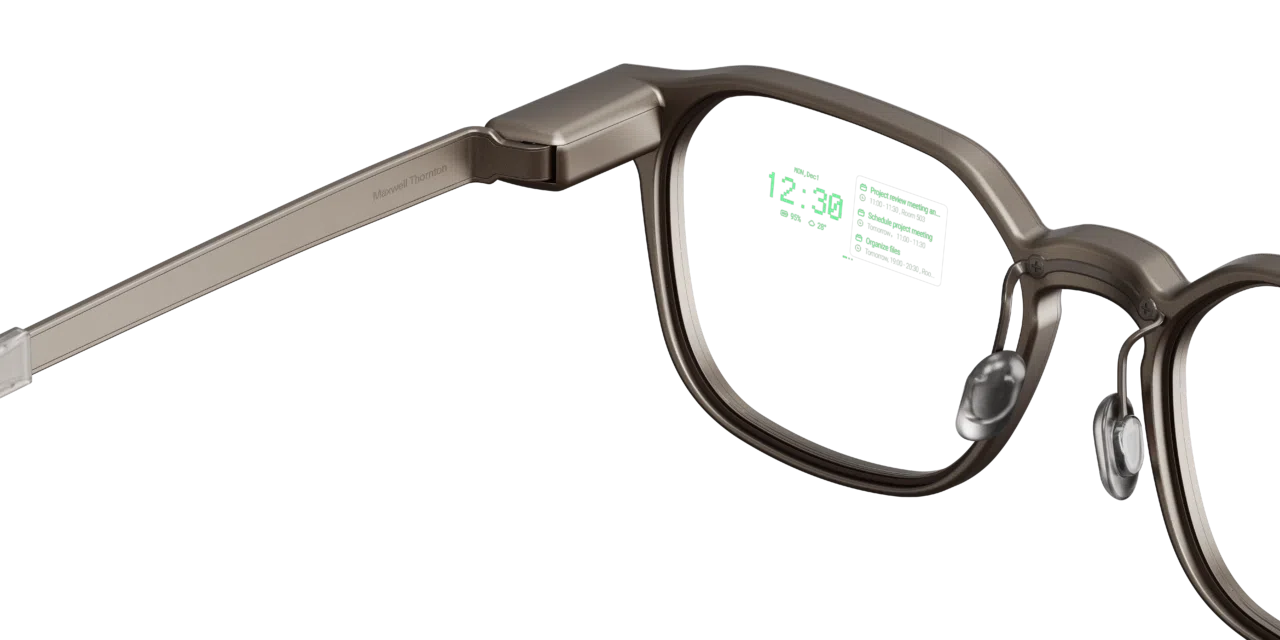
The RayNeo iO Smart Glasses feature a heads-up waveguide display, a 4-mic array with bone conduction sensor, and real-time streaming text translation.
RayNeo, a consumer augmented reality (AR) glasses maker, has announced two new product lines—the RayNeo iO Smart Glasses and the RayNeo GT Series — with both lines going on sale Sept. 4, 2026. For the hearing healthcare community, the iO stands out: it is engineered with an always-on heads-up display designed to deliver real-time captions and live translation directly in the wearer’s line of sight, without any visible screen to outside observers.
Powered by Timekettle BabelOS 3.0, the iO provides real-time streaming text translation across 55 global languages and 109 accents with approximately one-second latency. The feature functions as an ambient captioning layer, surfacing spoken language as scrolling on-screen text through a waveguide display that achieves 97% optical transparency and remains invisible to external onlookers.
This type of wearable captioning technology has drawn increasing attention in hearing healthcare circles.
Microphone Array and Bone Conduction for Noisy Environments
A key engineering consideration for hearing-related use cases is the iO’s audio capture system. The glasses pair a 4-microphone array with a bone conduction sensor that isolates vocal vibrations to improve transcription accuracy in noisy environments. The device includes no speakers — it is designed purely as a visual display and audio capture instrument, making it a potential complement to hearing aids or cochlear implants rather than a competing device.
The 240mAh battery is rated for up to two days of typical usage, 18 hours of continuous recording, or 6.2 hours of continuous translation — a meaningful figure for patients who rely on captioning throughout a full workday.
Ambient AI and Heads-Up Display Specs
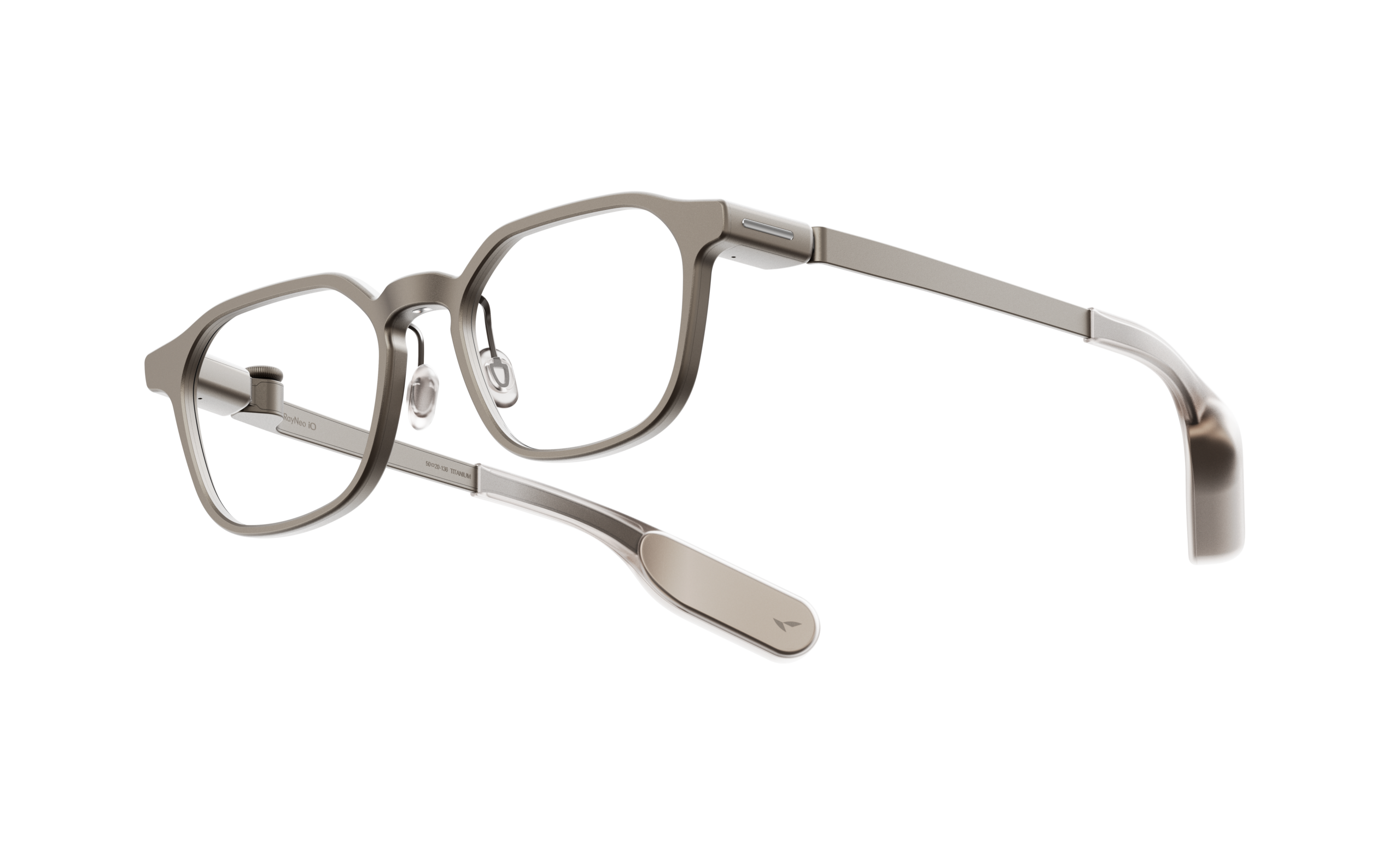
Weighing only 33 grams with a 50:50 front-to-rear weight distribution, the iO frames are constructed from AZ91D magnesium-aluminum alloy and dual aerospace-grade titanium temples. On-screen text reaches 1,300 nits of eye-level brightness, delivered through the Firefly Nano Engine and Blue Lake diffractive waveguide.
Beyond captioning, the Ambient AI Life Log operates in a low-power background mode to capture conversation context, extract action items following meetings, and prompt calendar updates that users can confirm hands-free with a head nod. Core AI features are powered by RayNeo AI and Gemini 3.1 Flash Lite, with an optional tier allowing users to toggle between Gemini, ChatGPT, Claude, and DeepSeek.
The iO also features a hardwired LED status light that illuminates whenever recording or translation modules are active—a privacy-oriented design choice that may be relevant in clinical and professional settings.
Market Position and Distribution
RayNeo holds a 23.7% market share by shipment volume in the global consumer AR smart glasses market, according to Counterpoint Research Q1 2026 data.
“RayNeo iO and the GT Series represent a fundamental commitment to purpose-built spatial hardware,” says Howie Li, founder and CEO of RayNeo, in a release. “Rather than compromising with a single device that tries to do everything, we designed two dedicated experiences: the iO as an invisible, all-day assistant for heads-up productivity, and the GT Series as an uncompromising personal cinema for travel and entertainment. Together, they deliver intuitive tools tailored precisely to how people work and relax every day.”
The RayNeo iO will be available in Polar Night (Dark Grey) and Dune (Gold) colorways via RayNeo’s official website and Amazon store beginning Sept. 4, 2026. Both product lines will be demonstrated at IFA 2026 in Berlin at Hall 21A, Sept. 4–8, 2026.
The RayNeo GT Series, designed for cinematic spatial viewing rather than productivity or accessibility, features a 59-degree field of view, Dolby Vision support, Bang & Olufsen spatial audio, and hardware 3DoF head tracking, with models weighing 68g (GT) and 78g (GT Max).