By Erin M. Picou, PhD; Laura Winther Balling, PhD; and Eric Branda, AuD, PhD
Sound quality is central to hearing aid satisfaction and hearing aid sound design. In a recent study, we found that hearing aid sound quality also affects the daily moods of hearing aid wearers, who showed improved ratings of fatigue, vigor, and esteem-related affect when wearing hearing aids with individually optimized sound quality. This further reinforces the importance of choosing hearing aids with good sound quality and of individualizing the sound to the individual wearer, in order to improve their mood and well-being.
As clinicians, we often focus on audibility and intelligibility for our clients since treatment is meaningless without achieving these. At the same time, it is important to remember that hearing loss and hearing aids affect a much broader range of areas of life than ‘just’ what a person with hearing loss can hear and understand. Both direct and indirect effects of hearing loss may have broad and deep influences on people’s lives.
One important effect of hearing loss is the risk of reduced well-being, both mentally and physically. 1,2,3 One contributor to this may be moods: affective states that are transient but persist for some time, such as experiences of fatigue, satisfaction, or vigor. While moods are typically less intense than emotional responses to specific occurrences, they remain important mediators between what happens in a person’s life and their general well-being. Events shape moods, which shape well-being—a phenomenon both intuitively relatable and backed by research. 4,5
Audiological research on moods has focused mostly on fatigue, especially listening-related fatigue as the result of sustained listening effort. 6,7,8 For the individual person with hearing loss, feelings of listening-related fatigue may be increased by their actual hearing loss, but are likely more influenced by perceivedhearing difficulties.9 In addition to fatigue, both general and listening-related, it is also interesting to consider moods more broadly.
In the study10 we summarize here, we investigated both fatigue and vigor, as well as esteem-related affect, which covers feelings like confidence, competence, and satisfaction 11, focusing on the key hypothesis that hearing aid sound quality affects mood. This question is important because sound quality is a main factor in hearing aid satisfaction 12,13,14 and in hearing aid design 15,16,17, and a relationship between sound quality and mood may be part of the reason why. Moreover, it is possible that previous inconsistent results on the effects of hearing aid provision on mood states like fatigue and vigor 7,18 may be attributable to the sound quality not being sufficiently considered or sufficiently optimized for the individual. In the Widex Sound Philosophy 17, sound quality and naturalness are central to a good life with hearing aids, and the tailoring of the sound to the individual wearer is key to achieving this in reality. Based on this, the study hypothesis was that hearing aid settings that were individually tailored to optimize sound quality would result in better mood at the end of the day.
METHOD
The study used a cross-over design, where a group of experienced hearing aid wearers completed two home trials with the same set of Widex Moment RIC hearing aids: one trial period where the sound quality was optimized to their individual preference and one trial period where the sound quality was worse but tolerable. During both trial periods, participants completed daily questionnaires about their mood and hearing-related experiences.
Sound quality was manipulated by the individual participant who adjusted the hearing aid gain in three frequency bands within the limits set by the Widex Moment app first to create a sound that they found optimal, then a sound that was noticeably worse but still tolerable to wear. This approach of individual adjustment of sound was chosen because sound quality cannot be manipulated at a group level without introducing distortions that are clinically unrealistic, due to the considerable inter-individual variability in sound preferences. 19,20,21
Participants
Thirty experienced hearing aid wearers completed the study. They were aged between 51 and 80 years (median = 74, SD = 6.2) and all had mild to moderately severe bilateral sensorineural hearing loss, with a better-ear mean four-frequency pure-tone average of 40.0 dB HL (SD = 8.9). All participants indicated that sound quality was important for them, mostly for broad reasons of communication and speech understanding.
Procedure
Figure 1 shows an overview of the study procedure. During the first visit, the hearing aids were first fitted to NAL-NL2, before participants constructed two programs by manipulating gain in three frequency bands using the Moment hearing aid app, creating first a personally optimized sound quality, then a worse but wearable sound. While adjustments of up to 12 dB up and down were allowed, in practice adjustments were much smaller, with average absolute changes between 2.7 and 3.3 dB in the different frequency bands. Participants made the adjustments while listening to different recorded scenarios and verified their settings during a short, real-life guided walk. All 30 participants included in the study were able to identify their two programs in a subsequent blind identification test. Three additional participants were unable to successfully complete this identification test and were therefore discontinued from the study. The first visit also included a QuickSIN test to ensure that there were no significant differences in speech intelligibility between the two programs created or between the custom programs and NAL-NL2.
After a cooling-off period of approximately one week (to weaken possible participant expectations about the programs), the study continued with two home trials of approximately one week each, where participants wore their ‘Good’ and ‘Tolerable’ programs. Participants were blinded to which of their two settings they were wearing. Half the sample started with their Good and half with their Tolerable settings.
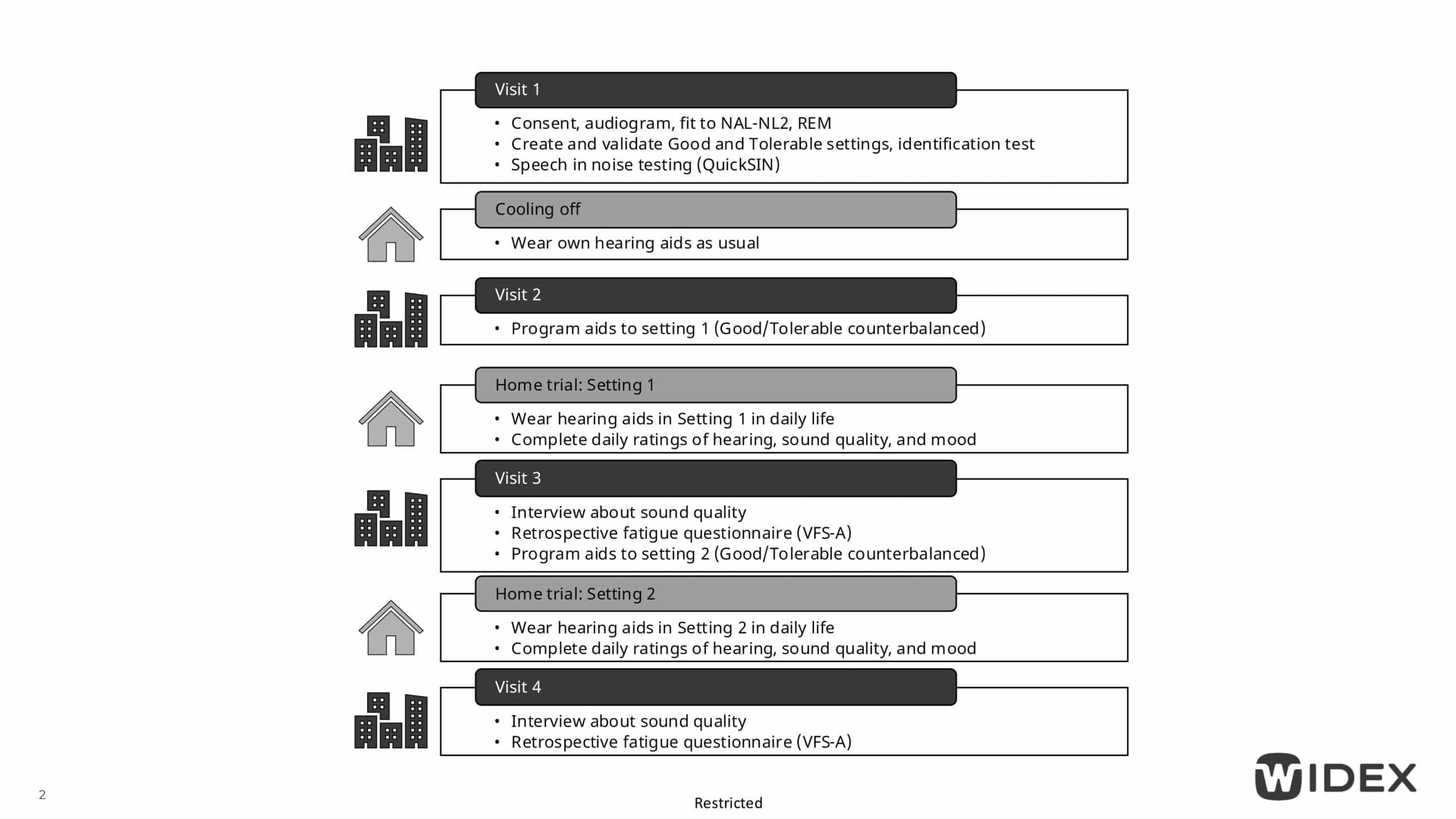
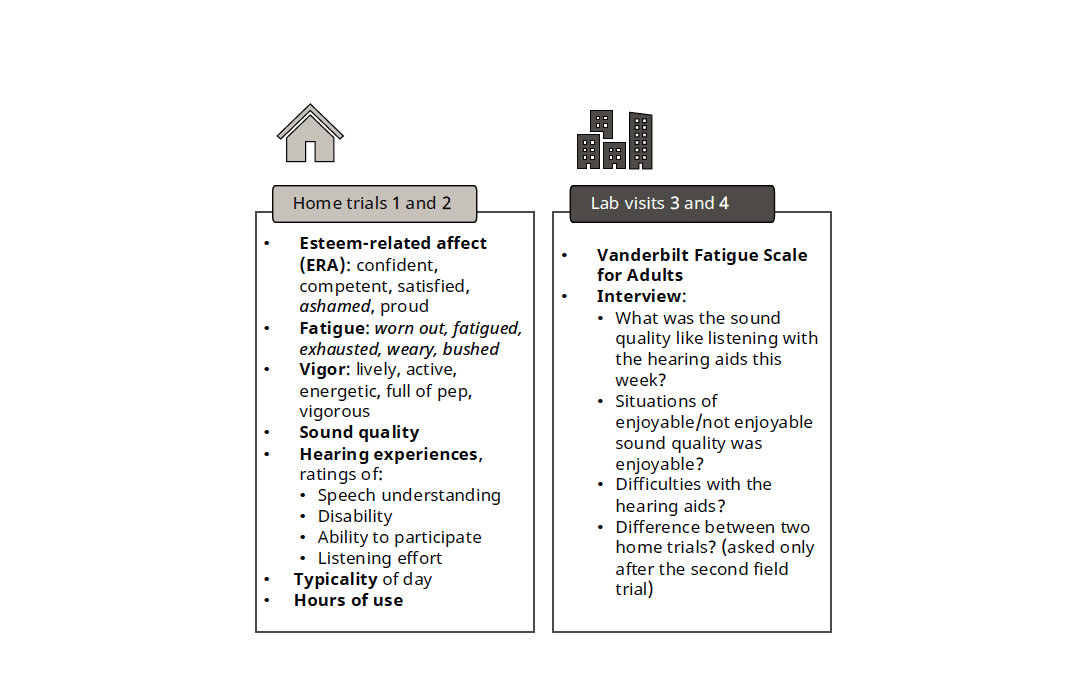
During these home trials, participants completed daily questionnaires about their mood and hearing experiences during that day (see Figure 2). In between the home trials, study visits included an interview about hearing experiences and the brief version of the Vanderbilt Fatigue Scale for Adults (VFS-A22).
Analysis Methods
The primary outcomes of the study were the daily ratings that the participants provided, especially their mood ratings, but also the hearing-related variables. We also considered the weekly ratings of listening-related fatigue, using the Vanderbilt Fatigue Scale. Each of these outcome variables was analyzed using linear mixed models, with random intercepts for participants, to account for the multiple observations for each participant. The models also tested a range of predictor variables, both control variables and variables relating to the key hypotheses concerning sound quality and mood.
RESULTS
The key hypothesis that mood is affected by hearing aid sound quality was confirmed in three ways.
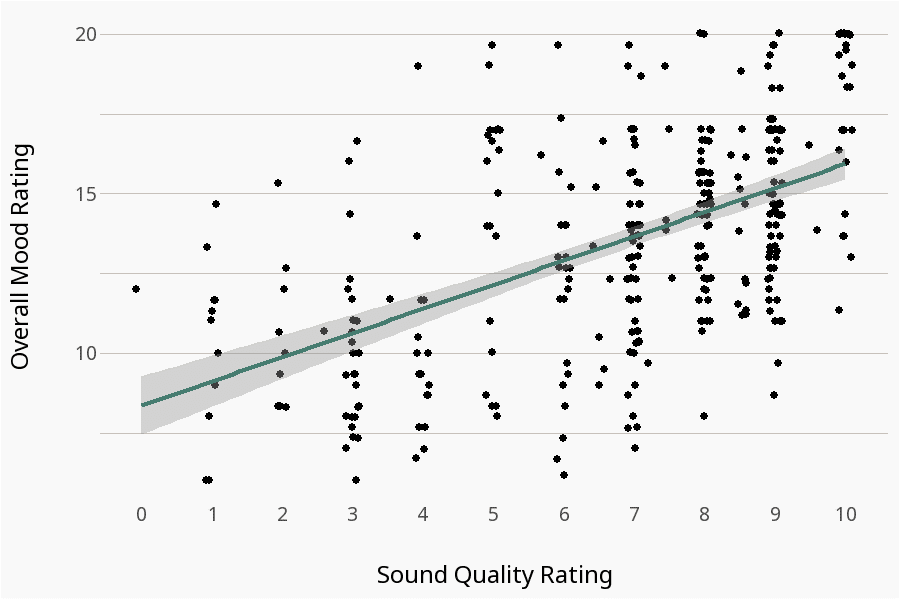
First, the analysis of daily ratings showed a significant positive relationship between ratings of mood and ratings of sound quality, such that mood was rated higher on days where sound quality was also rated highly, as illustrated in Figure 3.
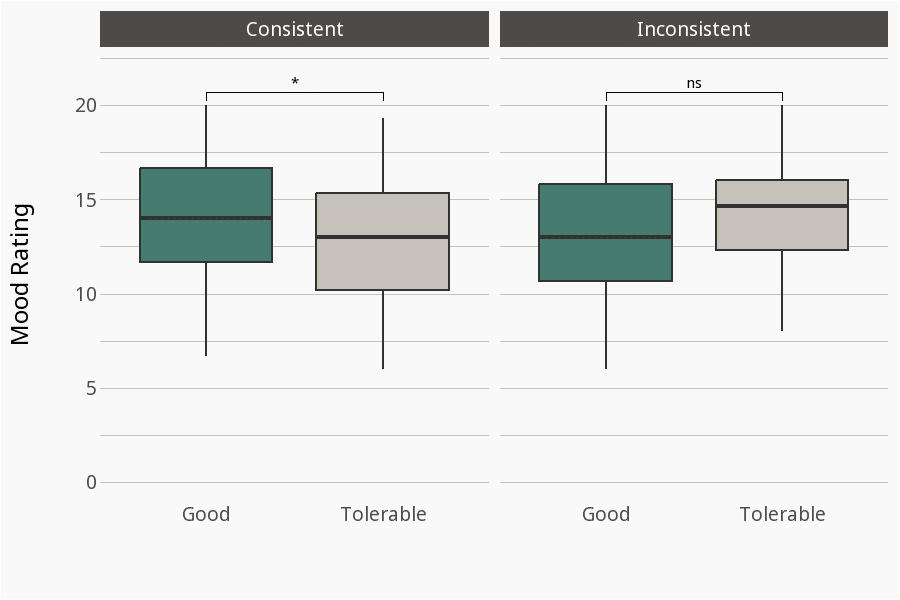
Second, the analysis of the daily ratings also showed better mood during the period where participants wore their Good program. Interestingly, this only applied to participants who were consistent in their program judgment: based on the qualitative interview at the end of the study, participants were categorized into those who preferred their Good program (n = 19 with consistent preference) and those who indicated that they preferred the Tolerable program during the blinded field trial (n = 11 with inconsistent preference). For those with consistent preference, daily mood ratings were significantly higher when they wore their Good program; for those with inconsistent preference, there was a trend toward the opposite pattern, i.e. higher mood ratings when wearing the originally Tolerable but ultimately preferred program. This interaction effect is displayed in Figure 4.
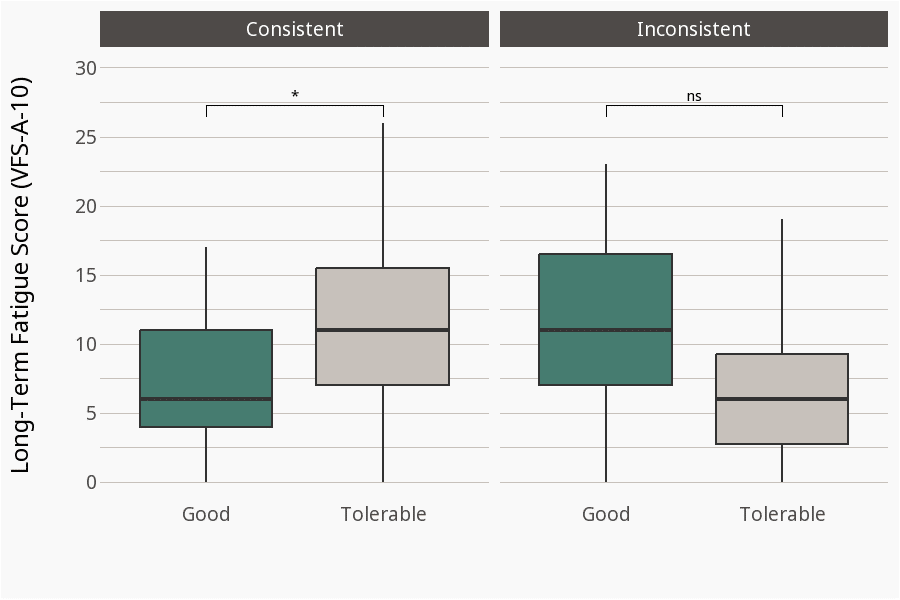
Third, the analysis of the retrospective ratings of listening-related fatigue showed a similar pattern of significantly lower fatigue for the Good program for the participants with consistent preference, and a trend toward lower fatigue for the Tolerable but preferred program of the participants with inconsistent preference, as illustrated in Figure 5. The difference was four points on a 40-point scale, which is comparable to the 10% improvement of fatigue scores observed (on a different scale) at first fit with hearing aids.18 This indicates that sound quality plays an important role in listening-related fatigue.
Importantly, the analyses also tested a range of control variables, to ensure that the effects of sound quality were not confounded with these. The analyses showed no effects of age, pure-tone average, absolute program change in dB, real-ear aided response, first vs. second trial period, day typicality, or speech intelligibility score with the program worn. It is particularly interesting that the mood effects do not appear to be related to speech intelligibility, and that there were no differences in QuickSIN outcomes between the two custom programs and the NAL-NL2 prescription. In other words, the benefits of sound quality for mood do not appear to come at the expense of or as the result of changes in intelligibility.
CLINICAL IMPLICATIONS
The study summarized here shows clear effects of sound quality on mood. Differences in sound quality were achieved by individually adjusting gain settings, but the results also speak to sound quality more broadly, showing how important a preferred sound quality is for hearing aid wearers’ mood and, through that, their well-being in daily life.
To apply this in practice, a first step is to select hearing aids with good sound quality. In addition to this, much can be done in the clinic to individualize sound quality, by choosing and adjusting hearing aids based on what patients say about their needs and experiences. However, our results also show that preferences in the lab or clinic may not always generalize to real-life use or may shift during everyday use.
Approximately one-third of study participants preferred something other than their laboratory-set Good program once they were at home. One way of addressing this issue is to use app functions such as the AI Sound Assistant in Widex hearing aids to optimize gain settings for the individual. Such functions may be used independently by the hearing aid wearer or in collaboration with their hearing care professional.
Given that hearing aid sound quality is only one of many possible co-determinants of mood, the effects we observe on the participants’ ratings are surprisingly solid. This shows how important it is to consider hearing aid sound quality and the individual wearer’s preferences in clinical practice. The robust findings also indicate that any effort required for individualization of sound quality is likely to be justified by the benefits for subjective experiences of mood and fatigue.
References
[1] Singh NK, Gupta N, Rao KV. “Impact of Hearing Loss and Rehabilitation on the Psychological Well-Being of the Elderly,” Audiology and Speech Research, vol. 19, no. 1, pp. 43–50, Jan. 2023, doi: 10.21848/asr.220052
[2] Kramer SE, Kapteyn TS, Kuik DJ, Deeg DJ. The association of hearing impairment and chronic diseases with psychosocial health status in older age. J Aging Health. 2002;14(1):122-137. doi:10.1177/089826430201400107
[3] Jayakody DMP, Wishart J, Stegeman I, et al. Is There an Association Between Untreated Hearing Loss and Psychosocial Outcomes?. Front Aging Neurosci. 2022;14:868673. Published 2022 May 19. doi:10.3389/fnagi.2022.868673
[4] Kriegel U, “Mood and Wellbeing,” Inquiry, vol. 68, no. 1, pp. 1–24, Jan. 2025, doi: 10.1080/0020174X.2022.2126153
[5] Thayer RE, The biopsychology of mood and arousal. Oxford: Oxford University Press, 1989.
[6] McGarrigle R, Munro KJ, Dawes P, et al. Listening effort and fatigue: what exactly are we measuring? A British Society of Audiology Cognition in Hearing Special Interest Group ‘white paper’. Int J Audiol. 2014;53(7):433-440. doi:10.3109/14992027.2014.890296
[7] Davis H, Schlundt D, Bonnet K, Camarata S, Bess FH, Hornsby B. Understanding Listening-Related Fatigue: Perspectives of Adults with Hearing Loss. Int J Audiol. 2021;60(6):458-468. doi:10.1080/14992027.2020.1834631
[8] Hornsby BWY, Picou EM, Ricketts TA, Gifford R. Listening-Related Fatigue in New and Experienced Adult Cochlear Implant Users. Ear Hear. 2024;45(4):929-944. doi:10.1097/AUD.0000000000001488
[9] Hornsby BW, Kipp AM. Subjective Ratings of Fatigue and Vigor in Adults With Hearing Loss Are Driven by Perceived Hearing Difficulties Not Degree of Hearing Loss. Ear Hear. 2016;37(1):e1-e10. doi:10.1097/AUD.0000000000000203
[10] Picou EM, Balling LW, Dalzell T, Branscome K, Branda E. Optimizing Sound Quality Improves Hearing Aid Users’ Moods and Listening-Related Fatigue. Trends Hear. 2026;30:23312165261431922. doi:10.1177/23312165261431922
[11] Grove R and Prapavessis H, “Abbreviated POMS Questionnaire,” Int. J. Sport Psychol., vol. 23, no. April, pp. 93–109, 1992.
[12] Picou EM. Hearing Aid Benefit and Satisfaction Results from the MarkeTrak 2022 Survey: Importance of Features and Hearing Care Professionals. Semin Hear. 2022;43(4):301-316. Published 2022 Dec 1. doi:10.1055/s-0042-1758375
[13] Bannon L, Picou EM, Bailey A, Manchaiah V. Consumer Survey on Hearing Aid Benefit and Satisfaction. J Speech Lang Hear Res. 2023;66(4):1410-1427. doi:10.1044/2022_JSLHR-22-00066
[14] Wong LL, Hickson L, McPherson B. Hearing aid satisfaction: what does research from the past 20 years say?. Trends Amplif. 2003;7(4):117-161. doi:10.1177/108471380300700402
[15] Balling LW, Vormann M, Hau O, and Rose S, “The Superior Sound Quality of Widex Allure,” WidexPress, vol. 56, 2025.
[16] Ziegler J, Balling LW, and Helmink D, “The Importance of Natural Sound for Hearing Aid Users and Clinicians.” Hearing Review. 2024;31(6):20-23.
[17] Ziegler J, Balling LW, Helmink D, and Marcoux A, “The Widex Sound Philosophy: A Global Perspective on Natural Sound, Innovative Technology, and User Satisfaction,” WidexPress, vol. 53, 2023.
[18] Holman JA, Drummond A, Naylor G. Hearing Aids Reduce Daily-Life Fatigue and Increase Social Activity: A Longitudinal Study. Trends Hear. 2021;25:23312165211052786. doi:10.1177/23312165211052786.
[19] Keidser G, Brew C, Brewer S, Dillon H, Grant F, Storey L. The preferred response slopes and two-channel compression ratios in twenty listening conditions by hearing-impaired and normal-hearing listeners and their relationship to the acoustic input. Int J Audiol. 2005;44(11):656-670. doi:10.1080/14992020500266803
[20] Dreschler WA, Keidser G, Convery E, Dillon H. Client-based adjustments of hearing aid gain: the effect of different control configurations. Ear Hear. 2008;29(2):214-227. doi:10.1097/AUD.0b013e31816453a6
[21] Nelson PB, Perry TT, Gregan M, VanTasell D. Self-Adjusted Amplification Parameters Produce Large Between-Subject Variability and Preserve Speech Intelligibility. Trends Hear. 2018;22:2331216518798264. doi:10.1177/2331216518798264
[22] Hornsby BWY, Camarata S, Cho SJ, Davis H, McGarrigle R, Bess FH. Development and Validation of a Brief Version of the Vanderbilt Fatigue Scale for Adults: The VFS-A-10. Ear Hear. 2023;44(5):1251-1261. doi:10.1097/AUD.0000000000001369