With hearing care practices facing a shortage of audiologists, creative scheduling, staffing, and technology solutions are essential for meeting patient demand and ensuring clinic efficiency.
By Melanie Hamilton-Basich
Finding and retaining qualified audiologists has become a significant challenge for hearing care practices across the country. The strain of this staffing shortage is felt in packed schedules, long patient wait times, and the potential for provider burnout. While recruiting efforts continue, many practices are discovering that the most immediate and effective solutions lie in optimizing the resources they already have.
“I have had extreme difficulty finding audiologists and hiring them,” says Hunter Gerhart, AuD, director of audiology at Livingston Hearing Aid Centers, where he manages multiple businesses in Texas and several other states. “But I’m assuming that it’s the same experience that other places are having across the country as well.”
This shared challenge is prompting a shift in perspective, forcing clinics to reevaluate traditional workflows and embrace new models of care delivery that help stretch staff resources. By rethinking staff roles, implementing strategic scheduling techniques, and leveraging technology, practices can not only survive the shortage but also build more resilient and efficient operations for the future.
Rethinking Roles Within the Clinic
A key strategy for maximizing an audiologist’s time is to delegate tasks that do not require a doctoral-level clinician. This begins with a simple but critical question. “We really look at, what is the audiologist truly needed for?” explains Gerhart. “Is it for Bluetooth pairing? No, that’s a task that can easily be passed off to the audiology assistant. The same goes for showing someone how to clean and maintain their hearing aids.”
In states where they are permitted, audiology assistants can significantly offload an audiologist’s schedule. Kira Savin, president of California Hearing Center based in the San Francisco Bay Area and Audiology Associates of Westchester in New York, notes the difference between her offices. While audiology assistants are not an option in New York, she employs them in her California locations.
She has found that a talented individual can be trained fairly quickly to handle troubleshooting, pre-program hearing aids, and manage the educational part of a one-hour fitting appointment. “If I could just spend half an hour with this patient, just doing the programming and all the gold standard stuff, and then saying, ‘OK, I’m going to pass you on to my audiology assistant,’ who’s then going to sit there and teach them red is right, blue is left, all of that, that opens up a half hour of my time to see more people,” Savin says.
Even without official assistants, there is immense potential within a practice’s existing support staff. Many longtime employees may have already learned a lot on the job that can allow them to help patients. Savin emphasizes that the front office is the front line. By training patient care coordinators, for example, to ask the right triage questions, they can differentiate between a true emergency and a less urgent issue, preventing the schedule from being derailed.

Training can also extend to basic technical support. “My receptionist can walk in and look at your hearing aid and pretty much fix a lot of these major simple problems,” Savin adds, noting that tasks like re-pairing a hearing aid to a phone can be a two-minute fix at the front desk instead of a 30-minute appointment that needs to be fit in the schedule.
For some practices, particularly those in rural areas, a mixed-provider model can be another effective approach. Gerhart’s practice has a 50-50 mix of audiologists and hearing instrument specialists. “In the more rural areas we serve, our application pool consists of more hearing instrument specialists rather than audiologists,” Gerhart says. Because the practices he manages have a narrow scope focused on hearing aids for adults, the roles are essentially identical. This model is further supported by promoting from within. “We have multiple team members who actually started as a patient care coordinator and then went through all of the training and licensure process to become a hearing instrument specialist,” Gerhart shares. He himself started as a hearing instrument specialist and then also became an audiologist.
The Untapped Potential of Students
For practices located near universities with audiology programs, interns and externs represent a powerful and often overlooked resource. Savin is a strong advocate for opening clinic doors to students, countering the misconception that they are a drain on time and energy.
“Don’t be shy about opening up your door to students,” she urges. “These programs have these students so well trained at this point. They come in knowing so much with such a fantastic base that they truly are an amazing help to the clinic.”
This relationship is symbiotic, she says. The students gain invaluable real-world clinical experience, which helps ensure they complete their programs and enter the workforce. In return, the clinic gains capable assistance from what Savin calls “really bright, very eager talent that’s just at your fingertips.” Students can step in to manage walk-in patients or common emergencies, such as a hearing aid clogged with wax.
Strategic Scheduling to Protect Provider Time
Beyond who performs the tasks, how the day is structured is fundamental to efficiency. Block scheduling has emerged as a best practice for many clinics trying to manage high demand with limited staff. This involves dedicating specific times in the schedule for certain types of appointments.
“We’re big, big proponents of block scheduling,” says Savin. “Every provider has blocks in their schedule for new patient evaluations, which usually take longer, for fittings, and for follow-ups after the fit.” This ensures that patients moving through the most critical parts of their hearing journey can be seen in a timely manner. Her practice also proactively blocks time for emergencies, especially on Mondays and after long weekends, when call volume for urgent issues is predictably high.
Gerhart’s practices use a similar strategy, with a particular focus on accessibility for new patients. “We typically, in most of our offices, have one to two appointments blocked out per day, where the only appointment type that can be scheduled there is a new patient consult,” he says.
The objective is to get these patients into the office quickly. “Our goal is within three days,” he says. “We know that if patients call and are able to get care within that timeframe, they are more likely to show up and more likely to pursue treatment.” This approach also has a direct financial benefit, ensuring that the schedule isn’t filled exclusively with non-reimbursable visits like clean-and-checks, which Gerhart notes “can cut into profitability margins.”
To make these systems work, proactive planning is crucial. Gerhart recommends that all providers review their schedule for the following day before leaving the office. “It just allows us to be more efficient and spend our time more wisely throughout the day,” he explains. If a provider sees a simple task on the schedule, they can triage it to support staff in advance, rather than in the moment when they might be running behind.
Leveraging Technology and Teleaudiology
Technology offers another powerful avenue for extending a clinic’s reach and optimizing schedules. For clinicians considering this path, Rachel Artsma, AuD, CCC-A, lead audiologist at hear.com, suggests a simple starting point: “Asking what am I doing right now in my practice that could be done remotely? So that could be troubleshooting, follow-up appointments, education, counseling, things like that.”
Offering teleaudiology as an option can remove geographical barriers for patients in rural areas or those with mobility constraints. Artsma says this is one reason members of hear.com’s provider network like making use of the company’s “Clinic in a Box” solution that sends medical-grade equipment to a patient’s home for virtual appointments. Hear.com calculates it saves patients commute time of 120+ minutes in rural areas and 60 minutes in urban areas. But this model also helps HCPs. “The scheduling can be a bit more predictable because the patients aren’t canceling appointments due to weather, transportation, and mobility,” she says. Plus, it allows clinics to see patients much faster. Artsma says Clinic-in-a-Box can save patients who contact hear.com for appointments roughly four weeks in scheduling time.
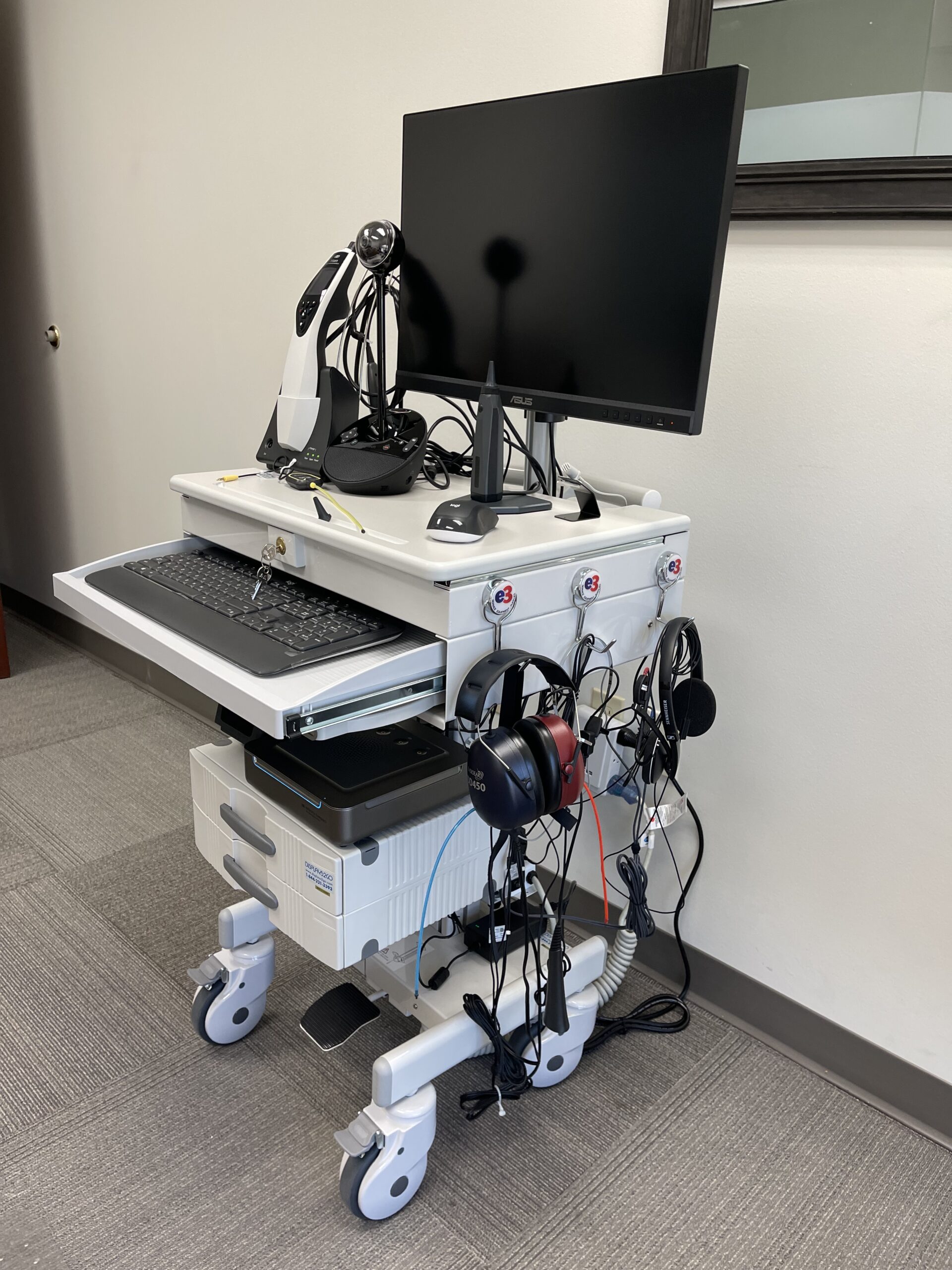
Another model focuses on supplementing in-person audiology care at ENT offices. Richard E. Gans, PhD, founder of the American Institute of Balance, developed WebAuD to help ENT practices that had a significant backlog of patients waiting for basic hearing tests. “The WebAuD model does NOT replace the ENT-based audiology team but rather supports and enhances them, like extenders,” Gans explains.
In this hybrid system, an on-site extender—a trained staff member—prepares the patient with full diagnostic equipment. A licensed audiologist then conducts the entire test remotely in real time. This frees the on-site audiology team to handle more complex and higher-revenue activities. “It gives them time to focus on pre-and post-surgery candidates, tinnitus, CI and hearing aid patients who require more TLC, and cognitive management,” Gans says. The results have been compelling. He says, “Practices are reporting greater job satisfaction by their audiologists, increased diagnostic revenue, and most importantly an increase in hearing aid revenue of 30% or more.”
Simple Fixes for Common Problems
Not all solutions require a major strategic overhaul or new technology. Some of the most effective scheduling optimizations come from simple, practical changes to clinic workflow. Savin’s practices, for example, utilize a drop-off system for hearing aid repairs. “If everyone’s busy, have them drop it off and they could pick it up at the end of the day,” she suggests. This allows a student or audiology assistant to work on the device when they have a free moment, turning a potentially disruptive walk-in into a manageable task.
Another low-effort, high-impact solution is to create a library of online resources for patients. Many common issues that lead to phone calls and appointments can be resolved by the patients themselves if they have clear instructions. “Your website could be a great resource of where you direct people for help,” Savin says. She recommends creating a “how-to” section with short, one- or two-minute videos demonstrating tasks like changing a wax guard or pairing a hearing aid. Manufacturer-produced videos are another option. Directing patients to these resources can free up the schedule for more critical needs.
Planning for the Longterm
Ultimately, overcoming the audiologist shortage isn’t about finding a single, quick fix, but about combining small changes to stretch clinic resources and protect provider time to create a more sustainable business model.
Featured image: Robert Kneschke | Dreamstime.com