
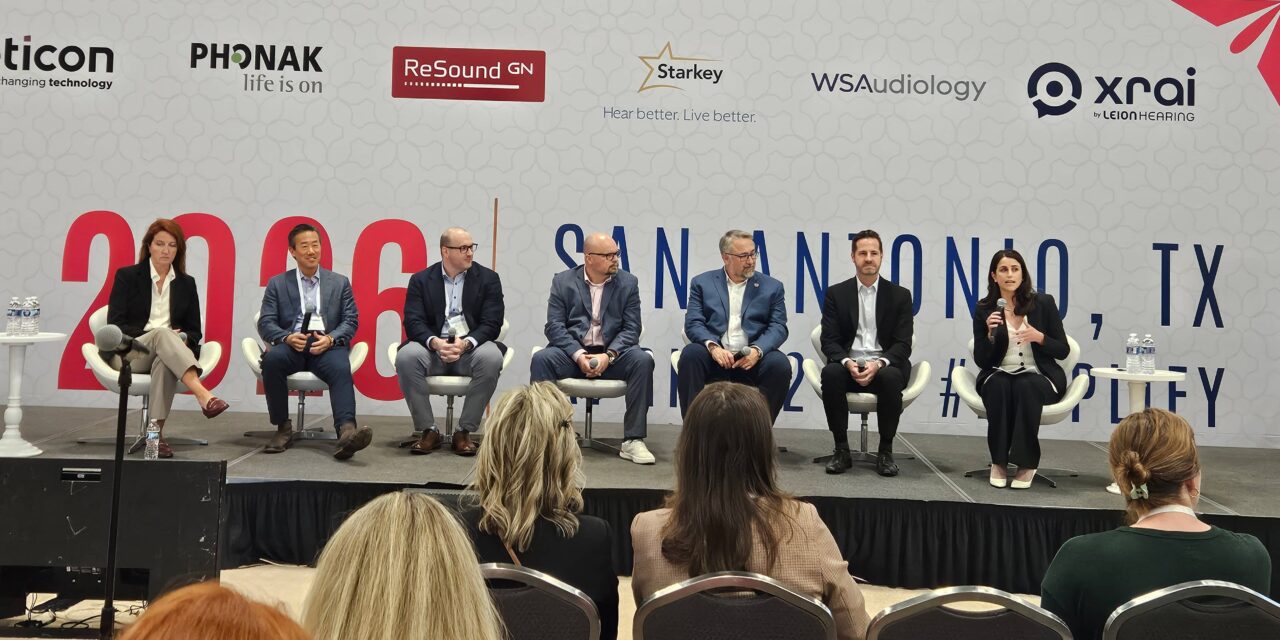
At AAA 2026, a panel of industry executives explored the impact of artificial intelligence, a looming talent shortage, and the critical need to reframe hearing loss as a core health issue.
At this year’s American Academy of Audiology (AAA) conference in San Antonio, Texas, leaders from across the hearing industry gathered to discuss the forces shaping the future of the profession. The conversation, moderated by Bridget Dobyan, JD, executive director of the Hearing Industries Association (HIA), moved quickly from the practical applications of new technology to the pressing challenges of provider shortages and the ongoing effort to elevate hearing care within the broader healthcare system. The panel offered a candid look at the pressures and opportunities facing audiologists today and in the years to come.
Panelists included Nicholai Dessypris, president, Sonova; Ty Lee, president, Demant North America; Mikkel Knudsen, president, ReSound US; Mike O’Neil, president, US wholesale, WSA; Kyle Acker, VP of US commercial sales, Starkey; and Patti Trautwein, AuD, MA, vice president, market access and clinical affairs, Cochlear Americas.
The discussion highlighted a field at an inflection point, where rapid technological advancement runs parallel to fundamental concerns about the profession’s capacity and perception. While artificial intelligence promises to create new efficiencies and more personalized patient outcomes, leaders also expressed deep concern over a shrinking supply of audiologists and the persistent view of hearing loss as a condition of aging rather than a critical health matter. This dual reality of innovation and workforce challenges framed the conversation, suggesting the industry’s path forward will require a concerted focus on both technology and people.
A central theme was the need to shift the narrative around hearing health, moving it from the margins of medicine to a central component of overall wellness. Patti Trautwein, AuD, MA, vice president of market access and clinical affairs at Cochlear Americas, argued for a more direct, clinical approach to communication. “We need to start to look at medicalizing hearing loss,” she said. This sentiment underscored a collective desire to integrate audiology more deeply with primary care and other medical specialties, ensuring patients receive timely and appropriate treatment.
AI’s Emerging Role in the Clinic and Beyond
Artificial intelligence was a dominant topic, with panelists viewing it not as a distant concept but as a tool already creating tangible change. The consensus was that AI’s potential extends across the entire patient journey, from initial engagement to long-term care, offering ways to make clinical practice more predictive, personalized, and efficient. Nicholai Dessypris, president of Sonova, urged providers to lean into the technology. “As AI ingests areas of our lives, we need to embrace it,” he said. “We need to leverage it across the patient journey for user experience.”
Kyle Acker, VP of US commercial sales at Starkey, explained how AI can shift the clinical model from reactive to proactive. He noted that AI is adept at analyzing large datasets to produce actionable insights, which can help providers identify patients who may be having follow-up issues or who might benefit from new technology. “Audiologists can go from being reactive to predictive with AI,” Acker said. “AI can make it easier for you in the clinic to make good decisions.”
The conversation also explored how AI is streamlining operations and support systems for hearing care professionals. Mike O’Neil, president of US wholesale at WSA, described how his company uses AI chatbots in customer service to anticipate questions and provide faster, more effective support. This has helped reduce training time for new representatives by two months. Acker added that AI assistants embedded in fitting software can answer provider questions directly, reducing the need to call customer service. For Mikkel Knudsen, president of ReSound US, these tools are about helping clinics manage their busy environments more effectively. He pointed to the potential for AI-powered chatbots that can help front office staff get up to speed faster, allowing practices to “optimize businesses faster and more effectively.”
Beyond clinical efficiency, panelists saw AI as a way to deepen the patient relationship. As devices learn an individual’s listening preferences and environments, the technology becomes more integrated into their life. “As the hearing aid learns through AI, it becomes part of the person,” Knudsen said. Ty Lee, president of Demant North America, emphasized that the ultimate goal should be to use AI to enhance trust and build a stronger provider-patient bond, adding that it is crucial to “make sure the provider is super comfortable with the technology.”
Confronting a Looming Talent Shortage
While technology presents significant opportunities, a recurring concern among the leaders was the state of the audiology profession itself. Multiple panelists voiced worries about a growing talent shortage, with not enough new audiologists graduating to replace those who are retiring. “I worry about not enough professional providers,” said Lee, a sentiment echoed by Dessypris, who asked, “How do we draw more to the field?”
Panelists agreed that the industry must do more to showcase the diverse and rewarding career paths available with an audiology degree. Acker, who holds a Doctor of Audiology degree, said he often speaks with students who feel their options are limited. “I speak to students and they feel pigeonholed in a specific path,” he said. “I give them a pep talk: there are so many different opportunities. You can pick one, and even switch. We as an industry have to get louder with students.”
The solution, many agreed, lies in earlier and broader outreach. Knudsen suggested that recruitment efforts need to begin before students even enter college. “We need to do a better job with awareness. Go younger. Talk to students when they’re in high school,” he said. O’Neil added that the profession has not done enough to promote its profound impact on people’s lives. “We don’t promote enough how great audiology is,” he stated. “We connect people, help with loneliness, and provide a wide scope of care.”
Addressing the talent gap also involves tackling practical concerns like compensation and provider fees. Trautwein noted the importance of advocating for the value of audiology to improve compensation, while Lee suggested that technology could play a role in making practices more efficient, thereby helping to “improve provider fees to help HCPs thrive.” The overarching message was that ensuring the future of hearing care requires a deliberate, industry-wide effort to attract, train, and retain the next generation of professionals.
Reframing Hearing Loss as a Health Imperative
A significant portion of the discussion centered on the need to reposition hearing loss not as an isolated issue of aging, but as a fundamental component of public health. Trautwein expressed concern over “where hearing health fits within the priorities of the healthcare system, against other diseases,” highlighting the challenge of competing for attention and resources.
To change this, panelists argued for a new vocabulary and a more assertive role within the medical community. Trautwein suggested that changing the language used to describe hearing loss could have a powerful effect on patient perception and urgency. “If we say ‘stage 1’ vs. ‘mild’ hearing loss, people will take it more seriously and see it as a medical condition that needs to be treated,” she explained. “We need to make sure patients get to the right care, at the right time, at the right price.”
Engaging directly with physicians is another critical piece of this strategy. Acker pointed out that patients with a physician referral are far more likely to seek treatment from an audiologist. “We’re not participating enough in our medical communities,” he said. He urged audiologists to be proactive advocates in their local areas. “You need to talk to ENTs, primary care physicians, etc. Engage your local medical community. Invite them into your office. Change their perception.”
This reframing could also help in communicating the broader benefits of hearing treatment, particularly concerning cognitive health. O’Neil offered a compelling perspective, viewing modern hearing technology as a tool for healthy aging. “I now see hearing aids as the best anti-aging device on the planet,” he said, citing their ability to support many aspects of brain health. The collective goal is to create a system where hearing screenings are a routine part of adult healthcare, leading to earlier intervention.
The Patient and Device of the Future
Looking ahead five years, the panel envisioned a patient journey that is more seamless, proactive, and personalized. Lee predicted that patients entering the system will be younger and better informed, with earlier screening leading to earlier care. “Provider care will be streamlined,” he said. “Hopefully that will be sooner than 5 years from now.” Knudsen imagined a future where a “super educated” patient is met by a provider who can “overdeliver” thanks to data and AI, resulting in a highly personalized solution that the patient sees as a valuable investment in their quality of life.
The hearing device itself is also poised for a significant evolution. Acker predicted that in five years, the hearing aid will become an “everything device” that seamlessly manages hearing, health, and community connection, all while working in the background. Trautwein saw a future that includes “always-on hearing,” not just hearing aids but augmentative devices and fully implanted cochlear implants.
Even as they looked toward advanced technologies like Auracast and fully implanted devices, the panelists stressed the importance of meeting the needs of patients who are using legacy devices. Knudsen made a strong case for backward compatibility, emphasizing the need to continue supporting established technologies like telecoils. “Don’t leave patients behind,” he urged. “They spend good money on hearing aids, so help honor that and maintain the technology for a good portion of time, until they are ready for their next hearing devices.” This pragmatic approach, balancing innovation with patient-centric continuity, captured the complex but hopeful outlook for the future of hearing care.
Featured image: A panel of hearing device company representatives discussed the future of audiology at AAA 2026. Photo: Melanie Hamilton-Basich




I am a cochlear implant recipient and leader in the Hearing Awareness Team at the Rose Villa retirement Community near Milwaukie OR, seeking ways to enlighten our 400 fellow retirees to become more wise consumers of the therapies available for our hearing needs. Thanks for this access to new knowledge. Please consider including us consumers in all of your education efforts!