
A proof-of-concept trial by UK mobile operator O2 and software provider Mavenir found that nearly 90% of participants with hearing loss reported improved call clarity through a network-level audio optimization technology that requires no new device or app.
UK mobile operator O2, part of Virgin Media O2, has completed a proof-of-concept trial of a network-based technology designed to improve phone call clarity for people with hearing loss — an approach that operates entirely within the carrier’s core network infrastructure rather than relying on device-based accessibility features or third-party applications.
The trial was conducted in partnership with Mavenir, a cloud-native network software provider. The technology works by first having participants complete a short, automated hearing test to identify how they perceive different sound frequencies. That information is used to generate a personalized hearing profile, securely linked to the individual’s mobile number, which then enables the network to adapt how speech is delivered during calls in real time.
Because the optimization occurs at the network level, participants were able to make and receive calls using their existing phones and numbers without any changes to their normal behavior.
Following the trial, nearly 90% of participants reported improvements in call clarity, with participants also noting reduced listening effort, fewer misunderstandings, and a more natural calling experience overall.
“For many people with hearing loss, making a phone call can be a difficult and frustrating experience. This trial is about using the intelligence within our network to improve that experience without asking customers to do anything differently. We are encouraged by the early results from this proof-of-concept and are excited to explore how this type of technology could support more accessible services for our customers in future,” says Jorge Ribeiro, director of core networks, Virgin Media O2, in a release.
The approach is notable for hearing healthcare professionals in that it functions independently of hearing aids or other wearables — a potential advantage for patients who do not consistently wear their devices or who find calls difficult even when amplified. One trial participant, Mary Higgins, who is profoundly deaf, offered a direct account of the experience.
“I usually find phone calls tiring and stressful, even with hearing aids. Making a call without them is almost impossible. Using the technology was a completely different experience, as I could hear clearly without my hearing aids and didn’t need to keep asking people to repeat themselves,” says Higgins, in a release.
For audiologists and hearing care providers, the trial points to a growing interest in addressing hearing accessibility through infrastructure-level solutions — a layer of the communication ecosystem that has historically received less attention than assistive listening devices, captioned telephone services, and telephone amplification products. The concept of generating an individualized frequency-response profile that shapes audio delivery in real time draws on principles familiar to hearing care — namely, that speech intelligibility can be meaningfully improved by tailoring audio output to a listener’s specific hearing profile.
“Core networks are a powerful platform for innovation of services and delivering new value to customers. Our partnership with Virgin Media O2 in improving the call experience for their customers with hearing loss is a great example of that,” says Brandon Larson, SVP and general manager, cloud, AI & IMS business strategy, Mavenir, in a release.
O2 and Mavenir describe the project as still in its early stages, with the proof-of-concept intended to explore the feasibility of the approach rather than signal an imminent commercial rollout. Whether the technology could eventually be deployed more broadly — and whether it might integrate with or complement existing hearing aid connectivity features — remains to be seen.
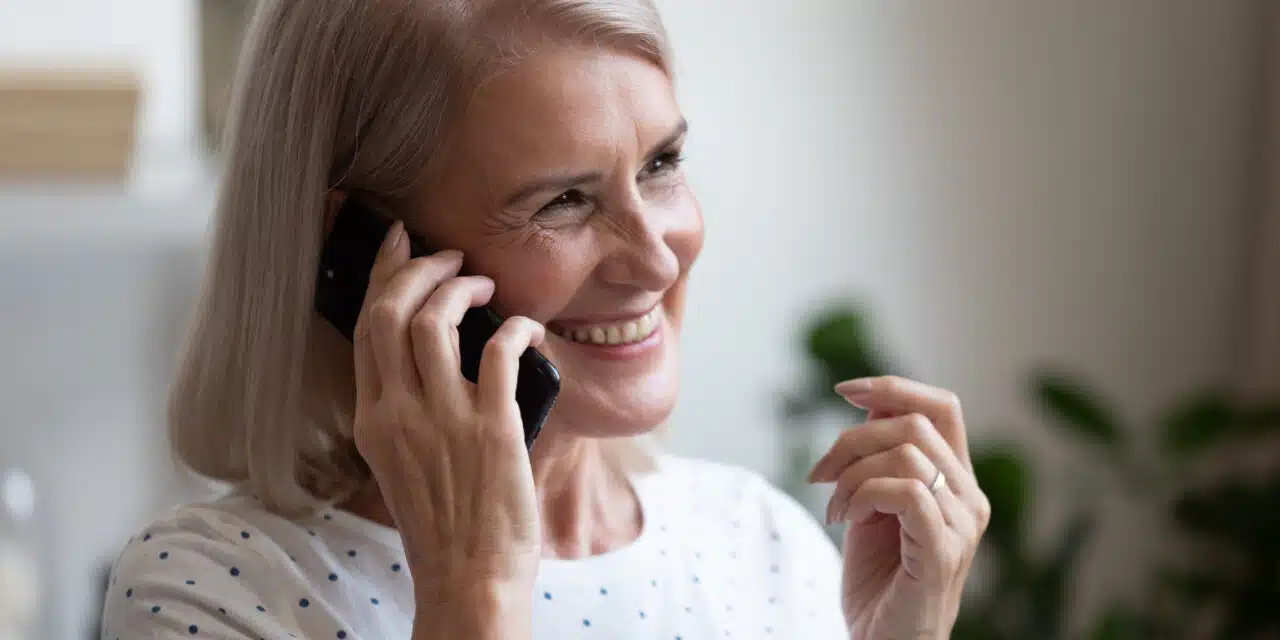
Featured image: happy woman talking on cell phone. Photo: ID 158579558 © Fizkes | Dreamstime.com

Enhancement of network phone clarity at source will indeed be welcome. Hope to learn more detail, for example whether dynamics will be controlled. Presumably the system will also enhance calls made to radio programmes