

For hearing care professionals, adding tinnitus treatment and services is a commitment that requires a certain mindset, a well-stocked clinical toolbox, and a passion for comprehensive patient care.
By Melanie Hamilton-Basich
Tinnitus is one of the most commonly reported healthcare concerns in the United States, yet for many patients, a diagnosis is often followed by the disheartening advice to simply “learn to live with it.” While some may find relief by turning on a fan or music to mask the ringing, a significant number of people find their tinnitus feeding into a debilitating cycle of stress, anxiety, and depression, impacting their overall health and quality of life. For these individuals, hearing care professionals (HCPs) are in a unique position to offer meaningful solutions that go far beyond simple dismissal.
When Patty Kalmbach, AuD, started the Colorado Tinnitus and Hearing Center more than 20 years ago, the landscape was vastly different. “I was told that we were going to starve to death, and I was told that nobody knows what tinnitus is. Don’t put it in your name,” she recalls. Today, however, providing specialized tinnitus care is a viable path for clinics looking to offer comprehensive, patient-centered audiological services. Adding these services requires a significant commitment of time, training, and resources, but for the right practice, it can be a deeply rewarding endeavor that strengthens the clinic and profoundly changes patients’ lives.
The Right Motivation and Mindset
Before a practice invests in new equipment or training, experts suggest the first and most critical consideration is motivation. Tinnitus care is not a simple add-on service; it represents a fundamental shift toward a more holistic, counseling-heavy model of care.
“What is your motivation? Is it just to add an extra service, or is it to add a process or some type of a path that you can get the patient down?” asks Kalmbach. “If a provider goes at it thinking, ‘I need to have another service,’ I would say don’t do it. Tinnitus is not easy. Patients can be having the worst day of their life. If you’re really motivated to get into the trenches and provide it as a process, then I would say great.”
This sentiment is echoed by Eileen Clark, AuD, owner of Integral Audiology in Cornelius, N.C. She contrasts the traditional “retail model” with the healthcare model she strives for. “I don’t want to be the person to say I can address one concern, but I can’t address all of your concerns,” she says. “I like to be very comprehensive and make a person feel like I’m not just doing a hearing test and saying, ‘Yes, you have hearing loss. Here’s a set of devices to correct your hearing loss,’ and then out the door. I like the healthcare model where it’s a full plan of care.”
This approach requires not just an understanding of tinnitus and the treatments available, but also a comfort level with the emotional aspects of the condition. Sarah Lundstrom, AuD, CH-TM, of HearCare Audiology & Tinnitus Center in Venice, Fla., notes that the emotional entanglement can be nerve-racking. “Management requires a lot of counseling and education,” she says. “If this is not something you are comfortable with or maybe even not passionate about, do what you can for them and then refer them to someone who can help more. Personally, I enjoy working with tinnitus patients as it can be so rewarding to help them habituate and improve their quality of life.”
Building Your Treatment Toolbox
A recurring theme among HCPs experienced in helping patients manage tinnitus is the necessity of having multiple treatment options available. Because each patient’s experience with tinnitus is unique, a one-size-fits-all approach is destined to fail.
“I always tell patients, we have a toolbox,” says Kalmbach. “If a patient that comes in is suicidal, very depressed, very anxious, hearing aids are not going to be my best option. So I may pull out Lenire or Neuromonics or something else. There is no cookie-cutter approach to tinnitus. If you only offer one treatment or you only offer one hearing aid, you’ve just missed so many patients.”
Ideally, this toolbox should be diverse, addressing the various facets of the patient’s condition. Treating an underlying hearing loss, if one exists, is often the best foundation. “Having device options that can add a tinnitus program for patients is helpful for tinnitus management,” notes Lundstrom. “Proper counseling on how and when to use this program is crucial.”
Hearing aids can serve a dual purpose, providing both amplification to compensate for hearing loss and a platform for sound therapy. “We can create a tinnitus masker that we customize based on that person’s hearing loss and we’re putting in white noise, pink noise, ocean sounds,” says Clark. “Depending on what sounds comfortable and relaxing to them, we can create this soundscape that we put into the hearing aids so that they have a masker built right in.” But as Kalmbach notes, this option is not going to meet the needs of every patient with tinnitus.
Tools Beyond Sound Therapy
Beyond sound therapy, other approaches play a key role. Tinnitus retraining therapy (TRT) aims to change how a person perceives and reacts to their tinnitus using directive counseling along with sound therapy. The goal, Clark says, is not a positive reaction but a neutral one. “It’s about getting them to a neutral reaction where if they say, ‘Yeah, I hear the tinnitus in my ears right now,’ it’s not going to cause any sort of a negative reaction. It’s just, ‘Yep, it’s there. It’s not affecting me. I can carry on with my life.’”
For patients who need more support, there is a variety of other modalities. And Kalmbach offers several at Colorado Tinnitus and Hearing Center. For biofeedback, she uses Heart Math, which uses breathing and biofeedback techniques to helps reduce stress response, calm the nervous system, and make tinnitus less bothersome over time. Neuromod’s Lenire is a bimodal neuromodulation device that uses simultaneous tongue and auditory stimulation to help reform the habit of reacting negatively to tinnitus. It is usually administered for 30 minutes twice daily at home for 12 weeks up to 12 months, with follow-up assessments in the clinic at regular intervals over the course of treatment.
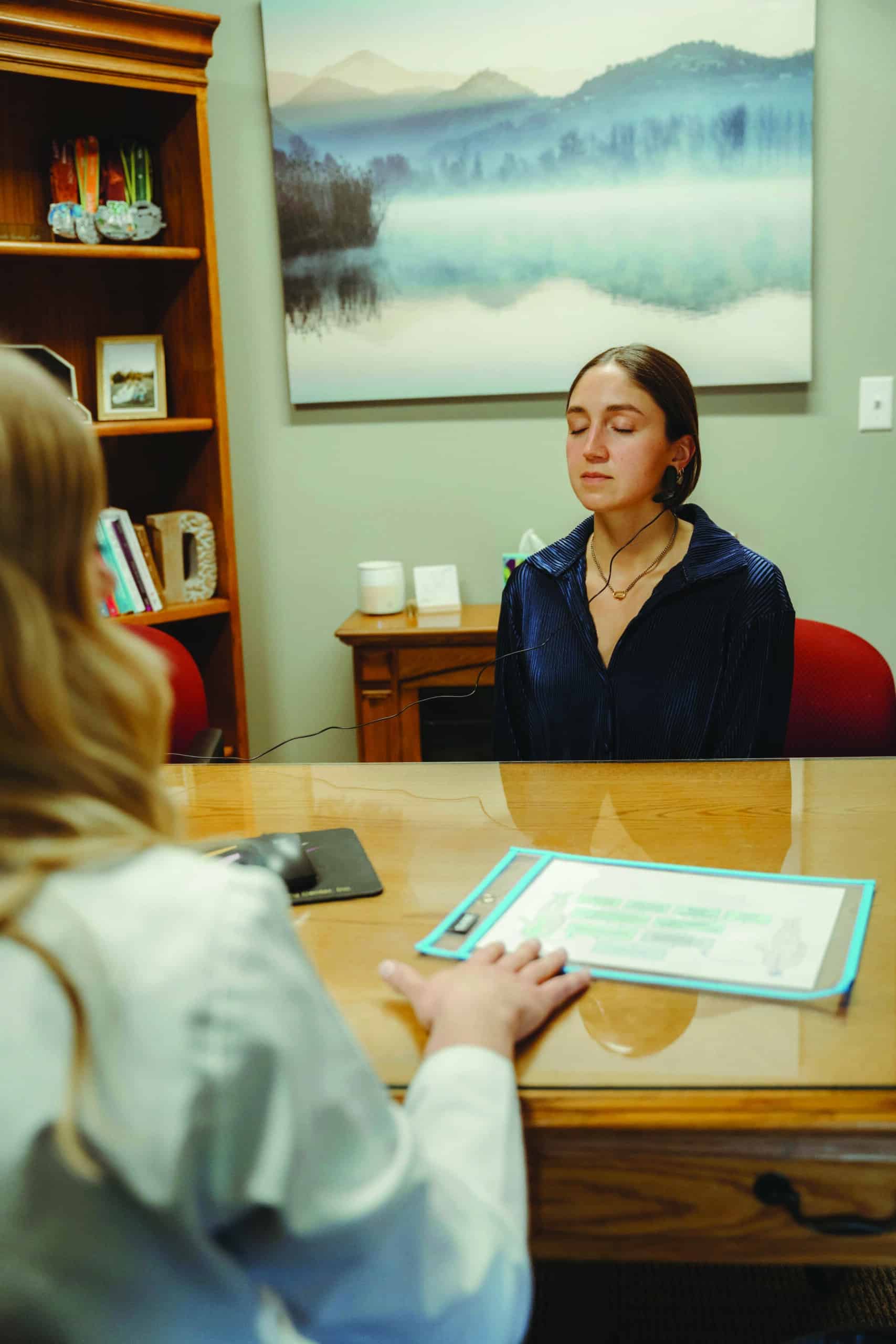
Photo: Colorado Tinnitus and Hearing Center
Cognitive behavioral therapy (CBT) is another powerful tool, which focuses on changing the emotional reaction to tinnitus, as opposed to TRT’s focus on changing auditory perception. Since finding psychologists who specialize in tinnitus can be difficult, some clinics recommend or prescribe apps like Oto, which provides a CBT-based program specifically for tinnitus management. Oto’s treatment program is structured around 10-minute daily audio sessions and typically takes 8 to 12 weeks to complete.
Kalmbach occasionally uses the Neuromonics app for hyperacusic tinnitus patients, which she says “delivers precisely calibrated acoustic signals within relaxing music to reprogram how the brain processes tinnitus.” Initial treatment is 2-4 hours per day for six months guided by an audiologist, followed by a maintenance period and eventually weaning the patient off the device.
Tinnitus Pro is a newer app that hearing care professionals can use with patients that contains a CBT component. According to Neurotone AI, it combines four sound therapy modes (Habituation, Adaptation, Relief, Sleep), CBT-informed cognitive behavioral intervention (CBI) and a counseling library, plus meditation and mindfulness tools. It features a personalized Therapeutic Tone Finder, which helps identify a patient’s tinnitus percept and uses that profile to personalize sound therapy and tone-layered guided sessions. While there is no specific treatment program length, it is typically used daily for 3 to 12 months, depending on the patient’s needs.
The key is to personalize the plan. “There’s not a right or wrong answer on where you start and what you finish with,” says Clark. “It’s really going to be dependent on that individual. What is their primary concern? Are you primarily concerned that you can hear the ringing, or are you primarily concerned that you feel like you can’t hear voices over the ringing? That’s going to make a difference in what direction we want to start with.”
The Importance of Case History
To build that personalized plan, providers must first listen. The audiologists interviewed for this article agree that the initial consultation and case history are perhaps the most critical components of the entire process, requiring a significant investment of time and a shift in clinical focus from testing to talking.
“People underestimate the value of the case history,” says Kalmbach. “And I think the case history is more important almost than your testing because you’re going to find out what’s going on in this person’s life.”
She uses an iceberg analogy to explain the complexity. “Tinnitus is like the tip of the iceberg, and underneath that iceberg is stress and hearing loss and anxiety and depression and all these other things that if we don’t address those, we can’t really address the tinnitus,” she explains. “If you only focus on the sound, you miss the person.”
This approach requires going into an appointment with a completely open mind. “Don’t go into a tinnitus appointment with a plan of care ready to go,” advises Clark. “Listen to what the patient is telling you. A patient may come in and on paper they may have tinnitus and a fairly significant hearing loss. But if the hearing loss is not the thing that’s driving them into the office, I’m not really going to address that, at least not at first.” The goal is to focus energy on what is truly bothering the patient and let them guide the conversation, with the HCP providing professional expertise to navigate the options.
Structuring Your Practice for Success
Integrating this patient-centered, counseling-heavy approach requires a practical look at clinic workflow, scheduling, business models, and training.
First and foremost is time. A standard hearing aid evaluation might be scheduled for an hour, but a comprehensive tinnitus consultation often takes much longer. “We can spend up to two to three hours with every patient,” says Kalmbach. “And when I tell colleagues that, they’re like, ‘You’re kidding.’” Clark and Lundstrom both schedule initial tinnitus appointments for two hours to accommodate a diagnostic evaluation, tinnitus-specific testing, a detailed case history, and in-depth counseling. This model can be challenging to implement, especially in settings like ENT clinics where appointments are often in 15- or 20-minute blocks.
To manage the time commitment, clinics can restructure their teams. Clark suggests that a practice could “have a technician doing testing and having the audiologist doing the interpreting and the counseling, having an audiology assistant maybe stepping in for a few of the follow-ups and sending the questionnaires to the patient.” This allows the primary provider’s time to be used most effectively.
Training is another important element. Provider confidence is crucial, as tinnitus patients are often highly educated about their condition and can be skeptical after being told by other professionals that nothing can be done. “These individuals are coming to you for your expertise and they really need somebody to lean on,” says Clark. “If you can be a very solid source of, ‘Hey, I’m hearing what you’re saying and this is what I recommend for you,’ having that confidence is going to go a very long way.”
Recommended training includes courses like TRT courses covering tinnitus retraining therapy protocols developed by Pawel Jastreboff, PhD, ScD, the American Board of Audiology’s Certificate of Tinnitus Management (CH-TM), and online programs. Speaking with other audiologists who have successful tinnitus practices is also an invaluable resource.
When it comes to business models, there are different paths. Kalmbach’s clinic uses a bundled care treatment plan. “I never want a patient not coming back in to see me because they’re struggling because they’re worried about having to pay for an office visit,” she explains. “When we get them through the process, I want them well taken care of. I want them finishing well.” This all-inclusive model covers all visits for a set period, allowing the focus to remain on treatment rather than cost. Lundstrom’s practice, by contrast, modifies its traditional workflow, with an extensive initial appointment followed by follow-ups that are scheduled and billed accordingly. Both models can be successful, but the choice depends on the practice’s philosophy and structure.
Finally, knowing your limits and building a strong referral network is essential. “It is OK to refer someone elsewhere if you feel you have reached the end of your knowledge or tools,” Lundstrom advises. This network can include psychologists for CBT, TMJ specialists, sleep specialists, and other audiologists who may offer different services.
For clinics willing to make the commitment, adding tinnitus care can be a powerful way to grow a practice and enhance an HCP’s own professional satisfaction. It increases a business’s presence in the community and provides a vital resource for both new and existing patients.
“I think finding that passion within the field is great; not everybody has a passion for tinnitus,” Kalmbach concludes. “You’re changing lives, you’re saving lives. You’re kind of somebody’s Sherpa and you’re guiding them through. If you’ve got a passion for it, go for it, because it’s an amazing field.”
Featured image: Because each person’s experience with tinnitus is unique, not every treatment approach will work for everyone. It requires time, patience, and an open mind to recognize and address all the underlying issues related to a patient’s tinnitus and help them manage their symptoms. Photo: ID 39133016 © Judith Kiener | Dreamstime.com



In so admirably developing remedies for tinnitus, please clever researchers peep outside the box and explore ‘fringe’ approaches. A cranial osteopath switchrd off my noises of 30 years by an almost imperceptible pressure on my lower back. In the interest of scientific credibilty Richard Holding DO switched it back on at my request, then off. Stayed off for years. It’s real, others say so too.