Staying close to the bass player—or otherwise enhancing bass audibility—helps musicians and listeners, especially those with hearing loss, maintain pitch, follow musical structure, and better appreciate music by providing a clear, low-frequency reference that supports relative pitch perception.
By Marshall Chasin, AuD
Very few people have perfect pitch (also known as absolute pitch). The prevalence in the general population is on the order of 0.01%, and among musicians it’s roughly 4%-7%. However, many musicians and non-musicians alike have fairly good “relative” pitch. And for the many trained musicians who have very good relative pitch, when presented with a musical chord or interval they may not be able to recognize the exact note, but they likely would be able to identify the musical interval.
This acquired skill is of course related to many phenomena, but at least in part is related to being able to hear certain notes. When a musician or person who likes to listen to music has a hearing loss, the audibility of certain notes, and therefore musical intervals, may be problematic. In cases such as this, moving closer to the bass player may be quite useful.
Anecdotally, in the music of some cultures, a drone or root note of the music is quite audible. Indian Vedic music and Celtic bagpipe music are two examples that come to mind. Hearing a drone appears to assist both musicians and listeners who have a hearing loss to stay in tune and to better appreciate the music.
In Indian Vedic music, melody is less of an issue than for Western music, and the drone (bass note) can help all musicians—whether or not they have hearing loss—to stay on key and follow the music. However, in Western music, the melody may change keys and may even include different “turn-arounds,” such as the common II-V-I in jazz music (e.g., D, G, C) where each 12-bar segment would be in a different key. This would necessitate a different “drone-like” identifier every 12 bars.
A strategy that appears to be quite useful for musicians with hearing loss who play Western music (or listeners of this type of music) is to have improved audibility of the bass line, which is a drone-like indicator that changes according to the needs of the music.
Up on stage, physically moving closer to the bass player will provide valuable information, especially when the music is not as familiar or well-practiced as it could be. This is true for both people with normal hearing (such as myself) and anyone with a hearing loss. In-ear monitors with an increased level of the bass would also be quite useful. And for people who wear hearing aids, it makes sense to provide them with more low frequency (bass) amplification, irrespective of any fitting formula, at least for a “music program.”
This is not a new concept and has been around since at least the 1930s when W.B. Snow argued for a low-frequency extension for music that would be greater than that for speech.1 In the 1940s and 1950s, Harvey Fletcher2 and Harry Olson3 both argued that the low frequency limit for amplified music be at 60 Hz and 40 Hz, respectively. And more recently, Brian Moore and Chin-Tuan Tan demonstrated that an extension down to 55 Hz would be beneficial for music listening.4However, Hirsch and Bowman showed that the maximum sound in the low frequency region (<100 Hz) should be limited to levels below 80 dB SPL due to inherent cochlear distortion for sound levels above that.5 Despite high-level music potentially being in excess of 100 dBA in the mid- and high-frequency region, music rarely approaches 80 dB SPL in the lower frequency region.
Of course, clinically this can easily be accomplished by having an open (non-occluding) eartip/earmold fitting that allows non-amplified low-frequency music to get into the ear canal directly through the venting system. It may be necessary to fit music lovers who have hearing loss with two types of earmold/RIC coupling for music: a more occluding eartip coupler depending on the hearing loss requirements for a “speech program,” and a “non-occluding” eartip coupler for a “music program” regardless of the specifications of any one hearing aid fitting formula.
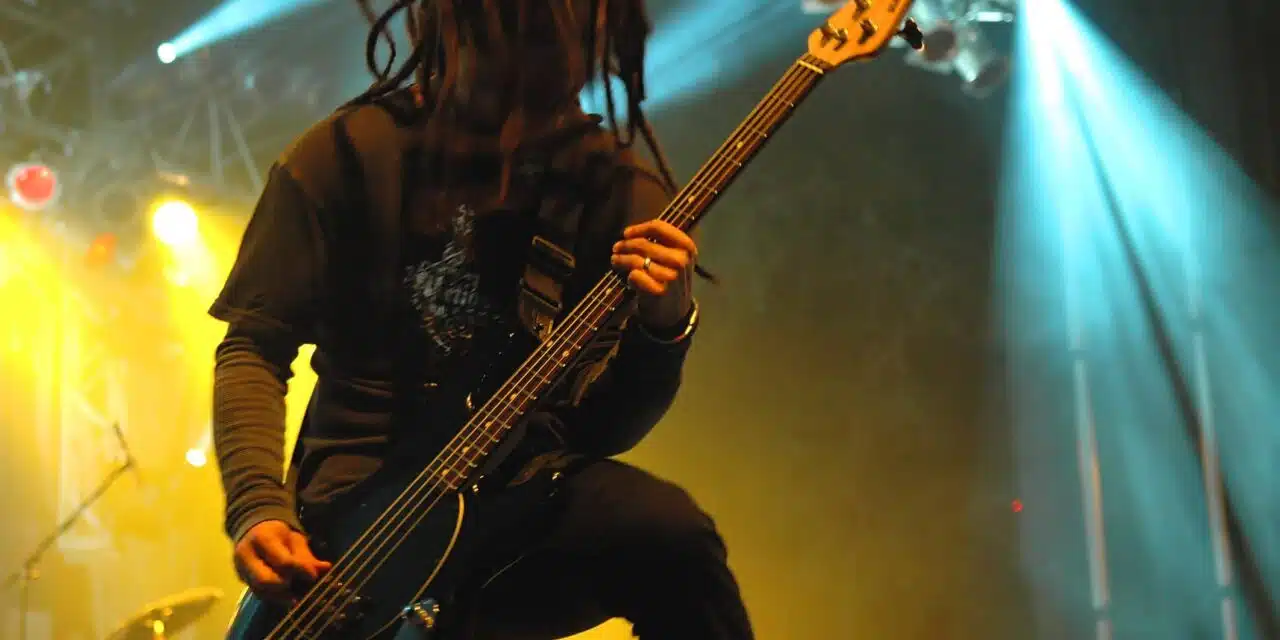
Featured image: Bass guitar player performing live. Photo: ID 1593971 © Mary Katherine Wynn | Dreamstime.com
References
1. Snow WB. Audible frequency ranges of music, speech, and noise. Bell Sys Tech J. 1931;10:616-637.
2. Fletcher H. Hearing, the determining factor for high-fidelity transmission. Proc Inst Radio Eng. 1942;30(6):266-277.
3. Olson HF. (1957). Acoustical Engineering. New York: Van Nostrand.
4. Moore BCJ, Tan CT. (2003). Perceived naturalness of spectrally distorted speech and music. J Acoust Soc Am. 2003;114(1):408–419. doi:10.1121/1.1577552