Are you and your staff prepared for unexpected health events at work?
By Robert M. DiSogra, AuD; and Kaitlyn M. Kennedy, AuD
Disclaimer: The content of this article is strictly for informational purposes. It is not a substitute for professional medical or legal advice and should not be relied on as health advice. Consult your local emergency medicine physicians or emergency medical technicians for any specific information or guidance.
Medical emergencies can happen at any time, in any location, to any patient. As providers, it is our responsibility—and our staff’s—to be prepared and have an emergency action plan (EAP) in place before first responders show up. There is no current research on managing medical emergencies in an audiology office. This article will attempt to identify the most common ones experienced in an audiology office and suggest ways to effectively manage one when it occurs.
Definition
A medical emergency is an unexpected health event where the evaluation or treatment of a patient has to stop due to concerns about protecting the life of the patient. Approximately 75% of common medical emergencies occur due to an underlying condition that is asymptomatic at rest but becomes exacerbated when stressed.1
Incidence
The incidence of medical emergencies in an audiology office are not known. However, research in dentistry has shown that medical emergencies could occur once every two years per provider.2 If these numbers are similar in audiology, you could expect at least one medical emergency annually, with the chances increasing with more providers and more patients. Although emergencies are rare, it is essential to have a plan in place to ensure that you and your staff know what to do when such an emergency occurs.
How Detailed Is Your Case History?
A thorough patient history intake can identify patients ‘at risk’ for a potential in-office medical emergency.
Prior and current medical conditions, medications (for any ailment), allergies, social history, recent hospitalizations, and surgeries (beyond otologic surgeries) should be made known.
It is also helpful (and for some offices mandatory) to include a mental health screening (i.e., Patient Health Questionnaire – 9 from the American Psychological Association (2024) and/or a general anxiety assessment (i.e., General Anxiety Disorder – 7 from the Anxiety and Depression Association of America, 2024).3,4
While not clinically validated, it may also be beneficial to include a Likert Scale that measures attitudes or opinions, or behaviors by asking respondents to choose a series of answer options. The results can identify how nervous or anxious a patient is about their appointment. This could also help providers have a better idea of which patients could be at risk to experience a medical emergency in the office.5
Types of Medical Emergencies
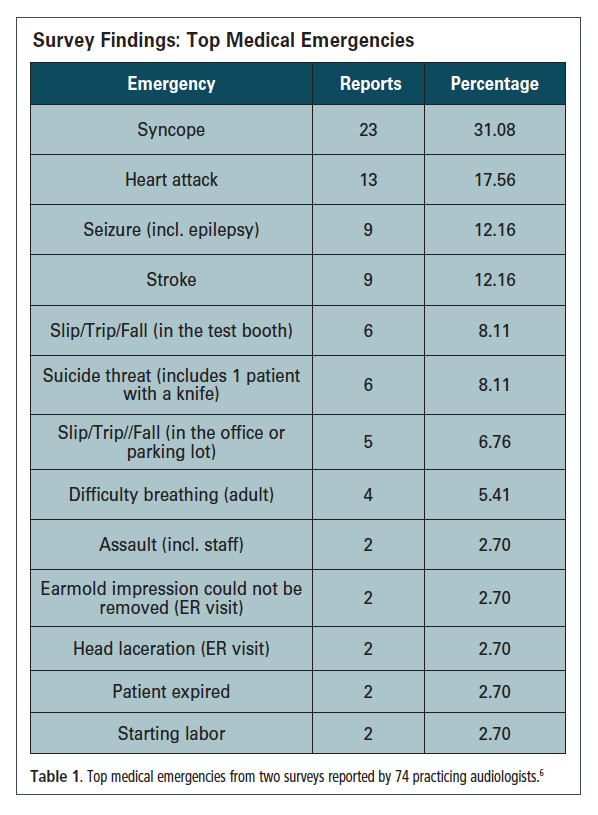
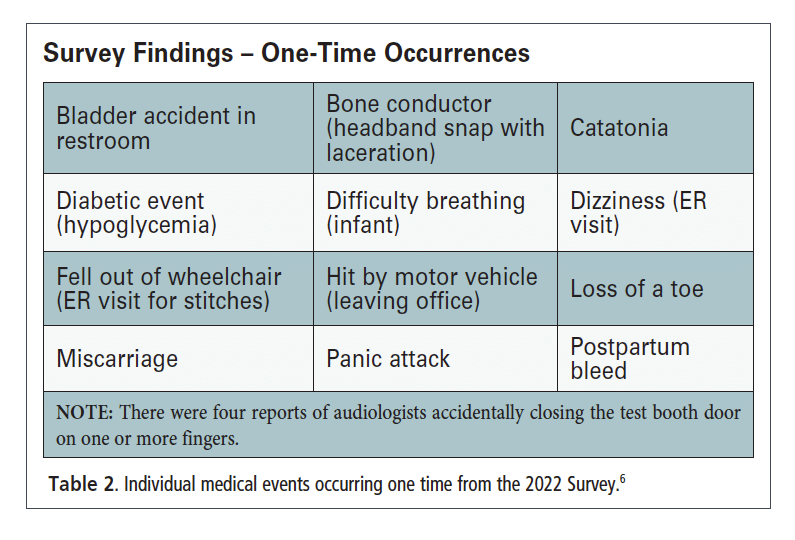
In 2022 and 2024, one of the authors (RMD) conducted an online survey on a popular audiology Facebook page (Audiology Happy Hour). Members were asked to reveal any medical emergency they had experienced with their patients at any time in their career. Table 1 shows the types of emergencies (highest incidence to lowest) as reported by 74 respondents. Table 2 shows medical events occurring once from both surveys.6
NOTE: Intervention for an abraded ear canal during cerumen management is covered in cerumen management courses and will not be covered here.
Staying Calm
You have to stay calm when an emergency occurs. If you panic, everyone panics. Having a calm and gentle manner is extremely helpful when trying to reduce patient stress during an emergency.
According to the American Psychological Association, fight, flight, freeze, and fawn are all responses to fear, trauma, and stress. When this happens, your body releases hormones like adrenaline and cortisol. When your sympathetic nervous system becomes activated, your body prepares first for either fight or flight. This causes your heart rate to go up and prepares your body for movement. But your nervous system can shift to a freeze or fawn response if your body determines that fight or flight won’t be effective in managing the stressor at hand.7
Here are some tips to avoid panic:
1. Communicate with Your Staff
This will reduce the chances of mistakes. Be sure you can communicate all medical history to any professionals to avoid any medical errors.
2. Decide Who Takes the Lead
In a small office, one person should be designated as the “lead.” This person will take charge and call out orders to others (i.e., “Call 911,” “Clear the waiting room,” etc.). Everyone should have a defined role in an emergency.
3. Have an Emergency Action Plan
An emergency action plan should be developed and reviewed periodically and with all new employees. One can be developed with the assistance of your local Red Cross and/or first aid squad. Sample EAPs can be found online and tailored to your office. It is important to follow the plan, as this will help to save time in a time-sensitive situation. It may also be required by your liability insurance carrier.
4a. Panicking – You
Rash decisions and a foggy mind often make a hard situation harder. If you feel the panic coming on, take a moment to breathe deeply and clear your mind before making any decisions. During an emergency, it is common for people to make irrational decisions; slow down and breathe deeply before you act.
4b. Panicking – Your Patient
If you’re calm, your patient will (or should) be calm.
4c. Panicking – The Over-Reactive Accompanying Person
Have a designated person to relocate a relative/accompanying person from the area. This person will only get in the way if they begin to panic. Once out of the area, the designated staff person can try to ascertain any pertinent medical information before first responders arrive.
5. Call 911! – Even if You’re Not Sure
Getting help from trained professionals will only help the situation.
Preparation
While no published data was found for audiology, based on the personal experiences of both authors, it is likely that most audiologists and audiology practices are under-prepared for medical emergencies beyond the ear (i.e. ear canal abraded during cerumen management).
Although practices should have an EAP in place, unless staff are regularly practicing and reviewing it, it will be difficult to know what to do when an emergency occurs.8
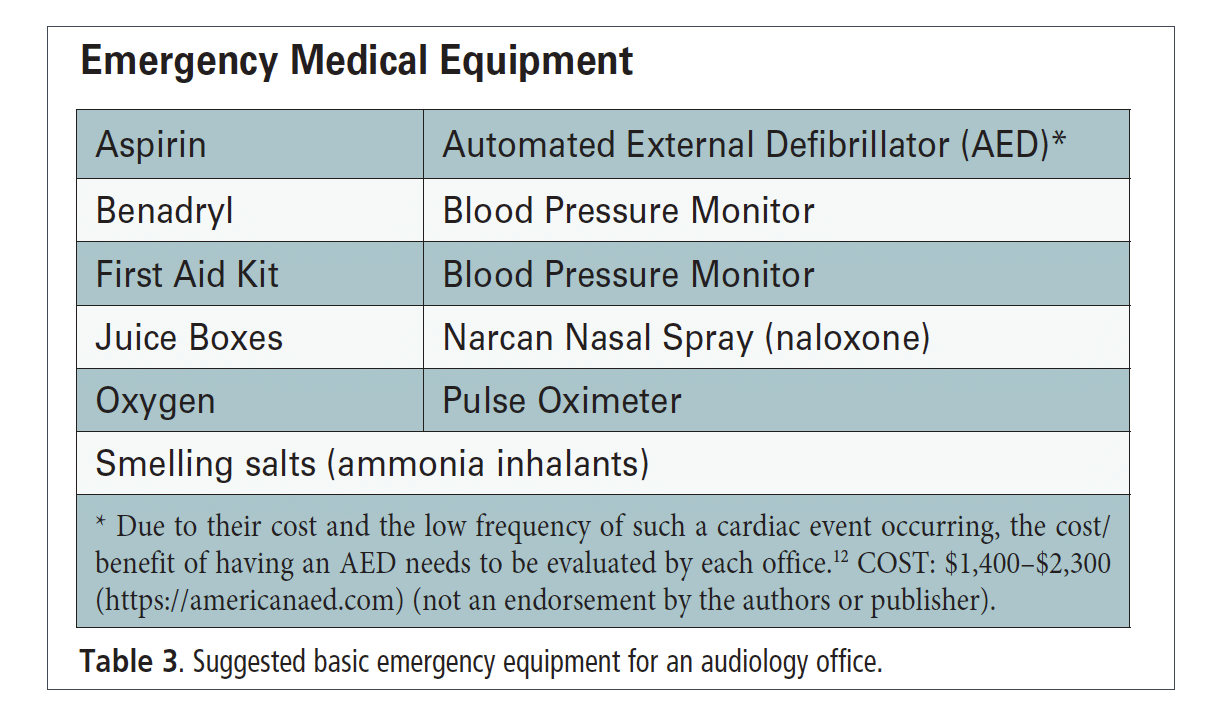
Table 3 lists some emergency medical equipment that should be kept in the office.
Basic Life Support
One of the most readily available forms of emergency preparedness is Basic Life Support (BLS). Many hospitals and healthcare systems require this certification for all employees. BLS certifications and recertifications are offered through the American Heart Association (www.heart.org) or the American Red Cross (www.redcross.org) either online or in person.9,10 In addition to BLS, it may be beneficial to obtain a certification in emergency medical response so that you are better prepared if an emergency occurs.
Training
Training in the use of basic life support/cardio-pulmonary resuscitation (CPR), emergency cardiovascular care (ECC), and automated external defibrillators (AEDs) can be scheduled (live or online) through your local hospital/medical center, first aid squad, or your local chapter of the American Red Cross. Recertification is strongly recommended.
Legal Issues
When it comes to preparation for emergencies, most states provide immunity for rescuers acting in good faith. However, be sure to review the liability laws in your state before designing and implementing an EAP for your office.
Potential liability protections at the federal and state levels for different types of persons and entities involved in emergency response efforts during declared and non-declared emergency events is available from the Network for Public Health Law.11
NOTE: this website does not provide legal advice.
Good Samaritan Laws
Good Samaritan laws protect people who voluntarily help others in an emergency situation from being held liable for their actions. The goal of these laws is to encourage people to help others without fear of legal consequences.
The law protects non-medical persons from being responsible for injury or death caused to the victim during a medical emergency. When giving aid in an emergency (as long as you only do as much as a reasonable and sensible person with your level of training would do in the same situation and you do not expect compensation for adaptation aid) these laws apply. In addition, you are not legally held responsible for any injury or death that occurs. These laws were considered to allow people to help others without the panic of being sued or prosecuted if something goes wrong (www.mycprcertificationonline.com).
Good Samaritan laws differ by state in terms of consent, parental rights, and the right to refuse treatment. It is best to review your individual state’s law on this matter.
General Liability/Business Insurance Coverage
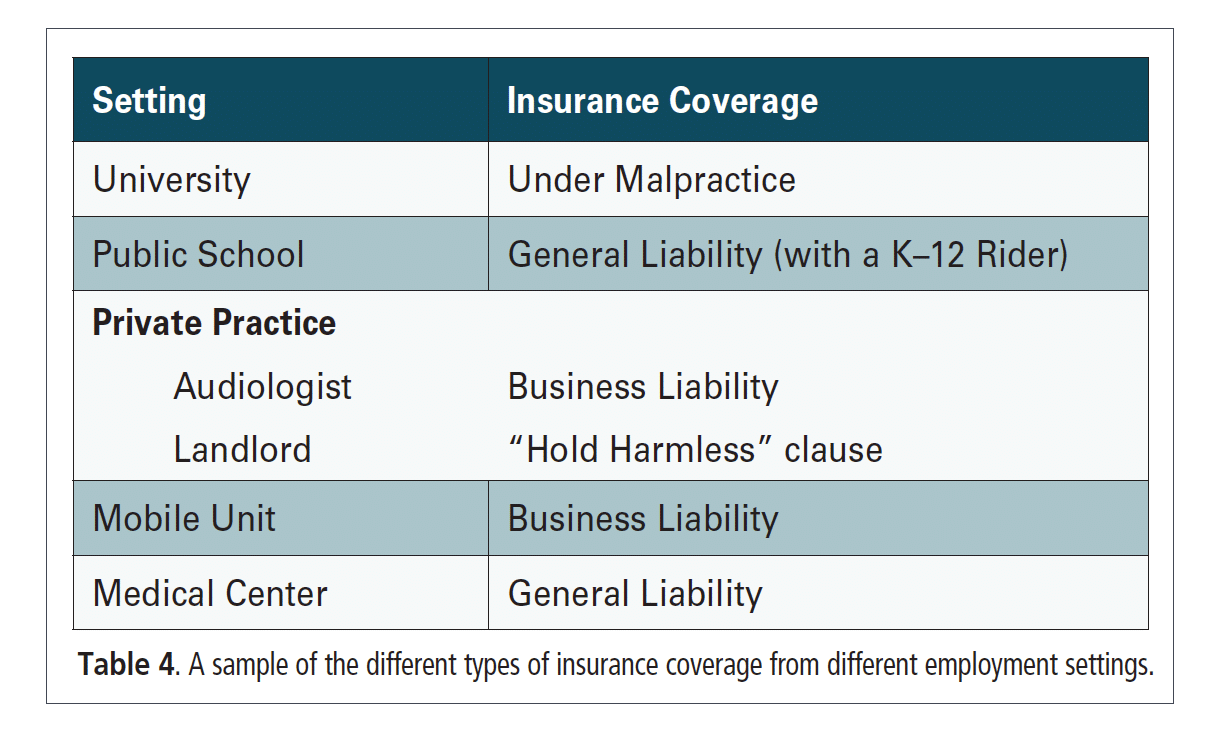
Always check with your individual professional liability insurance carrier to determine if any emergency medical intervention actions (or the actions by your staff) will hold you harmless (or your landlord for business owners) in a lawsuit or if there is a limit on liability. In-office emergencies are usually covered under “general liability,” but it’s best to have it in writing.
Table 4 shows five work settings and the sample insurance coverage for a “trip and fall” type of accident.
Summary
While medical emergencies are rare in most audiology practices, being prepared for whatever may occur is essential. Having training and a plan can provide a positive outcome for patients if an emergency occurs during their audiology appointment. Readily available programs, like basic life support (BLS) training, provide everyone on a healthcare team with training on how to respond in a medical emergency.
Having an emergency action plan ensures everyone in a practice can respond immediately when an emergency occurs. With a regularly reviewed plan, all staff will be aware of the locations of a first aid kit, AED, and any sugary drinks or food available in the office.
Knowledge, training, and planning can make the difference between life and death for a patient presenting with a medical emergency in your office.
Get certified in CPR and ECC. And most of all, get to know your first responders!
About the Authors
Robert M. DiSogra, AuD, is an audiology consultant and serves as VP for outreach for The Audiology Project (www.theaudiologyproject.com). Kaitlyn M. Kennedy, AuD, is an audiologist in the Department of Special Education for St. Louis Public Schools in Missouri.
Featured image: © Robert Young | Dreamstime.com
References
1. Malamed S. Medical Emergencies in the Dental Office. 8th ed. St. Louis, Mo: Elsevier; 2022.
2. Jevon P. 2020. Medical emergencies in the dental practice poster: revised and updated. Br Dent J.2020;229(2):97–104. https://doi.org/10.1038/s41415-020-1789-y
3. American Psychological Association. 2024. Patient Health Questionnaire – 9). www.apa.org/depression-guideline/patient-health-questionnaire.pdf
4. Anxiety and Depression Association of America. 2024. GAD-7 anxiety scale. https://adaa.org/sites/default/files/GAD-7_Anxiety-updated_0.pdf
5. Bhanari P, Nikokopoulou K. 2023. What is a Likert Scale? Guide & Examples. Scribbr. https://www.scribbr.com/methodology/likert-scale
6. DiSogra RM. 2022, 2024. Survey: medical emergencies in the audiology office. Facebook, Audiology Happy Hour
7. American Psychological Association. 2024. Stress effects on the body. www.apa.org
8. Academy of Doctors of Audiology. 2020. Accreditation standards for audiology programs. https://www.audiologist.org/_resources/documents/about/academy-docs/Accreditation-Standards.pdf
9. American Heart Association. 2024. CPR. https://cpr.heart.org/en/
10. American Red Cross. CPR steps. American Red Cross. https://www.redcross.org
11. Network for Public Health Law. 2017. Legal liability protections for emergency medical and public health responses. www.networkforphl.org/wp-content/uploads/2020/01/Legal-Liability-Protections-for-Emergency-Medical-and-Public-Health-Responses.pdf
12. Toback SL. Medical emergency preparedness in office practice. Am Fam Physician. 2007;75(11):1679–1684