
This article provides clinical and research evidence to support the use of the new NAL-NL3 prescription for hearing aid fittings.
By Vicky Zhang, Justin Zakis, Padraig Kitterick, and Brent Edwards
Over the past several decades, the National Acoustic Laboratories (NAL) has been leading the development of widely adopted hearing aid prescriptions. This progression began with the original NAL fitting rule [1], followed by NAL-R [2], NAL-RP [3], NAL-NL1 [4, 5], and most recently, NAL-NL2 [6]. NAL-NL2 has been implemented globally across more than 70 companies, including all major hearing aid manufacturers and real-ear measurement (REM) equipment providers, and a wide range of over-the-counter hearing aid products.
Since its release in 2011, NAL-NL2 has become the clinical standard for hearing aid prescription by maximizing speech intelligibility while ensuring that speech is no louder than with normal hearing. NAL-NL2 introduced a range of user-specific refinements over its predecessor, including user-specific modifications based on factors such as gender [7, 8], user experience with hearing devices [7, 8], language background [6], and stage of acclimatization [8, 9]. These refinements allowed clinicians to provide more individualized fitting targets tailored to user needs.
Consistent with other major prescription formulae (e.g. DSL and earlier NAL versions), NAL-NL2 generated gain targets that could be objectively verified using REM, a technical process which has been widely regarded as the gold standard for verifying hearing aid fittings (e.g.[10-16]). REM objectively measures the sound delivered by a hearing aid directly at the eardrum by placing a small probe microphone into the ear canal. Unlike simulations or approximations, it captures how the individual’s unique ear shape and hearing aid acoustics interact in real-world conditions. This allows hearing care professionals to ensure that amplification is appropriately matched to the user’s hearing loss, based on the selected prescription formula.
Numerous studies have demonstrated that REM-verified fittings are associated with reduced mismatch errors [10, 17, 18], improved speech recognition [10, 18], and higher satisfaction [19, 20]. A meta-analysis, for instance, reported that at least twice as many hearing aid users prefer REM fitting over the manufacturer’s initial fit [18], while other studies found that 64% to 80% of fittings without REM verification fail to meet prescription targets which may potentially compromising speech intelligibility and user satisfaction [10, 17]. Research consistently underscores how accurate objective fitting directly influences perceived benefit and satisfaction. However, the effectiveness and clinical significance of REM ultimately depends on the prescription’s ability to produce relevant and flexible targets for diverse hearing needs.
Why a Modern Prescription Is Needed
While NAL-NL2 marked a substantial advancement at the time of its release and it has proved highly effective for typical audiometric configurations, clinicians increasingly encountered challenges when applying NAL-NL2 to atypical audiograms, such as reverse-slope or mixed losses. In addition, NAL-NL2 prescribes no insertion gain for people with minimal hearing loss but significant speech-in-noise difficulties. As a result, this specific group of people with hearing needs are often unable to benefit from the advanced features provided by modern hearing technologies, highlighting a growing clinical need not addressed by existing prescriptive logic. In many such cases, frequent manual adjustments, particularly in complex listening environments, were required. These workarounds introduced inconsistency across fittings, reducing efficiency and diminishing confidence in the prescription. These limitations likely reflect the fact that NAL-NL2 was developed to optimize speech in quiet listening environments and, although it used groundbreaking technologies for the time (e.g. a neural network), could not leverage the newer technologies and greater capacity to learn from large clinical datasets that we now have access to.
While optimizing speech intelligibility remains a key objective, today’s expectations of modern prescriptions and devices have gone beyond listening in quiet environments. It is largely driven by rapid technological innovation and shifting consumer expectations. As MarkeTrak data from the late 2010s showed [21], a growing segment in hearing aid users’ needs now prioritize comfort in complex listening environments, support for minimal or hidden hearing loss, and greater control over their devices. These users seek personalized solutions that perform effectively across diverse environments, while they also value sound quality and ease of use in hearing devices. This trend reflects a broader shift toward lifestyle-oriented and user-centered hearing care.
Consequently, modern prescriptions should be grounded in real-world data, capable of modeling a wide range of audiometric configurations, and adaptable to the needs of both first-time hearing aid users and those with complex hearing losses. A gold-standard prescription must be supported by evidence from both research and clinical practice, demonstrate effectiveness in achieving its intended outcomes, and be practically usable in everyday clinical settings to foster clinician confidence and adoption. Evidence of benefit should also span quiet and noisy environments, subjective comfort, loudness perception, user satisfaction, ease of fitting, and overall usability. Seamless integration into clinical workflows and responsiveness to individual patient profiles are now essential benchmarks for prescriptive excellence.
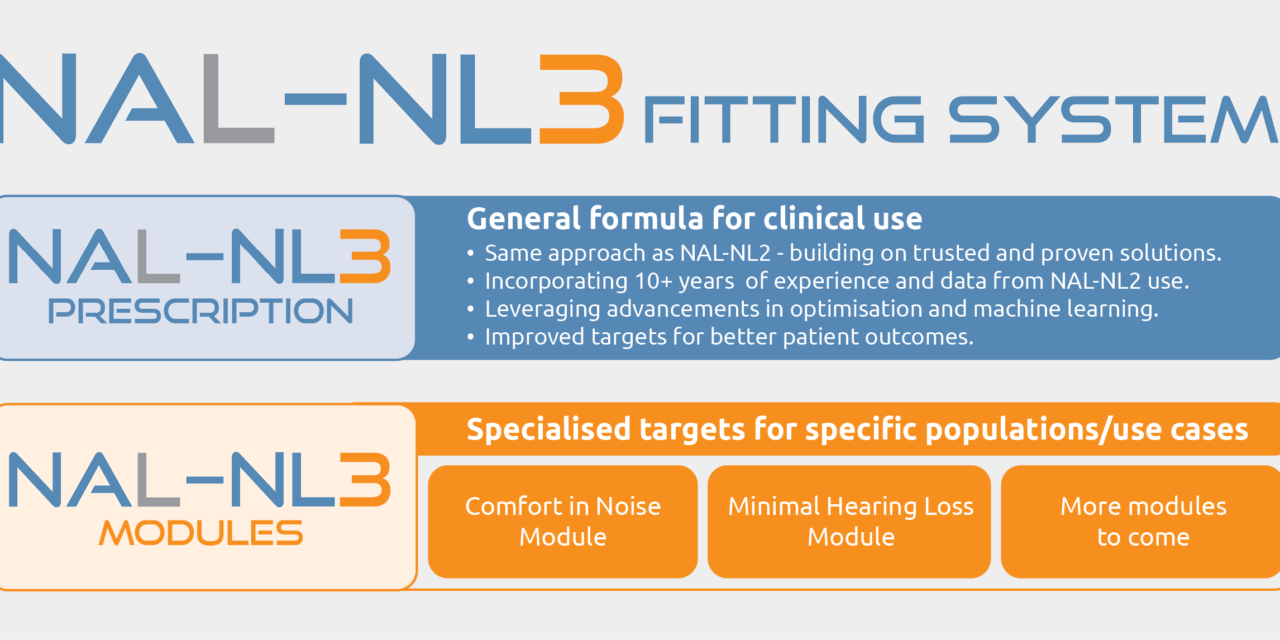
To address emerging demands, NAL developed NAL-NL3, a next-generation hearing aid fitting system, which consists of the core Prescription and specialized Modules designed for modern hearing care. This article presents the rationale behind NAL-NL3’s development, the methodological innovations that underpin it, and early clinical evidence [22, 23] that support its designation to redefine best-practice standard in hearing aid fitting.
Clinical Framework of the NAL-NL3 Prescription
NAL-NL3 is not merely a revision of its predecessor, but a transformation in prescription philosophy, moving from a one-size-fits-all model to a modular design built from both retrospective insights and large-scale prospective empirical validation.
The NAL-NL3 Prescription was developed based on an analysis of large datasets of real-world hearing aid fittings. The data were organized around common audiometric profiles and atypical configurations, such as steep slopes, reverse slopes, and mixed losses. Gain targets within the NAL-NL3 Prescription were optimized to find gain patterns by exploring thousands of possible fittings per audiogram, while consistently balancing speech intelligibility with loudness across input levels [24]. The data-driven optimization is stabilized by a set of explicit principled constraints derived from clinical data and fitting experience. Reverse-slope audiograms are fitted more conservatively at low frequencies to minimize noise intrusion, own-voice resonance, and masking effects. For conductive and mixed losses, a smoother gain shaping is used to better reflect true hearing sensitivity across frequencies and to improve alignment with real-ear measurements. The optimized gains and corresponding audiograms were used to train a deep neural network, which was then able to learn patterns to prescribe the optimized gain for any audiogram. In addition, compression behavior is further refined by applying compression ratio limits to ensure fast-acting compression remains within clinically preferred bounds and supports better sound quality and temporal clarity.
The foundation of the NAL-NL3 Prescription remains the long-standing NAL prescription rationale of maximizing speech intelligibility while keeping loudness at or below normal levels. By incorporating these hybrid optimization techniques and principled constraints, NAL-NL3 addresses common clinical pain points and clinical feedback indicates that it also reduces the need for manual fine-tuning, particularly in complex audiometric configurations. Building on this foundation, the NAL-NL3 Fitting System also introduces two additional targeted Modules:
- Comfort in Noise (CIN): For hearing aid users with mild or greater hearing loss and designed to improve listening comfort in challenging noisy environments without compromising intelligibility.
- Minimum Hearing Loss (MHL): For individuals with normal or near-normal thresholds who experience speech understanding difficulties in noise.
This modular design aims to address user-specific listening goals and supports fitting strategies tailored to individual context and lifestyle. Going forward, this flexible design will also enable future expansion, allowing NAL to release additional modules in response to clinician feedback and emerging needs.
Clinical Evaluation of NAL-NL3 Fitting System
The NAL-NL3 Prescription has been evaluated through a combination of expert clinical review of prescriptive targets, objective modeling, in-clinic trials, and real-world data collected across multiple phases of development. Detailed statistical analyses and full reports have been submitted for publication in an upcoming special issue of the International Journal of Audiology [24]. Below, we present selected results across key domains.
Expert review of target gains
To evaluate the clinical appropriateness of insertion gains generated by the NAL-NL3 Prescription, an interactive review tool was developed in-house and used by experienced clinicians to assess gain targets across a wide range of audiograms. Clinicians provided structured feedback on overall suitability and identified specific concerns where present (e.g., excessive high-frequency gain). These expert ratings directly informed iterative optimization refinements to ensure that the target gains used for model training did not display any unexpected behavior. For a small subset of complex audiograms where baseline optimization did not meet expert expectations, a more advanced two-stage optimization framework was selectively applied to search for improved solutions. The iterative, expert-informed refinement improved the quality and robustness of the training targets that underpin the NAL-NL3 Prescription [24].
Objective evaluation
Objective analyses were also conducted to assess how the NAL-NL3 Prescription performed relative to NAL-NL2 across key acoustic and perceptual metrics. Overall, across a wide range of audiometric configurations and input levels, the NAL-NL3 Prescription preserved the core NAL design principle of maximizing speech intelligibility while maintaining loudness at or below normal limits. Specifically, the results demonstrated that predicted desensitized speech intelligibility indices (SII) were comparable to, and in some cases slightly higher than, those obtained with NAL-NL2 across input levels, indicating that the refinements did not compromise access to speech cues [24].
In addition, NAL-NL3 demonstrated improved control of compression behavior, with prescribed outputs consistently adhering to clinical preferred compression ratio limits. These combined objective improvements were observed consistently across both common and less typical audiometric configurations, such as for steeply sloping, reverse-slope, and mixed losses. By explicitly modeling a broad range of real-world audiograms during development, NAL-NL3 reduced variability in prescribed targets compared with NAL-NL2, so NAL-NL3 provides a more consistent first fit in terms of loudness and intelligibility across audiograms.
Clinical use and clinician feedback
Clinician feedback was collected on feasibility, usability, ease of integration into clinical software, time required for fine-tuning, and subjective satisfaction. A total of 44 qualified clinicians participated across 33 sites in Australia covering 263 fittings. Clinicians reported a largely smooth transition from NAL-NL2. Most clinicians described easy integration into existing fitting software and clinical programming workflows. For new fittings, about 60% of clinicians rated NAL-NL3 as easier to use than NAL-NL2, with no reports of increased difficulty. Similar trends were observed for existing hearing aids users and for more complex mixed-loss cases when transitioning from NAL-NL2 [24].
Clinicians frequently noted improved alignment between NAL-NL3 targets and real-ear measurements across a wide range of audiometric configurations. This closer alignment reduced the need for manual fine-tuning and shortened appointment times. Many clinicians commented that adjustments previously applied manually for complex cases were now incorporated directly into the prescriptive logic, resulting in fewer instances requiring substantial post-fit gain modification. These findings support the role of the NAL-NL3 Prescription as a robust default fitting strategy suitable for routine clinical use. Overall, clinicians reported increased confidence in ease of fitting, greater consistency across fittings, and improved efficiency within routine clinical workflows.
Observed outcomes in Modules
Results from the Comfort in Noise (CIN) and Minimum Hearing Loss (MHL) Modules further demonstrate how the NAL-NL3 Fitting System can be adapted to address specific listening goals.
For the CIN Module, laboratory and real-world evaluations in adults with mild to severe hearing loss showed that overall speech loudness was reduced by approximately 30%–35% (on average) relative to the NAL-NL3 Prescription, while maintaining comparable speech intelligibility in noise. Real-world ecological momentary assessment data indicated that when participants preferred the CIN Module in noisy environments, they consistently reported that it improved naturalness and comfort while reducing listening effort and loudness, indicating that lower gain in noise can substantially improve comfort without compromising understanding [25].
For the MHL Module, evaluations in adults with normal or near-normal audiograms but self-reported hearing difficulties demonstrated that by prescribing modest positive insertion gain (minimum 3-4 dB from 1-4 kHz), the MHL module enabled more effective use of modern hearing aid features such as directionality and noise reduction. This change resulted in measured improvements in speech perception in noise due to the improved signal-to-noise ratio from the hearing aids. Real-world evaluations demonstrated a clear user preference for the MHL Module compared to the Prescription (0 dB gain for normal audiograms), with participants reporting that with closed domes it made speech easier to understand with equivalent comfort and own-voice quality in everyday noisy environments [26].
Together, these module-specific findings illustrate how the NAL-NL3 Fitting System supports targeted, needs-based adaptations while remaining a consistent underlying core prescription rationale.
Conclusion
Developed using real-world data and advanced machine-learning techniques, the NAL-NL3 Fitting System marks what we believe is a new and exciting chapter in prescriptive audiology. It is the result of extensive empirical analysis, clinician-informed refinement, and a commitment to integrating real-world behavior into prescription logic. The modular design of the NAL-NL3 Fitting System offers the potential for both improved clinical outcomes and better workflow integration.
More than a technical update, the NAL-NL3 Fitting system is a practical tool for delivering individualized care with greater confidence and efficiency. It supports improved first-fit accuracy, better comfort outcomes, and broader fitting options, including for people with minimal or no audiometric hearing loss but significant hearing difficulty. As additional modules are introduced, the NAL-NL3 Fitting System will continue to evolve with clinician and industry feedback. We invite clinicians to adopt NAL-NL3 Fitting System in practice, offer feedback, and contribute to an ongoing evolution of personalized hearing care. Detailed guidance on how to use the NAL-NL3 fitting system in clinical practice is available in an open-access Clinical Note [27].
Acknowledgements
The authors of this article gratefully acknowledge that the research described here was conducted by a large collaborative team at the National Acoustic Laboratories (NAL), led by Dr Padraig Kitterick and Dr Justin Zakis. Their leadership, along with the contributions of the entire NAL-NL3 team, were instrumental in the development and validation of the NAL-NL3 Prescription and the NAL-NL3 Modules.
About the Authors
Vicky Zhang, PhD, is a senior research audiologist and line manager who joined the National Acoustic Laboratories (NAL) in Australia in 2009. Justin Zakis, BEng (Hons), PhD, joined NAL in 2024 as a principal research engineer. Prior to that, he led research and human studies on hearing-aid signal processing algorithms and self-fitting software at Blamey Saunders Hearing and Sonova Audiological Care Australia. Padráig Kitterick, PhD, head of Audiological Science at NAL, leads the audiological sciences team, focusing on bridging the gap between scientific discovery and clinical practice. With a background in psychology and auditory neuroscience, he brings expertise in complex auditory processing, auditory device outcomes, and evidence-based clinical implementation. Brent Edwards, PhD, is a global leader in hearing research and innovation. As director of the National Acoustic Laboratories, he oversees a multidisciplinary team dedicated to advancing hearing healthcare through cutting-edge science and technology.
References
1. Byrne, D. and W. Tonisson, Selecting the gain of hearing aids for persons with sensorineural hearing losses. Scand Audiol, 1976. 5: p. 51-59.
2. Byrne, D. and H. Dillon, The National Acoustic Laboratories’ (NAL) new procedure for selecting the gain and frequency response of a hearing aid. Ear Hear, 1986. 7(4): p. 257-65.
3. Byrne, D., A. Parkinson, and P. Newall, Modified hearing aid selection procedures for severe/profound hearing losses, in The Vanderbilt hearing aid report II, G.A. Studebaker, F.H. Bess, and L. Beck, Editors. 1991, York Press: Parkton, MD. p. 295–300.
4. Byrne, D., et al., NAL-NL1 procedure for fitting nonlinear hearing aids: characteristics and comparisons with other procedures. J Am Acad Audiol, 2001. 12(1): p. 37-51.
5. Dillon, H., NAL-NL1: A new procedure for fitting non-linear hearing aids. The Hearing Journal, 1999. 52(4): p. 10,12,14,16,.
6. Keidser, G., et al., The NAL-NL2 Prescription Procedure. Audiol Res, 2011. 1(1): p. e24.
7. Keidser, G. and H. Dillon, Chapter 10: What’s new in prescriptive fittings Down Under?, in Hearing Care for Adults C.V. Palmer and R. Seewald, Editors. 2006, Phonak AG: Stäfa, Switzerland. p. 133-142.
8. Keidser, G., et al., Variation in preferred gain with experience for hearing-aid users. Int J Audiol, 2008. 47(10): p. 621-35.
9. Keidser, G., D. Hartley, and L. Carter, Long-term usage of modern signal processing by listeners with severe or profound hearing loss: a retrospective survey. Am J Audiol, 2008. 17(2): p. 136-46.
10. Valente, M., et al., Differences in word and phoneme recognition in quiet, sentence recognition in noise, and subjective outcomes between manufacturer first-fit and hearing aids programmed to NAL-NL2 using real-ear measures. J Am Acad Audiol, 2018. 29(8): p. 706-721.
11. Zitelli, L. and C. Palmer, Chapter 4: Introduction and getting ready for real-ear probe microphone measures. Semin Hear, 2024. 45(2): p. 205-215.
12. Mueller, H.G., Probe microphone measurements: 20 years of progress. Trends Amplif, 2001. 5(2): p. 35-68.
13. Brügel, F.J. and K. Schorn, In-situ measurement as necessary component of hearing aid fitting. Laryngo-Rhino-Otologie, 1991. 70(11): p. 616-619.
14. Jorgensen, L.E., Verification and validation of hearing aids: Opportunity not an obstacle. J. Otol., 2016. 11(2): p. 57-62.
15. Jorgensen, L.E. and M. Novak, Verification and Validation: Just the Standards. Semin Hear, 2022. 43(2): p. 85-93.
16. Bentler, R., H.G. Mueller, and T.A. Ricketts, Modern hearing aids: Verification, outcome measures, and follow-up. 2016: Plural Publishing.
17. Aazh, H. and B.C. Moore, The value of routine real ear measurement of the gain of digital hearing aids. J Am Acad Audiol, 2007. 18(8): p. 653-64.
18. Almufarrij, I., H. Dillon, and K.J. Munro, Does probe-tube verification of real-ear hearing aid amplification characteristics improve outcomes in adults? A systematic review and meta-analysis. Trends Hear, 2021. 25: p. 2331216521999563.
19. Hickson, L., et al., Factors associated with success with hearing aids in older adults. Int J Audiol, 2014. 53(Suppl 1): p. S18-27.
20. Nam, G.S., et al., Comparison between the International Outcome Inventory for Hearing Aids Questionnaire and real-ear measurement. Audiol Neurootol, 2025. 30(1): p. 52-57.
21. Edwards, B., Emerging technologies, market segments, and MarkeTrak 10 insights in hearing health technology. Semin. Hear., 2020. 41(1): p. 37-54.
22. Edwards, B. and P. Kitterick. The Next Generation Hearing Aid Fitting System. in AAA 2025+HearTECH Expo. 2025. New Orleans, LA.
23. Edwards, B., P. Kitterick, and J. Zakis. The Next Generation Hearing Aid Fitting System. in Audiology Australia Conference. 2025. Adelaide, Australia.
24. Kitterick, T. P. et al., Development and validation of the NAL-NL3 Prescription (in revision). Int J. Audiol., 2026.
25. Kitterick, T. P. et al., A New approach to hearing aid gain prescription for listening in noise: The NAL-NL3 Comfort In Noise module. Int J. Audiol., 2026. Published online ahead of print. doi: 10.1080/14992027.2026.2725523.
26. Kitterick, T. P. et al., Fitting hearing aids beyond the audiogram: the NAL-NL3 Minimal Hearing Loss Module (in revision). Int J. Audiol., 2026.
27. Croteau, M., and Kwok, C., Using NAL-NL3 in clinical practice: a modular NAL fitting system for real-world listening needs. Int J. Audiol., 2026. Published online ahead of print. doi: 10.1080/14992027.2026.2680131.


