By Christopher Slugocki, PhD; Francis Kuk, PhD; Petri Korhonen, MSc; and Heidi Peeters, MA
A study of Widex’s Clarity Boost AI noise-reduction technology found that preserving natural sound quality improved speech understanding in challenging noisy environments and reduced neural markers of listening effort, even when speech intelligibility was already high.
Introduction
Modern hearing aids are increasingly using artificial intelligence (AI) to help separate speech from background noise. The goal of these technologies is to help make conversations easier to follow by improving how much speech a person understands. However, there is growing recognition in audiological science and hearing healthcare that sustained success with hearing aids and consequent enhanced social engagement involves more than simply maximizing the number of words a listener is able to recognize correctly in noisy situations. How natural sounds are perceived (Lelic et al., 2024), how comfortable listening feels (Kuk et al., 2024), and how much mental effort is required to follow a conversation (Kiliç et al., 2022) are also important aspects of the holistic listening experience, and these factors can have tangible impacts on a listener’s socio-emotional well-being (Mamo & Henckel, 2022; Timmer et al., 2024).
Many AI-based noise reduction systems rely on deep neural networks (DNNs), a form of machine learning that has been trained to take input audio signals containing mixtures of speech and noise and transform them into output signals that contain mostly speech and much less noise. Although these systems have been shown to improve speech understanding, they may also alter the acoustic characteristics of sounds in ways that feel unnatural to listeners. In some cases, the DNN algorithm can introduce subtle distortions or artifacts to the audio output. Such artifacts may then increase demand on the listener’s cognitive resources to reconstruct missing or distorted speech sounds, which can increase feelings of listening effort and fatigue following social interactions (Peelle, 2018) even in situations where speech recognition performance remains high.
For decades, Widex hearing aids have been developed with a focus on preserving natural sound quality to support the way the brain would normally process acoustic input. Indeed, Korhonen et al., (2026) recently showed that a focus on natural sound alone can provide speech-in-noise (SiN) performance advantages over DNN-based noise reduction systems. This design philosophy has also guided the development of Clarity Boost, a DNN-based noise reduction system introduced in the Widex Allure AI RIC hearing aid. Rather than focusing exclusively on maximizing speech intelligibility, Clarity Boost was engineered to help users understand speech while preserving sound qualities that contribute to naturalness, listening comfort, and awareness of the surrounding environment. By leveraging a Large Audio Foundation Model (LAM), a new generation of AI models trained on extensive collections of real-world sounds and speech, Clarity Boost was able to learn how sounds naturally occur and evolve over time, allowing the system to reduce unwanted noise while maintaining the sound characteristics that listeners rely on to process the acoustic world with minimal cognitive strain.
Recent work by Slugocki et al. (2026a) compared Clarity Boost processing with the default (i.e., non-DNN) Universal program of the Widex Allure hearing aid. That study found that Clarity Boost improved speech understanding in difficult listening conditions, where SiN intelligibility was about 50%, while also reducing listeners’ reported effort and increasing hearing comfort. More interestingly, in listening conditions where speech understanding was already very good (≥ 90% intelligibility) and did not differ between the two programs, participants still reported that listening felt easier and more comfortable with Clarity Boost. The finding of lower reported listening effort in noisy conditions where speech intelligibility is already at 90% is particularly compelling in that such conditions are more realistic for supporting real-world communication (Letowski & Scharine, 2017) and tend to reflect the majority of everyday communication situations encountered by real hearing aid users (Smeds et al., 2015).
To better understand the observed SiN benefits of Clarity Boost reported by Slugocki et al. (2026a), the present study analyzed brain activity recorded using electroencephalography (EEG) while listeners in that study were performing SiN testing. Specifically, we examined ongoing neural oscillatory activity in the alpha frequency band (7–14 Hz), which is commonly observed to increase with the difficulty of SiN tasks and has been considered as a neural marker of exerted listening effort (Dimitrijevic et al., 2019; Slugocki et al., 2024a).
Measurement of alpha-band power has also been shown useful for evaluating and comparing hearing aid technologies (Slugocki et al., 2024b). Here, it was expected that the Clarity Boost program would reduce alpha-band activity, indicating reduced mental effort, compared to the Universal program in challenging listening conditions (i.e., 50% speech recognition) where speech understanding benefits had already been demonstrated. We further explored whether differences in alpha-band activity would also emerge in conditions where speech intelligibility was high (i.e., 90% speech recognition) and equally good for both hearing aid programs, but where listeners still reported greater comfort and lower effort with Clarity Boost compared to Universal processing. Demonstrating such an effect would not only corroborate listeners’ subjective impressions of listening effort and comfort reported in Slugocki et al. (2026a) but go further to suggest that hearing aid technologies can improve the listening experience in ways that are not easily captured by speech recognition scores alone.
Methods
Participants
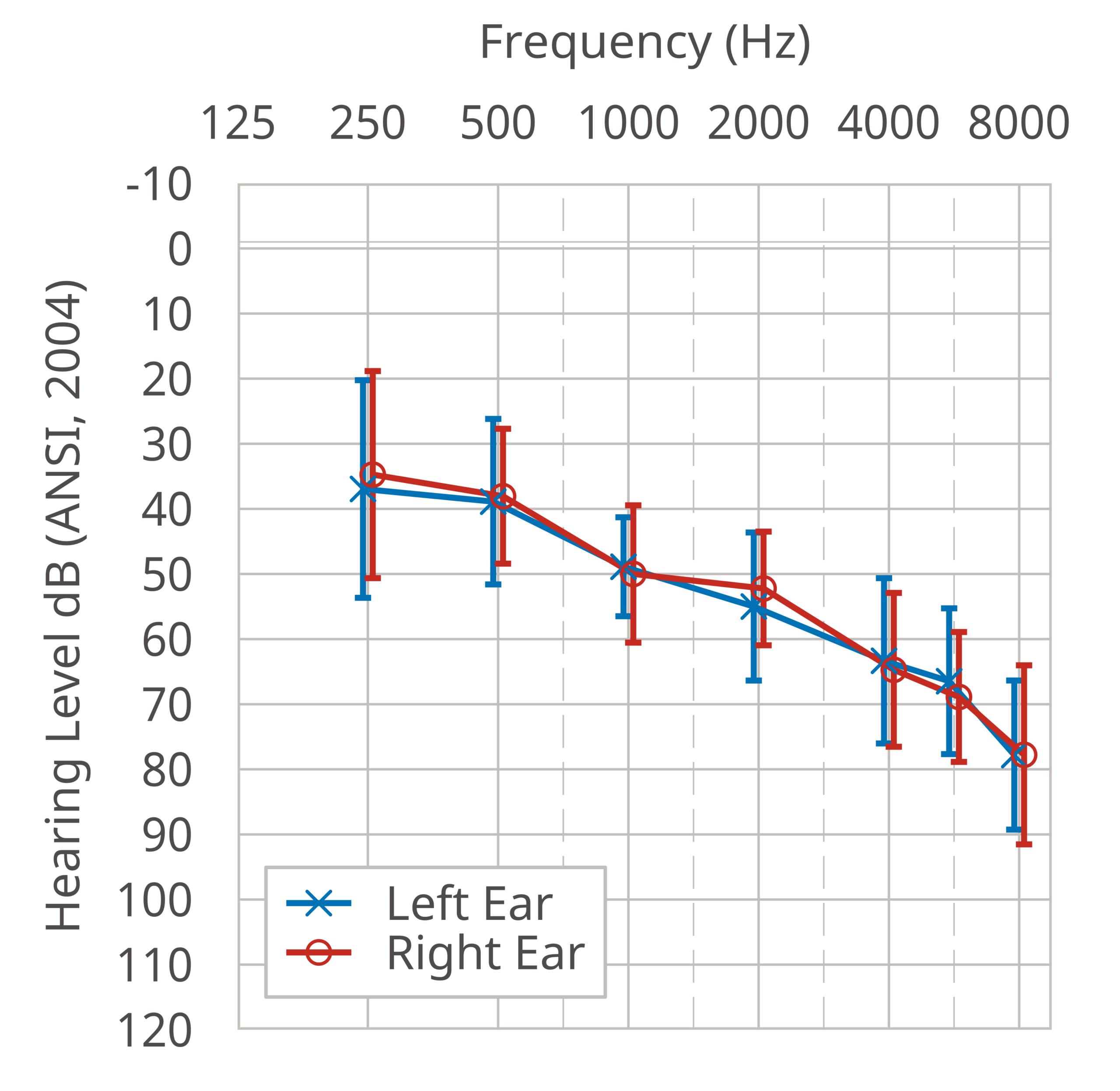
Eighteen older adult native English speakers (mean age = 73.2 years, range = 55–84 years, 8 females) with moderate-to-severe symmetrical sensorineural hearing loss (Figure 1) and normal cognitive function participated in the study. Participants had average bilateral four-frequency pure-tone averages (PTA4s) of 51.4 dB HL (range = 38.1–70.6 dB HL). Sixteen of the 18 participants were experienced bilateral hearing aid wearers with more than one year of experience (mean experience = 16.9 years, range = 2–63 years). Two of the participants were not current hearing aid wearers.
Study Hearing Aids
Participants were fitted bilaterally with Widex Allure AI receiver-in-canal (RIC) hearing aids. The study aids were programmed for each participant’s hearing loss according to the Widex fitting formula at 100% prescription gain and coupled using instant fit ear tips as recommended by Widex’s Compass Cloud fitting software (15 participants fitted with fully occluding double domes and three fitted with partly vented tulips). Feedback tests were conducted for all fittings prior to testing.
The Allure AI RIC study aids were configured with two programs. The first was the default Widex Universal program and the second was the Clarity Boost program that activates a dedicated AI co-processor (Bianchi et al., 2026).
Test setup and procedure
Alpha activity was measured while aided listeners performed SiN testing following the protocol described in Slugocki et al. (2026a). In brief, all testing took place with listeners seated in the center of a sound-treated booth surrounded by eight identical loudspeakers. The loudspeakers were located at a distance of 1 meter from the listener’s seated position and separated from one another by 45° in the azimuth. Target speech sentences drawn from the Repeat-Recall Test (RRT) speech corpus (Slugocki et al., 2018; Kuk et al., 2021) were presented one at a time in an alternating manner between loudspeakers positioned to the listeners’ sides (i.e., ±90°) at a level of 68 dBA SPL. Sentences were always presented in the presence of an ongoing background noise designed to simulate the acoustic environment of a busy cafeteria. The background noise was created by playing unique recordings of a real-life cafeteria lunch service from each of the eight loudspeakers surrounding the listener.
Testing involved two phases. In the first phase, a Bayesian-guided adaptive protocol known as the ezSRT test (Slugocki et al., 2026b) was used to determine individualized SNRs for each listener that targeted speech reception threshold (SRT) performance levels of 50% and 90% intelligibility (i.e., SRT50 and SRT90). The ezSRT test adaptively varied the combined level of background noise, and hence the effective test SNR, according to the listener’s accuracy of repetition for pre-determined target words across all preceding test trials. By selecting test SNRs according to Bayesian principles of entropy minimization, the ezSRT test is able to reliably estimate the listener’s complete performance-intensity (P-I) function for SiN using only 24 test sentences. Adaptive testing with the ezSRT test was always conducted with listeners wearing the Widex Allure AI-RIC in the Universal program. Estimated P-I functions were used to derive SNRs corresponding to 50% and 90% word-level intelligibility.
In the second test phase, listeners were fit with the EEG measurement caps and then performed SiN testing at fixed (i.e., non-adaptive) SNRs. Fixed SNR testing largely followed the protocol described for the adaptive ezSRT test, except that now the combined level of the background noise was fixed across all test sentences to produce SNRs targeting performance levels of SRT50 and SRT90. Each SRT performance level was tested separately for each of the study aid programs (i.e., Universal and Clarity Boost) with the order of SRT performance levels and study programs counterbalanced across participants. For each combination of study program and SRT level, listeners were also asked to provide ratings of listening effort and hearing comfort, both collected on 10-point Likert-type scales after the final test sentence. During this fixed SNR testing, listener EEG was recorded using 19 Ag/AgCl sintered electrodes positioned according to the 10-20 system. High forehead placement was used as ground and bilateral earlobe electrodes were used as references. Alpha activity was quantified by power in the EEG spectrum between 7–14 Hz.
Results
Behavioral results from Slugocki et al. (2026a) relevant to the current EEG study are summarized in Figure 2. When tested at individualized SNRs targeting SRT50, listeners correctly heard, on average, 20.5% more target words in the Clarity Boost program compared to the Universal program. Perhaps not surprisingly, in the SRT50 condition, listeners also rated listening to SiN as significantly less effortful and significantly more comfortable in the Clarity Boost program compared to the Universal program.
More interestingly, when tested at the higher performance level of SRT90 that is more “realistic” for supporting real world communication, there was no significant difference in SiN intelligibility between the two study programs. However, at SRT90 listeners still rated listening to be significantly less effortful and significantly more comfortable for the Clarity Boost program relative to the Universal program of the Widex Allure AI-RIC study aids.
Alpha-band EEG activity analyzed in the current study was found to align with the listeners’ subjective impressions of easier and more comfortable SiN listening for the Clarity Boost program over the Universal program. Figure 3 (top)compares the average scalp topography of participants’ alpha activity as they listened to the target sentences presented in the complex cafeteria-like background noise. As expected, alpha power measured over centro-posterior electrodes (i.e., those positioned around the mid-to-back of head as highlighted by white dots in Figure 3, top) appears to be stronger when measured in the more challenging SRT50 listening condition compared to the easier SRT90 listening condition. More critically, statistical analysis using linear mixed effects models confirmed that listeners’ alpha-band power was significantly lower for the Clarity Boost program relative to the Universal program in both the SRT50 (χ2(1) = 5.79, p = 0.016) and SRT90 (χ2(1) = 4.55, p = 0.033) target reception levels (Figure 3, bottom).


Discussion
Taken together, the results of the current study suggest that the natural-sounding DNN-based denoising of the Clarity Boost program significantly reduces neural signatures of effortful listening relative to the default Universal program both in challenging listening conditions (i.e., SRT50) where Clarity Boost is observed to improve objective SiN performance as well as in easier listening conditions (i.e., SRT90) where SiN performance is equally good between the two programs.
Taken together, the results of the current study provide converging subjective and neural evidence that DNN-based denoising designed with a focus on natural sound, as implemented in the Clarity Boost program, can reduce listening effort in older adults with hearing loss. As expected, EEG power in the alpha-band was lower as listeners performed SiN testing in the more challenging SRT50 condition while their study aids were in the Clarity Boost program compared to the Universal program. This reduction in alpha activity is consistent with the observed improvements in speech recognition scores, as well as listening effort and hearing comfort ratings, suggesting that listeners required fewer cognitive resources to reconstruct masked speech when the speech was made more accessible by DNN-based noise reduction.
More notably, reduced alpha activity was also observed at the less challenging test condition of SRT90, where speech recognition performance did not differ between Clarity Boost and the non-DNN Universal program. This finding indicates that the benefits of Clarity Boost extend beyond improvements to SiN intelligibility alone, and suggests that training a DNN to preferentially preserve acoustic features which are perceptually relevant to human speech processing might help diminish the need to allocate attentional and working-memory resources to reconstruct speech signals in conditions with lower levels of background noise. Moreover, alignment between alpha-band effects and subjective rating outcomes strengthens the interpretation that listeners experienced a genuinely less demanding listening experience rather than simply a preference for one processing scheme over another.
From a clinical perspective, these findings underscore the importance of evaluating hearing aid technologies using outcome measures beyond speech recognition scores. While SiN intelligibility remains an essential metric, the current results demonstrate that meaningful differences in listening experience can exist even when intelligibility is near ceiling and equivalent between hearing aid processing schemes. Measures of listening effort, comfort, and neural engagement are valuable in providing complementary information about how hearing aid technologies influence a listener’s hearing experience in more realistic listening conditions that are challenging but still conducive to supporting communication.
Conclusion
Preserving natural sound quality in designing DNN-based denoising algorithms may help hearing aid users communicate with less cognitive effort across both more challenging listening situations, where technologies can produce measurable impacts on SiN performance, and less challenging listening situations where listener SiN performance may be at ceiling. Considering neural markers of effortful listening, like alpha-band activity, alongside speech understanding and subjective impression of listening effort may be particularly useful for both evaluating and better understanding the scope of impact that modern AI-driven hearing aid technologies have on those that use them to reconnect with the auditory world.
References
Bianchi, F., Oestergaard, M., & Nielsen, J. B. (2026). Introducing 3rd generation audio-specific AI: Expressive. Efficient. Engineered for Optimal Balance. WidexPress 60.
Dimitrijevic, A., Smith, M. L., Kadis, D. S., & Moore, D. R. (2019). Neural indices of listening effort in noisy environments. Scientific Reports, 9(1), 1–10.
Kiliç, S., Yiğit, Ö., & Türkyilmaz, M. D. (2022). Listening effort in hearing aid users: is it related to hearing aid use and satisfaction? Journal of the American Academy of Audiology, 33(06), 316–323.
Korhonen, P., Kuk, F., & Slugocki, C. (2026). Comparing Widex Allure with four DNN-based hearing aids on speech in noise performance. WidexPress 59.
Kuk, F., Slugocki, C., & Korhonen, P. (2024). Subjective speech intelligibility drives noise-tolerance domain use during the Tracking of Noise-Tolerance test. Ear and Hearing, 45(6), 1484–1495.
Lelic, D., Picou, E., Shafiro, V., & Lorenzi, C. (2024). Sounds of nature and hearing loss: A call to action. Ear and Hearing, 46(2), 298–304.
Letowski, T. R., & Scharine, A. A. (2017). Correlational analysis of speech intelligibility tests and metrics for speech transmission (No. ARLTR8227).
Mamo, S. K., & Henckel, T. (2022). A holistic approach to addressing post-fitting needs in the short and long term for new hearing aid users. Seminars in Hearing, 43, (2), 121–134).
Peelle, J.E. (2018). Listening effort: how the cognitive consequences of acoustic challenge are reflected in brain and behavior. Ear and Hearing, 39(2), 204–214.
Slugocki, C., Kuk, F., & Korhonen P. (2024a). Alpha-band dynamics of hearing aid wearers performing the Repeat-Recall Test (RRT). Trends in Hearing, 28(1), 1–15.
Slugocki, C., Kuk, F., & Korhonen, P. (2024b). Using Alpha-Band Power to Evaluate Hearing Aid Directionality Based on Multistream Architecture. American Journal of Audiology, 33(4), 1164–1175.
Slugocki, C., Kuk, F., & Korhonen, P. (2026a). Widex Allure AI RIC with Clarity Boost: Clarity and Comfort, Naturally Combined. WidexPress 63.
Slugocki, C., Kuk, F., Korhonen, P., & Peeters, H. (2026b). The Intelligibility-based Repeat-Recall Test (i-RRT): I. Bayesian-guided estimation of multiple speech reception thresholds. Ear and Hearing, Advance online publication. https://doi.org/10.1097/aud.0000000000001885
Smeds, K., Wolters, F., & Rung, M. (2015). Estimation of signal-to-noise ratios in realistic sound scenarios. Journal of the American Academy of Audiology, 26(02), 183–196.
Timmer, B. H., Bennett, R. J., Montano, J., Hickson, L., Weinstein, B., Wild, J., … & Dyre, L. (2024). Social-emotional well-being and adult hearing loss: Clinical recommendations. International Journal of Audiology, 63(6), 381–392.