
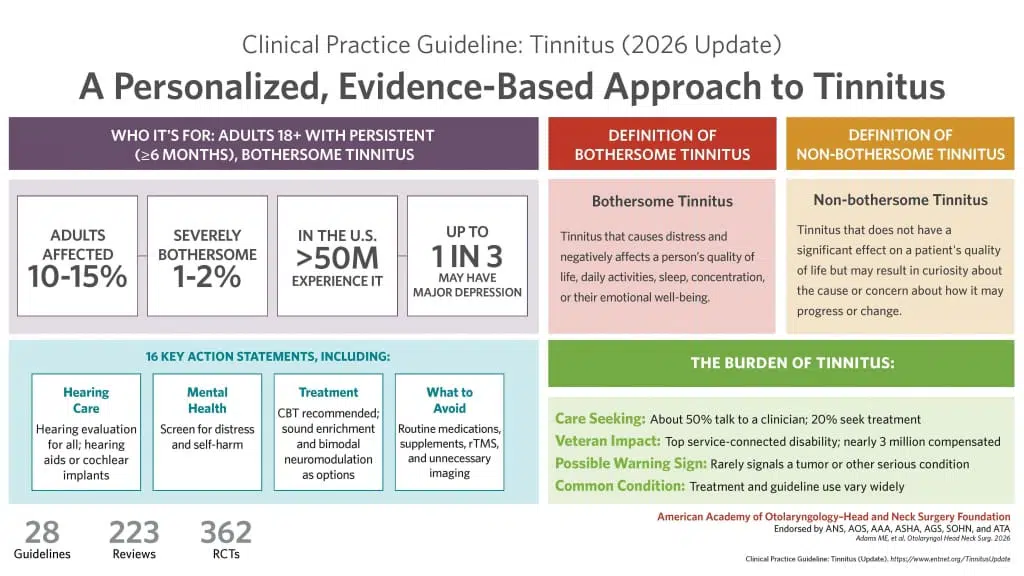
The American Academy of Otolaryngology–Head and Neck Surgery Foundation has released an updated clinical practice guideline on tinnitus, emphasizing a personalized, evidence-based approach to evaluation and management.
The American Academy of Otolaryngology–Head and Neck Surgery Foundation (AAO-HNSF) has published an updated Clinical Practice Guideline (CPG) for tinnitus, offering clinicians revised, evidence-based recommendations for the assessment and management of patients presenting with the condition. The update reflects advances in the evidence base since the original guideline was published by AAO-HNSF and is intended to support individualized, patient-centered care across the multidisciplinary tinnitus care team.
Tinnitus — the perception of sound in the absence of an external acoustic stimulus — affects a substantial portion of the adult population and represents one of the most common complaints encountered in audiology and otolaryngology practice. A 2020 study of tinnitus in the US documented the breadth of its prevalence, severity, and treatment patterns, underscoring the ongoing clinical need for clear, actionable guidance.
Scope and Target Population
The updated CPG addresses adults (18 years and older) with primary tinnitus — tinnitus that is idiopathic and not directly attributable to a specific underlying condition. The guideline is intended to assist otolaryngologists, audiologists, primary care physicians, and other clinicians who evaluate and manage patients with tinnitus in a variety of clinical settings.
Key Recommendations
The updated guideline reinforces and refines several areas of clinical practice, including the importance of distinguishing between primary and secondary tinnitus, appropriate use of diagnostic workup, and the role of validated outcome measures in tracking patient response to treatment.
Among the management recommendations, the guideline supports the use of structured counseling, sound-based therapies, and cognitive behavioral therapy (CBT) as evidence-supported interventions for patients with bothersome tinnitus. And the guideline addresses what clinicians should and should not offer patients — including recommendations against routine imaging, laboratory testing, and dietary supplement use in the absence of specific indications. It also includes new statements on self-harm, somatosensory tinnitus (tinnitus that changes with head, neck, or jaw movement), cochlear implantation, bimodal neuromodulation, and follow-up.
The CPG emphasizes a personalized approach, recognizing that the impact of tinnitus varies widely across patients and that management strategies should be tailored accordingly. Audiologists and other hearing care professionals are identified as central contributors to the tinnitus care continuum, particularly in the delivery of sound therapy, hearing aid fittings for patients with concurrent hearing loss, and tinnitus-focused counseling.
For context on how audiologists are currently approaching tinnitus services, see Toward Standardization of Basic Tinnitus Services by Audiologists and Integrating Tinnitus Treatment into Your Clinic.
Evidence Base and Guideline Development
The guideline was developed using a systematic review of the available evidence and reflects input from a multidisciplinary panel that included otolaryngologists, audiologists, neurologists, psychologists, and patient advocates. Recommendations are graded according to the strength of the supporting evidence, and the document includes action statements with accompanying evidence profiles.
The AAO-HNSF has noted that the guideline will be subject to periodic review and update as new evidence emerges — a recognition that the science of tinnitus management continues to evolve. Recent coverage on The Hearing Reviewhas tracked several developments in this space, including new insights on tinnitus from the Apple Hearing Study, highlights from the 2025 Warsaw Tinnitus Congress, and the American Tinnitus Association’s launch of the ATA Academy to close provider education gaps.
Clinical Implications for Audiology Practice
The updated CPG has direct implications for audiologists and hearing care professionals, reinforcing their role in tinnitus evaluation and management and providing a framework for evidence-based clinical decision-making. Practices offering tinnitus management services may find the updated guideline useful in standardizing protocols, communicating with referring physicians, and supporting patient education.
The full guideline is published in Otolaryngology–Head and Neck Surgery, the official journal of the AAO-HNS. Clinicians can access the guideline and accompanying resources through the AAO-HNS Foundation website at entnet.org.



My specific hearing loss profile presents a challenge for applying these general recommendations. Many practitioners overlook the importance of noise exposure history in their assessments.
Tinnitus does merit a multi-disciplinary approach. Here’s my optimistic hope that some information may be gathered from that minority of people who have been successfully treated by sacro-cranial osteopathy. Not weird – it can work. Stopped my head noises of 30 years in two minutes of gentle pressure. Like a switch.